
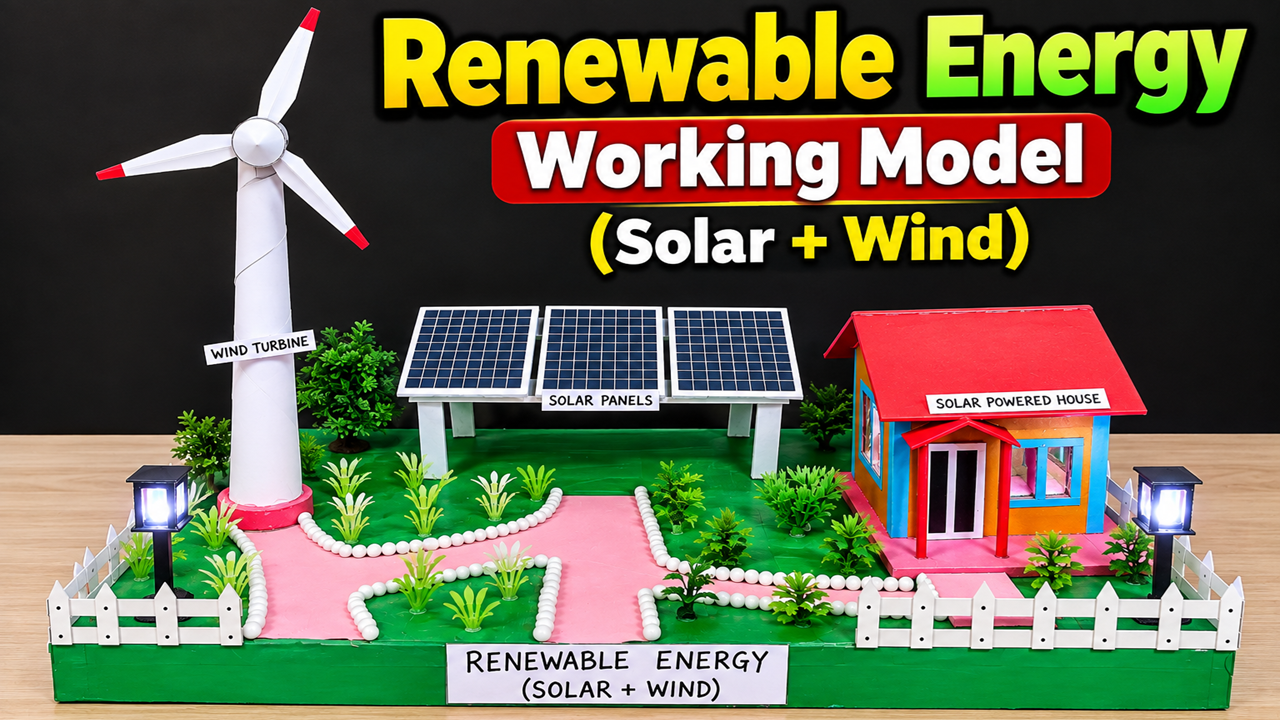
The Renewable Energy Working Model shown in the image is an attractive and educational science exhibition project that demonstrates how solar energy and wind energy can be used to generate electricity. The model represents a small sustainable community containing a solar-powered house, solar panels, a wind turbine, gardens, pathways, and solar-powered street lights.
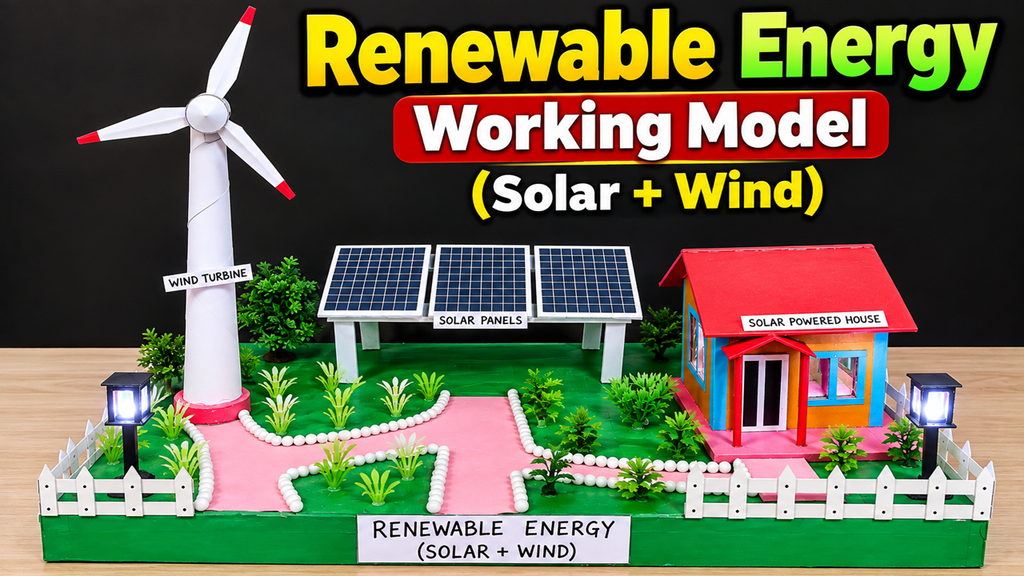
The main purpose of this project is to create awareness about clean and renewable sources of energy and explain how they can reduce our dependence on fossil fuels such as coal, petroleum, and natural gas.
1. Aim of the Project
The main aim of this working model is to demonstrate the use of renewable energy sources for electricity generation.
The project demonstrates two major renewable energy technologies:
- Solar energy
- Wind energy
Solar panels convert sunlight into electrical energy, while a wind turbine uses the movement of air to produce electricity.
The electricity generated can be used for applications such as lighting houses, operating small electrical devices, and powering street lights.
2. What Is Renewable Energy?
Renewable energy comes from natural sources that are continuously replenished.
Examples include:
- Solar energy
- Wind energy
- Hydropower
- Biomass energy
- Geothermal energy
- Tidal energy
Unlike fossil fuels, renewable energy sources do not depend on a limited underground supply that can eventually be exhausted.
Among these sources, solar and wind energy are particularly useful because sunlight and wind are naturally available in many regions.
3. Materials Required
This model can be made using inexpensive and easily available materials.
Basic materials
- Large cardboard sheet
- Thermocol sheets
- Green chart paper
- Blue, red, yellow, white and other coloured papers
- Cardboard boxes
- Glue or Fevicol
- Double-sided tape
- Scissors
- Cutter
- Small artificial plants
- Small decorative stones
- Ice-cream sticks
- White beads
- Small toy house materials
- Small solar panels
- Small DC motor
- Plastic or paper turbine blades
- LEDs
- Connecting wires
- Switch
- Battery or rechargeable battery
- Resistors where required
- Small solar-powered lamps
The exact components can be changed depending on the size and complexity of the project.
4. Preparing the Base
Take a strong rectangular cardboard sheet as the base.
Cover the top surface with green coloured paper to represent grass or land.
Create a border around the base using cardboard strips.
A pathway can be made using pink or another contrasting colour of chart paper. The pathway can be divided into sections leading toward the house, solar panels, wind turbine and garden.
Small white beads can be fixed along the edges of the pathway to give the model a decorative appearance.
The objective is to make the model look like a small eco-friendly renewable-energy community.
5. Making the Solar Panels
Solar panels are one of the most important components of the model.
For a decorative model, rectangular pieces of cardboard can be covered with dark blue paper. Thin white strips can then be added vertically and horizontally to create the appearance of solar cells.
For a working model, actual small solar panels should be used.
The solar panels can be mounted on cardboard supports at an angle so that they face a light source.
When sunlight falls on the solar panel, it produces electrical energy through the photovoltaic effect.
This electrical energy can be used to power LEDs or other small low-power components.
6. Making the Solar-Powered House
The house shown in the model can be made using cardboard.
Cut cardboard pieces to create:
- Four walls
- A floor
- A roof
- Doors
- Windows
Use brightly coloured paper to decorate the house.
Place the solar panel on the roof or nearby.
A small LED can be installed inside the house to demonstrate how electricity generated from solar energy can be used for lighting.
A label such as “SOLAR POWERED HOUSE” can be placed on the roof.
This helps viewers immediately understand the purpose of the house.
7. Making the Wind Turbine
The wind turbine is another important part of the project.
The tower can be made using:
- Rolled chart paper
- PVC pipe
- Cardboard tube
- Wooden sticks
For the blades, use lightweight plastic, cardboard or thick paper.
Attach the blades to a small DC motor.
When air moves the blades, the motor rotates.
The DC motor can work as a small generator and produce electrical energy.
The generated electricity can be used to illuminate a small LED, depending on the motor and circuit used.
This demonstrates the basic principle of wind power generation.
8. How the Wind Turbine Works
The working process can be explained in four simple steps:
Wind → Turbine blades → Generator → Electrical energy
When wind strikes the turbine blades, the blades rotate.
The rotating blades turn the shaft of the motor or generator.
The generator converts the mechanical energy of rotation into electrical energy.
The electrical output can then be connected to a small load such as an LED.
In a real wind power plant, many large turbines are installed together to generate much more electricity.
9. Solar-Powered Street Lights
The model also contains small street lights.
These can be made using small LEDs mounted on sticks or cardboard poles.
For a working version, small solar garden lights or LEDs connected to a suitable solar circuit can be used.
During daylight, solar energy can be collected and stored in a rechargeable battery when the appropriate charging circuit is used.
After the light level decreases, the stored energy can power the LEDs.
This demonstrates how renewable energy can be used not only in houses but also for public infrastructure and street lighting.
10. Creating the Garden
A green garden area makes the project more attractive.
Artificial plants, paper plants, small bushes and decorative stones can be placed around the model.
The garden represents an environmentally friendly community where clean energy is combined with green spaces.
Small fences can be made using ice-cream sticks or cardboard.
The garden also helps communicate the idea that sustainable development is not only about electricity generation but also about maintaining a healthy environment.
11. Working Principle of the Complete Model
The entire model demonstrates two different methods of producing clean electricity.
Solar energy
Sunlight falls on the solar panel.
The solar panel converts sunlight into electrical energy.
The electricity can be used to operate LEDs or other low-power devices.
Wind energy
Moving air rotates the wind turbine.
The turbine rotates a small generator.
The generator produces electrical energy.
This electricity can also be used to power a small electrical load.
Therefore, the model demonstrates that different renewable sources can work together to meet energy requirements.
12. Advantages of Renewable Energy
Renewable energy has several important advantages.
1. Environment-friendly
Solar and wind energy produce electricity without directly burning fossil fuels during generation.
2. Naturally available
Sunlight and wind are naturally occurring resources.
3. Reduces fossil-fuel dependence
Greater use of renewable energy can reduce dependence on coal, oil and natural gas.
4. Useful for remote areas
Small solar systems can provide electricity in places where conventional electricity infrastructure is difficult or expensive to establish.
5. Supports sustainable development
Renewable energy can be an important part of building cleaner and more sustainable communities.
13. Limitations
Renewable energy also has certain limitations.
Solar panels depend on the availability of sunlight, while wind turbines require suitable wind conditions.
Solar generation is lower at night and can be affected by clouds.
Wind turbines cannot produce maximum power when wind speeds are unsuitable.
Therefore, real renewable-energy systems often use energy storage, grid connections, or a combination of different energy sources to provide reliable electricity.
14. How to Demonstrate the Model
During a science exhibition, first point toward the solar panels and explain that they represent the collection of energy from sunlight.
Then show the solar-powered house and street lights.
Next, point toward the wind turbine and explain that moving air rotates its blades and drives a generator.
If the model is connected to actual working components, demonstrate the LED lighting or other electrical output.
Finally, explain that combining solar and wind energy can provide complementary renewable-energy resources.
15. Simple Explanation for Students
You can explain the project in the following way:
“This is our Renewable Energy Working Model based on solar and wind energy. The solar panels convert sunlight into electrical energy. This electricity can be used to power the house and street lights. The wind turbine uses moving air to rotate its blades. The rotating blades drive a small generator that produces electricity. Our model represents an eco-friendly community that uses renewable sources instead of depending completely on fossil fuels. Solar and wind energy are clean and naturally available sources of energy. By using renewable energy, we can reduce pollution and move toward a more sustainable future.”
16. Conclusion
The Renewable Energy Working Model is a simple but powerful way to demonstrate the importance of clean energy.
The project combines solar panels, a wind turbine, a solar-powered house, street lights, gardens and pathways to create a miniature sustainable community.
The most important message of the project is that energy can be generated from natural resources such as sunlight and wind. These resources can play an important role in reducing dependence on fossil fuels and supporting a cleaner energy future.
This project is particularly suitable for a school science exhibition, STEM activity, science fair, or environmental awareness project because it combines creativity, electronics, renewable-energy concepts and practical demonstration in one model.