
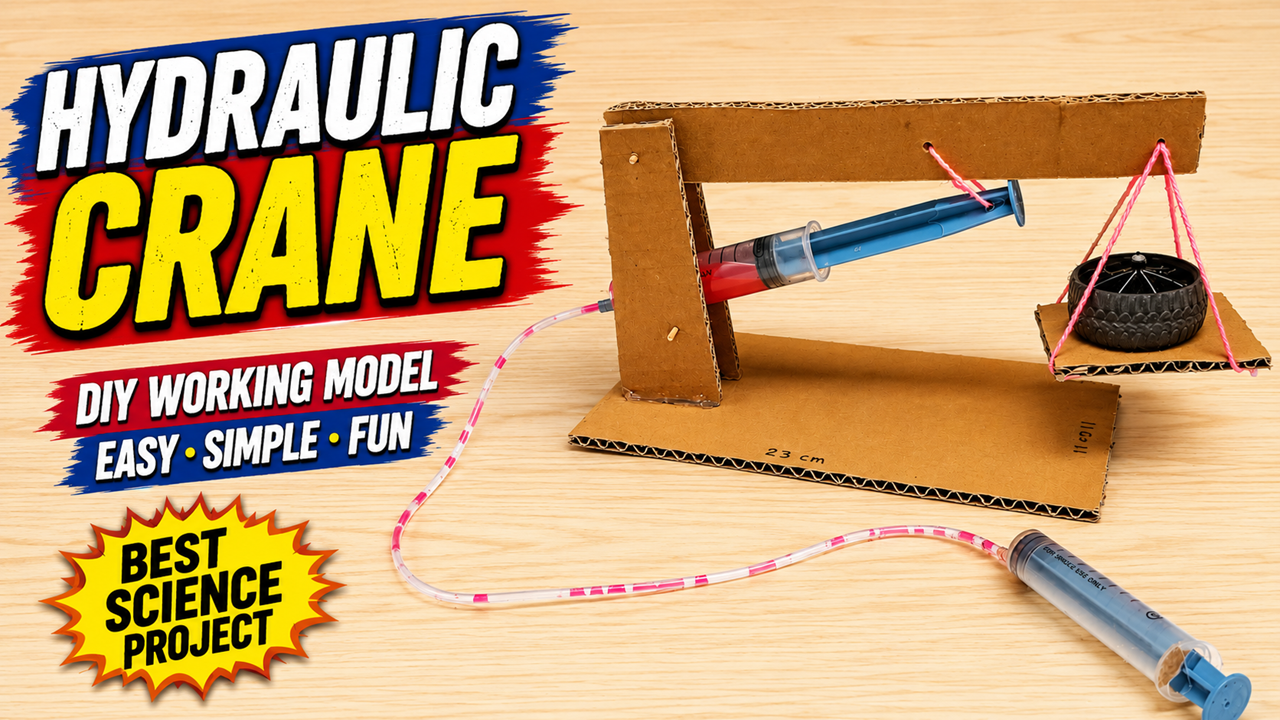
The Hydraulic Crane Working Model is an interesting and practical science exhibition project that demonstrates how hydraulic systems are used to lift heavy objects with very little effort. This DIY model is based on Pascal’s Law, one of the most important principles in physics and engineering. It is an ideal project for school science exhibitions, STEM activities, engineering fairs, and Inspire Award competitions. The model is simple to build using cardboard, syringes, plastic tubing, glue, and other inexpensive materials.
A hydraulic crane is a machine that uses the pressure of a liquid to lift and move heavy loads. Hydraulic systems are commonly used in construction cranes, excavators, forklifts, garbage trucks, car repair lifts, and heavy industrial machines. These machines can lift extremely heavy objects because liquids can transmit pressure equally in all directions.
The working principle of this model is based on Pascal’s Law, which states that when pressure is applied to a confined liquid, the pressure is transmitted equally throughout the liquid in every direction. In this project, water is used as the hydraulic fluid. Since water cannot be compressed easily, it efficiently transfers the applied force from one syringe to another.
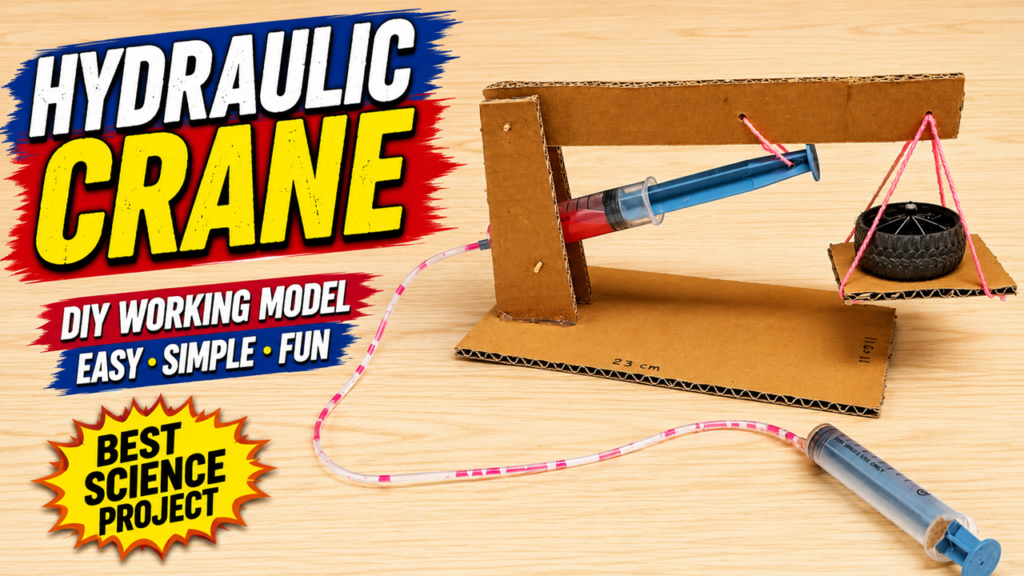
The model consists of a cardboard crane structure, two syringes, a plastic tube filled with water, a movable crane arm, and a platform for lifting objects. One syringe acts as the control syringe, while the other acts as the lifting syringe. The syringes are connected using a flexible plastic tube filled completely with water. The crane arm is attached to the lifting syringe so that it moves up and down as the syringe piston moves.
When the piston of the control syringe is pushed, pressure is created inside the water-filled tube. This pressure travels through the liquid and reaches the second syringe. As a result, the piston of the lifting syringe moves outward, raising the crane arm. When the piston of the control syringe is pulled back, the pressure decreases, allowing the lifting syringe to retract and lower the crane arm. In this way, the hydraulic system converts a small manual force into a lifting action.
The platform attached to the crane arm is used to lift lightweight objects such as toy blocks, small containers, or miniature tyres. This demonstrates how hydraulic cranes can safely lift loads without using excessive human effort. Students can easily observe the movement of the crane arm and understand how pressure is transferred through the liquid.
This DIY model explains several important scientific concepts, including hydraulic pressure, Pascal’s Law, fluid mechanics, force transmission, and mechanical advantage. It also introduces students to the engineering principles used in real construction equipment and industrial machinery.
Hydraulic cranes have many practical applications. They are widely used at construction sites to lift building materials, in factories to move heavy equipment, in warehouses for loading and unloading goods, in vehicle recovery trucks, and in ports for handling large cargo containers. Hydraulic systems are also used in aircraft landing gear, hydraulic brakes in vehicles, and medical equipment.
Building this project helps students improve their creativity, problem-solving skills, and practical knowledge. They learn how simple materials such as cardboard, syringes, and plastic tubes can be used to demonstrate advanced engineering concepts. Since the model uses inexpensive and easily available materials, it is suitable for students of different age groups and is environmentally friendly.
Materials Required
- Cardboard sheets
- Two plastic syringes
- Plastic tubing
- Water
- Hot glue or craft glue
- Wooden sticks
- String
- Cutter and scissors
- Ruler and pencil
Working Principle
- Fill both syringes and the connecting tube completely with water.
- Connect the syringes using the plastic tube.
- Push the control syringe.
- Water pressure travels through the tube.
- The lifting syringe moves outward.
- The crane arm rises and lifts the object.
- Pull the control syringe back to lower the crane arm.
Advantages of This Working Model
- Easy to make using low-cost materials.
- Demonstrates Pascal’s Law clearly.
- Shows real-life hydraulic technology.
- Improves understanding of fluid mechanics.
- Attractive and interactive for science exhibitions.
- Suitable for STEM and engineering projects.
- Encourages hands-on learning and creativity.
In conclusion, the Hydraulic Crane Working Model is an excellent DIY science exhibition project that demonstrates how liquids transmit pressure to perform useful work. Using simple materials like cardboard, syringes, and water, students can understand the basic principles behind hydraulic machines used in construction and industry. This project combines science, engineering, and creativity while helping students learn about force, pressure, and mechanical systems in an easy and practical way. It is an ideal project for school science exhibitions because it is educational, affordable, interactive, and demonstrates a real-world engineering application.