
The Hydraulic Crane Working Model is an exciting and educational DIY science project that demonstrates how hydraulic systems use liquid pressure to lift heavy objects with very little effort. This model is based on Pascal’s Law, a fundamental principle of physics that explains how pressure applied to a confined liquid is transmitted equally in all directions.
Hydraulic technology is widely used in cranes, excavators, forklifts, car lifts, garbage trucks, aircraft systems, and many industrial machines. This project is ideal for school science exhibitions, STEM activities, engineering fairs, and physics demonstrations because it is simple to build and clearly explains an important scientific concept.
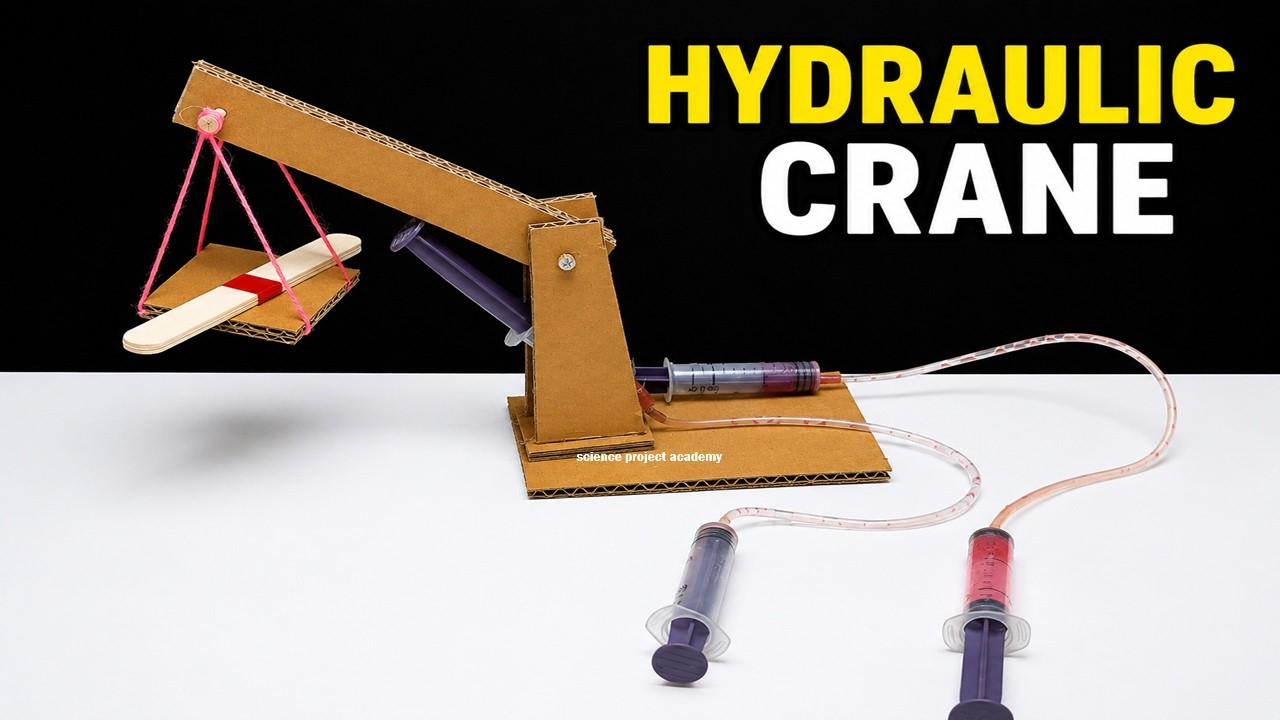
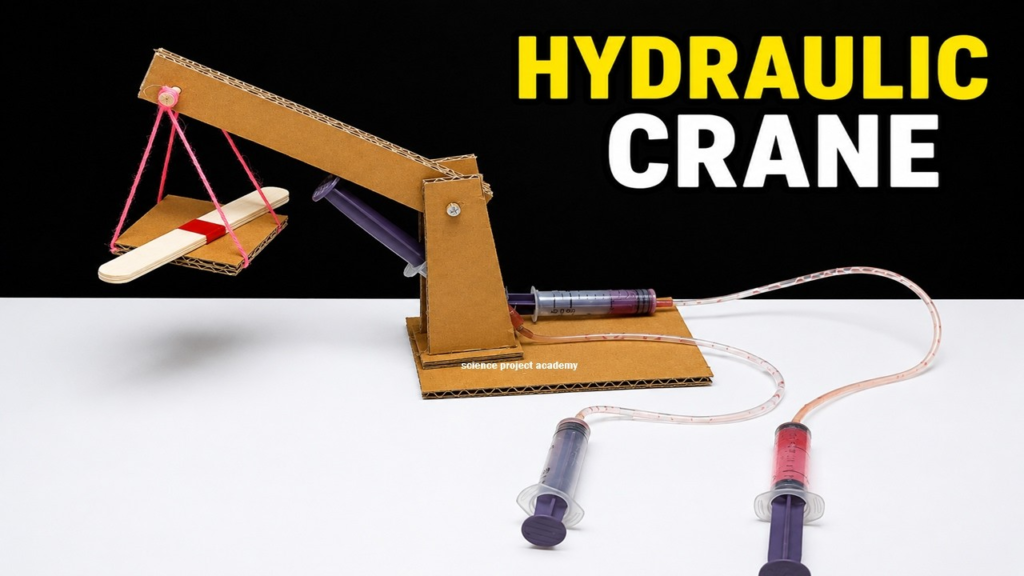
The model shown here is made using cardboard, plastic syringes, transparent tubing, water, wooden sticks, thread, and glue. The crane consists of a strong cardboard base, a vertical support, a movable crane arm, and a small platform used to lift lightweight objects. Two syringes are connected using plastic tubing filled with water. One syringe acts as the control syringe, while the other is attached to the crane arm as the lifting syringe.
The working principle of this model is based on Pascal’s Law. Water is filled inside the syringes and connecting tube, making a closed hydraulic system. Since water is nearly incompressible, any pressure applied to one syringe is transmitted immediately through the liquid to the other syringe.
When the user pushes the control syringe, pressure is created inside the water. This pressure travels through the plastic tube and pushes the piston of the lifting syringe outward. As the piston moves, it lifts the crane arm upward. When the control syringe is pulled back, the pressure decreases, allowing the lifting syringe to retract. This lowers the crane arm smoothly. In this way, the crane can easily lift and lower lightweight objects placed on the platform.
One of the biggest advantages of hydraulic systems is that a small force can be used to lift a much heavier load. This makes hydraulic machines extremely efficient and reliable. The hydraulic system also provides smooth movement, better control, and greater lifting power compared to many simple mechanical systems.
This DIY model demonstrates several important scientific concepts, including pressure, force, fluid mechanics, Pascal’s Law, mechanical advantage, and energy transfer. Students can explain that pressure applied to a confined liquid is transmitted equally throughout the liquid, allowing the crane to lift objects using hydraulic force. This helps visitors understand how modern hydraulic machines work in real life.
Hydraulic cranes have many practical applications. They are used in construction sites to lift steel beams and building materials, in factories to move heavy equipment, in warehouses for loading goods, in ports for handling shipping containers, and in vehicle recovery trucks for lifting damaged vehicles. Hydraulic systems are also found in car braking systems, aircraft landing gear, hospital beds, and industrial presses.
Building this project helps students improve their practical skills, creativity, and understanding of engineering concepts. They learn measuring, cutting, assembling, and designing while using affordable materials. Since the project is made mainly from cardboard and reusable components, it is also an eco-friendly and low-cost science exhibition model.
Materials Required
- Cardboard sheets
- Three plastic syringes
- Transparent plastic tubing
- Water
- Wooden sticks
- Thread
- Glue or hot glue gun
- Cutter and scissors
- Ruler and pencil
- Colour paper for decoration
Working Principle
- Fill the syringes and tube completely with water.
- Connect the syringes using the plastic tubing.
- Push the control syringe to create hydraulic pressure.
- Water transfers the pressure to the lifting syringe.
- The lifting syringe raises the crane arm.
- Pull the control syringe back to lower the arm.
- The crane lifts and lowers lightweight objects smoothly.
Advantages of This Working Model
- Easy to make using simple materials.
- Demonstrates Pascal’s Law clearly.
- Low-cost and environmentally friendly.
- Attractive and interactive for science exhibitions.
- Explains real-world hydraulic technology.
- Improves creativity and engineering skills.
- Suitable for physics, STEM, and engineering projects.
Educational Benefits
- Helps students understand hydraulic systems.
- Demonstrates pressure and force transmission.
- Explains the practical use of fluid mechanics.
- Encourages hands-on learning and problem-solving.
- Improves presentation and communication skills.
Conclusion
The Hydraulic Crane Working Model is an excellent DIY science exhibition project that demonstrates the power of hydraulic technology using simple materials such as cardboard, syringes, water, and plastic tubing. It clearly explains how pressure applied to a liquid can be used to lift objects with minimal effort. This project combines physics, engineering, and creativity while helping students understand one of the most important applications of fluid mechanics. It is an ideal model for school science exhibitions because it is educational, interactive, affordable, and closely related to real-life construction and industrial machinery.