
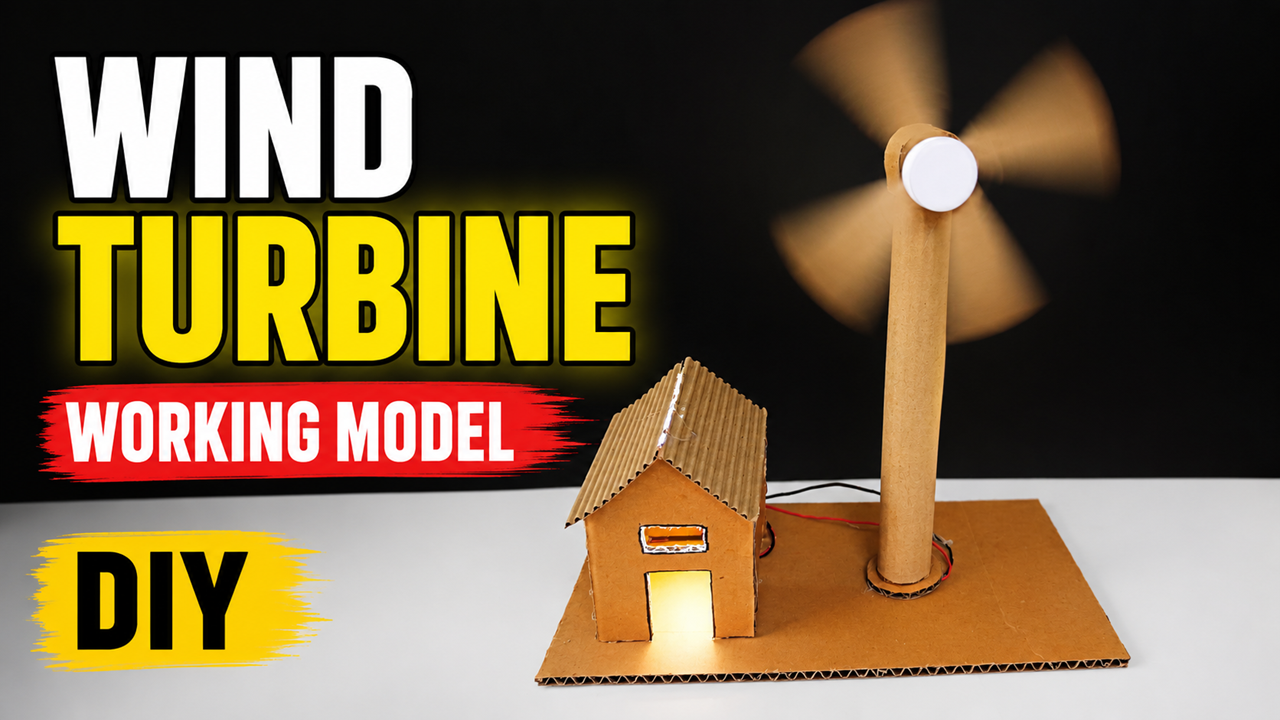
The Wind Turbine Working Model is an excellent DIY science exhibition project that demonstrates how wind energy can be converted into electrical energy using a simple wind turbine. Wind energy is one of the most important renewable energy sources because it is clean, sustainable, and environmentally friendly.
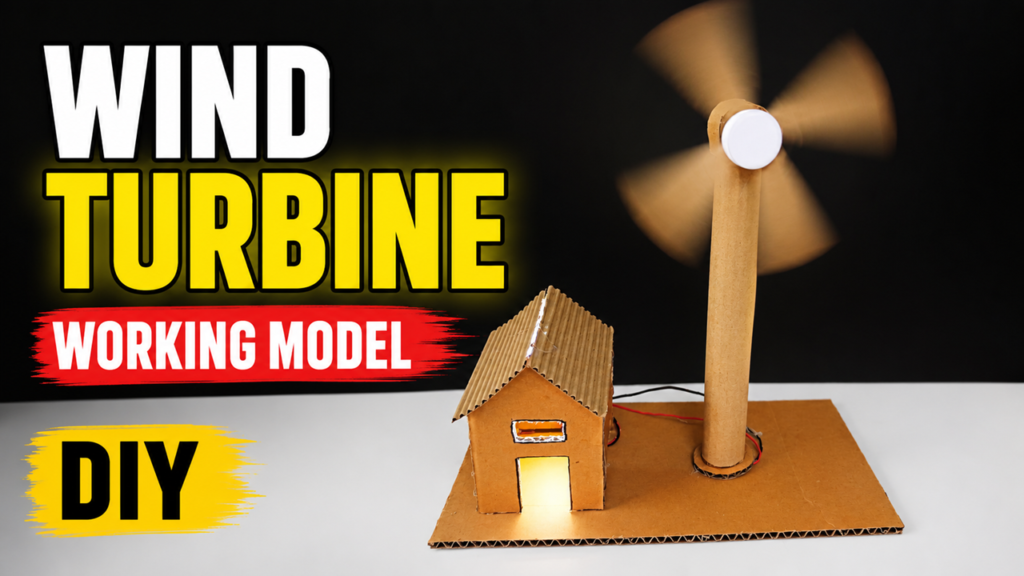
This model helps students understand the basic principles of renewable energy and electricity generation in a simple and practical way. It is an ideal project for school science exhibitions, STEM activities, engineering fairs, and environmental awareness programs.
A wind turbine is a machine that converts the kinetic energy of moving air into electrical energy. When wind blows, it rotates the turbine blades. The rotating blades turn a small shaft connected to a DC motor or generator. The generator converts the mechanical energy of rotation into electrical energy. The electricity produced can be used to power lights, charge batteries, or operate small electronic devices.
In this DIY project, the wind turbine is made using cardboard, a small DC motor, cardboard blades, wires, an LED bulb, and a miniature cardboard house. The turbine is mounted on a tall cardboard tower to capture more wind. Inside the cardboard house, an LED light is connected to the generator through electrical wires. When the turbine blades rotate, the LED glows, showing that electrical energy has been generated.
The working principle of this model is simple and easy to understand. When air from a fan or natural wind strikes the turbine blades, it creates a force that makes the blades rotate. This rotational motion turns the shaft of the DC motor. A DC motor can also work as a small generator when its shaft is rotated. As the shaft spins, electrical energy is produced. The generated electricity flows through the connecting wires to the LED light inside the house, causing it to glow. This demonstrates the complete process of converting wind energy into electrical energy.
This model explains the law of energy conservation, which states that energy cannot be created or destroyed but can only be converted from one form to another. In this project, wind energy is converted into mechanical energy by the rotating blades, and then into electrical energy by the generator. Finally, the electrical energy is converted into light energy when the LED bulb lights up.
Wind energy has become one of the fastest-growing sources of renewable energy across the world. Large wind farms containing hundreds of turbines generate electricity for thousands of homes. Countries are increasingly using wind power because it reduces pollution, lowers greenhouse gas emissions, and decreases dependence on fossil fuels such as coal and oil. Wind energy is clean, renewable, and available naturally without producing harmful gases.
This DIY wind turbine model also helps students understand several scientific concepts, including renewable energy, electricity generation, electromagnetic induction, mechanical energy, kinetic energy, and energy conversion. It provides a practical demonstration of how engineering and science work together to produce clean energy.
Building this project improves creativity, engineering skills, and problem-solving ability. Students learn how to design a stable tower, connect electrical components, and assemble moving parts. Since the model uses inexpensive materials such as cardboard and recycled items, it is also environmentally friendly and cost-effective.
Materials Required
- Cardboard sheets
- Small DC motor
- Cardboard or plastic turbine blades
- LED bulb
- Connecting wires
- Glue or hot glue gun
- Cutter and scissors
- Wooden stick or cardboard tube
- Battery (optional for testing)
- Mini cardboard house
Working Principle
- Wind blows against the turbine blades.
- The blades begin to rotate.
- The rotating blades turn the DC motor shaft.
- The DC motor acts as a generator.
- Electrical energy is produced.
- Electricity flows through the wires.
- The LED inside the house glows, demonstrating electricity generation.
Applications of Wind Turbines
- Electricity generation
- Wind farms
- Rural electrification
- Battery charging systems
- Street lighting
- Agricultural water pumping
- Renewable energy projects
Advantages of This Working Model
- Easy to make using cardboard.
- Demonstrates renewable energy clearly.
- Low-cost and eco-friendly.
- Attractive and interactive for science exhibitions.
- Explains electricity generation in a simple way.
- Encourages creativity and engineering skills.
- Suitable for STEM and environmental education.
Educational Benefits
- Explains wind energy and renewable resources.
- Demonstrates energy conversion.
- Introduces generators and electricity production.
- Develops practical engineering skills.
- Encourages environmental awareness and sustainable living.
Conclusion
The Wind Turbine Working Model is an excellent DIY science exhibition project that demonstrates how clean and renewable wind energy can be converted into useful electrical energy. Using simple materials such as cardboard, a DC motor, LED light, and wires, students can easily explain the complete process of electricity generation. This project combines physics, engineering, and environmental science while promoting the importance of renewable energy for a sustainable future. It is an ideal science exhibition model because it is educational, affordable, interactive, and helps students understand one of the most important green energy technologies used around the world.