
Introduction
The ozone layer is a protective layer of gas present in the Earth’s stratosphere. It absorbs most of the Sun’s harmful ultraviolet (UV) radiation and protects living organisms from problems such as skin damage, eye diseases, and harm to plants and animals.
This working model explains how ozone depletion happens, what causes it, and what we can do to protect the ozone layer.
Main Concept of the Model
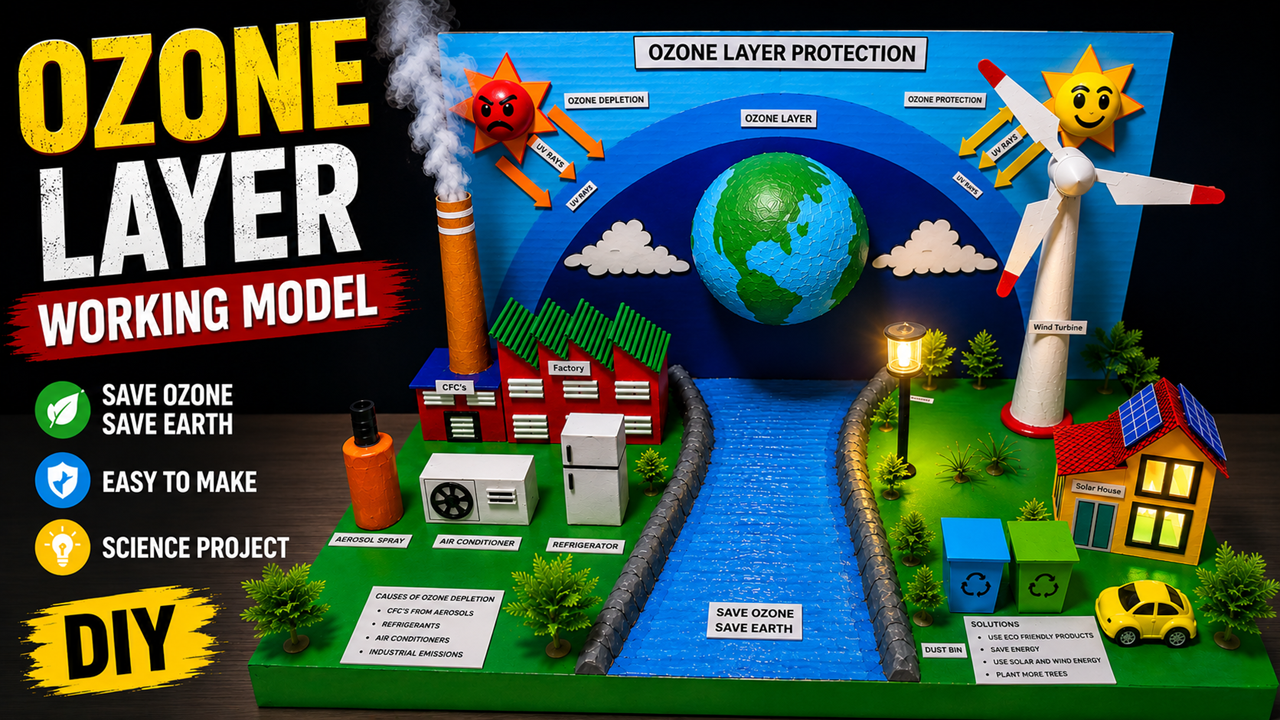
The model is divided into two main parts: causes of ozone depletion and solutions for protecting the ozone layer. At the center, a globe represents Earth, while the blue background represents the atmosphere. Above Earth, the ozone layer is shown as a protective region.
On one side, arrows and harmful symbols show substances that damage ozone. On the other side, renewable energy and eco-friendly practices show ways to reduce environmental pollution.
The factory represents industrial emissions. The chimney labeled CFCs shows chlorofluorocarbons, which were widely used in older refrigeration, air-conditioning, and aerosol products. Aerosol sprays, refrigerators, and air conditioners are included as examples of products historically associated with ozone-depleting substances.
When CFCs reach the upper atmosphere, ultraviolet radiation breaks them down and releases chlorine atoms. These chlorine atoms can destroy ozone molecules repeatedly, reducing the protective ozone layer.
The model also shows a wind turbine and a solar house. These represent clean and renewable sources of energy. Using solar and wind energy can reduce dependence on fossil fuels and help lower pollution.
The river, trees, recycling bins, electric-looking car, and “Save Ozone, Save Earth” message represent environmental protection and sustainable living.
Materials Required
For making this model, you can use a large cardboard or foam-board base, colored chart paper, cardboard sheets, thermocol or foam balls, acrylic or poster paints, glue, scissors, a cutter, wooden sticks, straws, plastic bottles, bottle caps, clay, small toy figures, LED lights, wires, and recycled materials. A small motor and battery can be used if you want the wind turbine to rotate.
How to Make the Model
First, take a strong rectangular cardboard sheet and cover it with green paper or paint. Build a raised blue backdrop at the rear and label it “Ozone Layer Protection.” Make a globe using a foam ball, paint it blue and green, and fix it in the center of the backdrop.
Next, make a small factory using cardboard. Add a chimney using a cardboard tube or bottle and label it “CFCs.” Create small models of an aerosol spray, air conditioner, and refrigerator from recycled boxes or bottles. Place them near the factory and add arrows showing ozone depletion.
On the opposite side, build a wind turbine using a cardboard tube, sticks, and lightweight blades. Make a small solar house from cardboard and attach miniature solar panels using black or blue paper.
Add an LED light if desired. Create a river with blue paper or paint, add trees around it, and place recycling bins and a small model car nearby.
Finally, add labels such as “Ozone Layer,” “UV Rays,” “Ozone Depletion,” “Ozone Protection,” “Causes,” and “Solutions.” Test the LED and moving parts, if included, and make sure all components are securely attached.
Conclusion
This project demonstrates that human activities can damage the ozone layer, but responsible choices can help protect it. The model encourages the use of eco-friendly products, renewable energy, proper waste management, fewer harmful chemicals, and planting more trees.
It is a simple and attractive science exhibition project that helps students understand ozone depletion and the importance of protecting Earth’s atmosphere.