
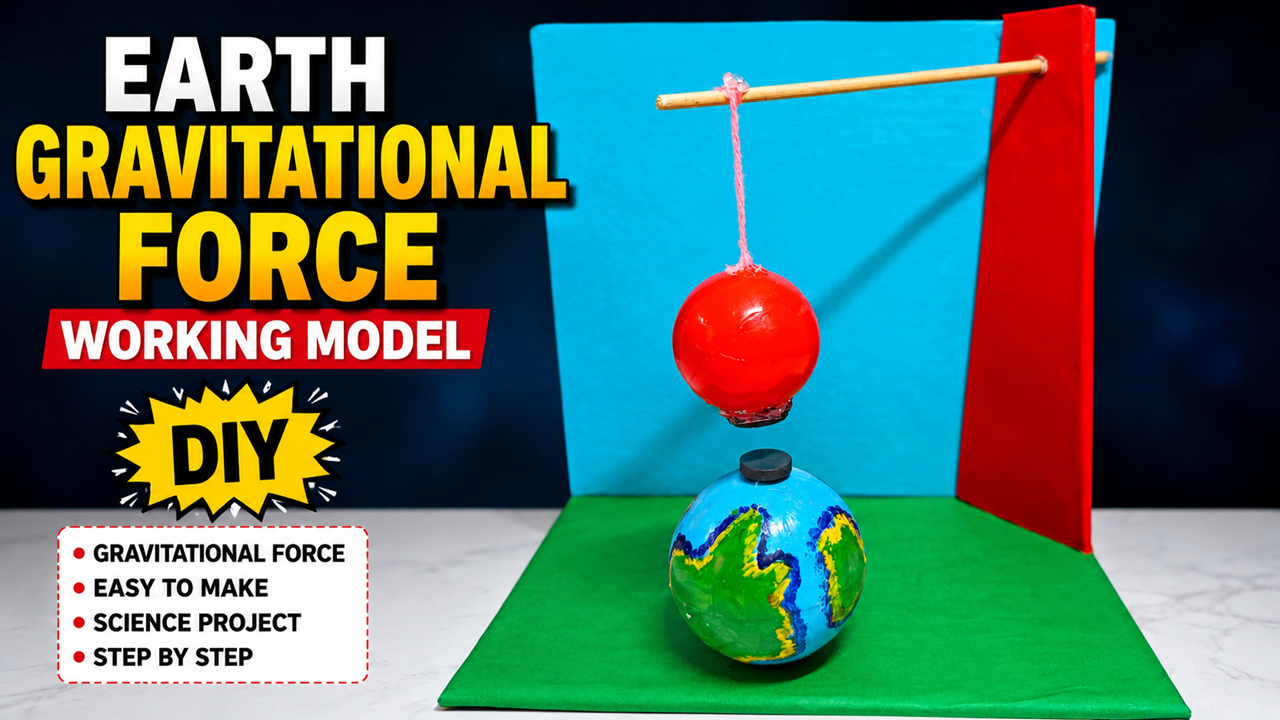
The Earth Gravitational Force Working Model is a simple and educational science exhibition project that demonstrates one of the most important forces in nature—gravity. Gravity is the invisible force that pulls all objects toward the centre of the Earth. Without gravity, people, animals, water, and even the atmosphere would float away into space.
This DIY model helps students understand how gravity works using simple materials such as cardboard, thermocol balls, thread, magnets, and colour paper. It is an excellent project for school science exhibitions, physics demonstrations, STEM activities, and classroom learning.
Gravity is a natural force of attraction between any two objects that have mass. The greater the mass of an object, the stronger its gravitational pull. Since the Earth is very large and heavy, it has enough gravity to pull everything towards its centre. This is why objects always fall downward when dropped. Gravity was explained by the famous scientist Sir Isaac Newton, who discovered that the same force that causes an apple to fall from a tree also keeps the Moon revolving around the Earth.
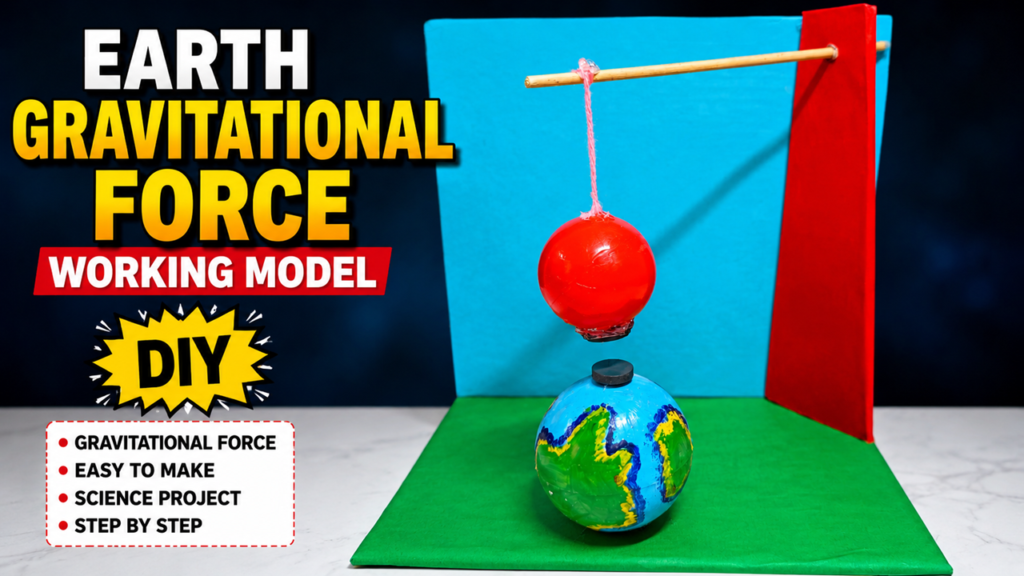
In this working model, the Earth is represented by a painted thermocol ball placed at the bottom. Above it, another coloured ball represents an object suspended using a thread. A small magnet can be hidden inside the Earth model and another magnet placed inside the hanging ball. The attraction between the magnets helps represent the invisible force of gravity pulling objects toward the Earth. Although real gravity is different from magnetism, magnets provide an easy way to demonstrate the idea of an invisible attractive force in a classroom model.
The model also includes a wooden support and thread to suspend the upper object. When students move the hanging ball closer to the Earth model, the magnetic attraction makes it appear as though the Earth is pulling the object downward. This visual demonstration makes it easier for young students to understand the concept of gravitational force.
The working principle of this model is based on the idea that the Earth attracts every object towards its centre. In real life, gravity acts continuously on all objects. When an object is released, gravity pulls it downward, causing it to fall to the ground. The force of gravity also gives objects their weight. On the Moon, where gravity is much weaker than on Earth, people weigh less and can jump much higher. This shows that the strength of gravity depends on the mass of the planet.
Gravity plays a very important role in our daily lives. It keeps us standing firmly on the ground and prevents the atmosphere from escaping into space. It causes rain to fall from the clouds and allows rivers to flow downhill toward lakes and oceans. Gravity also keeps the Moon revolving around the Earth and the planets revolving around the Sun. Without gravity, life on Earth would not be possible.
This DIY project helps students understand several important scientific concepts such as gravitational force, mass, weight, free fall, planetary motion, and Newton’s Law of Universal Gravitation. By observing the model, students can explain how invisible forces influence the movement of objects and why gravity is one of the fundamental forces of nature.
Building this model also improves creativity, observation, and practical skills. Students learn measuring, cutting, painting, and assembling while using inexpensive materials. The project encourages hands-on learning and helps students gain confidence while presenting scientific ideas during exhibitions.
Materials Required
- Cardboard base
- Thermocol balls (2)
- Acrylic paints
- Wooden stick or skewer
- Thread
- Small magnets
- Glue or hot glue gun
- Colour paper
- Marker pens
Working Principle
- The Earth model is placed on the base.
- A small magnet is fixed inside the Earth model.
- Another magnet is placed inside the hanging object.
- The object is suspended using a thread.
- As the object comes closer, magnetic attraction demonstrates the idea of gravitational pull.
- Students explain that in reality, gravity—not magnetism—is the force that attracts objects toward the Earth.
Applications of Gravity
- Keeps people and objects on the Earth’s surface.
- Causes objects to fall downward.
- Keeps the Moon in orbit around the Earth.
- Maintains the planets in orbit around the Sun.
- Controls the movement of oceans, rivers, and rainfall.
- Helps satellites remain in their designated orbits.
Advantages of This Working Model
- Easy to build using low-cost materials.
- Clearly explains the concept of gravity.
- Attractive and interactive for science exhibitions.
- Encourages hands-on learning.
- Suitable for physics and STEM projects.
- Improves creativity and presentation skills.
- Demonstrates an important natural force in a simple way.
Educational Benefits
- Explains the difference between mass and weight.
- Demonstrates the effect of gravitational force.
- Introduces Newton’s theory of gravity.
- Helps students understand planetary motion.
- Encourages scientific thinking through practical demonstration.
In conclusion, the Earth Gravitational Force Working Model is an excellent DIY science exhibition project that explains one of the most fundamental forces in the universe. It helps students understand how gravity keeps everything on Earth, causes objects to fall, and controls the motion of planets and moons. Using simple materials like cardboard, thermocol balls, thread, and magnets, this project provides a clear and engaging demonstration of an invisible force that affects every aspect of our daily lives. It is an ideal project for school science exhibitions because it combines creativity, practical learning, and important physics concepts in an easy-to-understand manner.