
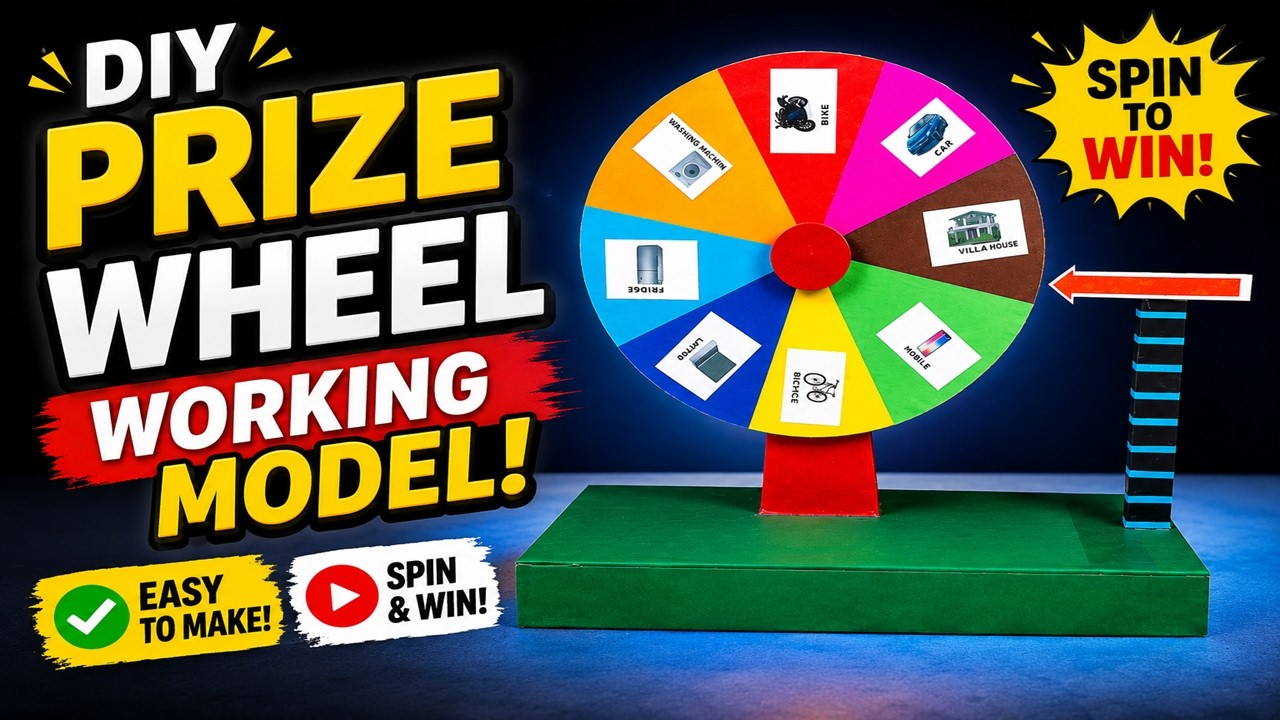
The DIY Prize Wheel Working Model is a fun, creative, and educational science exhibition project that demonstrates the principles of rotational motion, friction, force, balance, and simple machines. Although prize wheels are commonly seen in games, shopping malls, fairs, and exhibitions, they are also excellent examples of basic mechanical engineering.
This DIY project is perfect for school science exhibitions, STEM activities, mathematics demonstrations, and engineering fairs because it combines scientific concepts with an interactive game. It is easy to make using cardboard, colour paper, wooden sticks, glue, and other low-cost craft materials.
A prize wheel, also called a spinning wheel, is a circular wheel divided into several equal sections. Each section represents a prize, task, number, or question. When the wheel is spun, it rotates around a central axle. As the wheel gradually slows down because of friction, a pointer stops at one section, which determines the final result. This simple mechanism demonstrates how rotational motion changes over time due to resistance.
In this DIY model, the prize wheel is made from cardboard and divided into colourful sections. Each section displays a different prize such as a bicycle, mobile phone, refrigerator, washing machine, laptop, car, or other rewards. A fixed pointer is placed beside the wheel. When the wheel stops, the pointer indicates the winning section. This colourful design makes the model attractive and encourages visitors to participate during science exhibitions.
The most important part of the model is the central axle. The wheel is mounted on a wooden stick or metal rod that allows it to rotate freely. The smoother the axle, the easier the wheel spins. The base supports the entire structure and keeps the wheel stable during operation.
The pointer plays an important role in the working model. It remains fixed while the wheel rotates. As each coloured section passes beneath the pointer, a clicking sound may be produced if small cardboard tabs are added around the edge of the wheel. This clicking effect demonstrates how friction and mechanical contact influence motion.
The working principle of the prize wheel is simple. When a person applies force by spinning the wheel, rotational energy is created. Due to Newton’s First Law of Motion, the wheel continues rotating until an external force acts upon it. Gradually, friction between the axle and the support, along with air resistance, slows the wheel down. As the rotational speed decreases, the wheel finally stops. The fixed pointer indicates the winning section based on where the wheel comes to rest.
This model helps students understand several important scientific concepts. The spinning motion demonstrates rotational motion, while the slowing down of the wheel explains friction and energy loss. Students can also discuss force, torque, angular motion, balance, and probability. If all sections of the wheel are equal in size, each prize has an equal chance of being selected. This introduces the concept of probability in mathematics.
The project also demonstrates how engineering principles are used in everyday devices. Similar rotating mechanisms are found in roulette wheels, amusement rides, steering wheels, clocks, gears, turbines, and many industrial machines. Understanding these mechanisms helps students appreciate the role of physics in daily life.
Building this DIY project improves creativity, design skills, and practical knowledge. Students learn measuring, drawing circles, dividing equal sections, cutting cardboard, assembling rotating parts, and decorating the wheel. Since the materials are inexpensive and recyclable, the project is environmentally friendly and suitable for students of all age groups.
Materials Required
- Cardboard sheets
- Colour paper
- Wooden skewer or metal rod
- Glue or hot glue gun
- Cutter and scissors
- Ruler, compass, and pencil
- Marker pens
- Decorative stickers or printed images
- Cardboard base and stand
Working Principle
- Rotate the wheel by applying force.
- The wheel spins around the central axle.
- Rotational energy keeps the wheel moving.
- Friction and air resistance gradually reduce the speed.
- The wheel eventually stops.
- The fixed pointer indicates the winning section.
Scientific Concepts Demonstrated
- Rotational motion
- Force and torque
- Friction
- Angular velocity
- Newton’s First Law of Motion
- Balance and stability
- Probability and random selection
Advantages of This Working Model
- Easy to make using cardboard.
- Low-cost and eco-friendly.
- Demonstrates real-life mechanical principles.
- Attractive and interactive for science exhibitions.
- Improves creativity and engineering skills.
- Helps explain both physics and mathematics concepts.
- Suitable for STEM projects and classroom activities.
Educational Benefits
- Explains rotational motion in a simple way.
- Demonstrates the effect of friction on moving objects.
- Introduces probability using an interactive activity.
- Develops problem-solving and presentation skills.
- Encourages hands-on learning through DIY construction.
In conclusion, the DIY Prize Wheel Working Model is an engaging science exhibition project that combines entertainment with education. It demonstrates how rotational motion, force, friction, and probability work together in a simple mechanical system. Using only cardboard and basic craft materials, students can create a colourful, interactive model that attracts attention while teaching important scientific principles. This project is ideal for school science exhibitions because it is easy to build, economical, reusable, and provides an enjoyable way to learn physics, mathematics, and engineering concepts.