
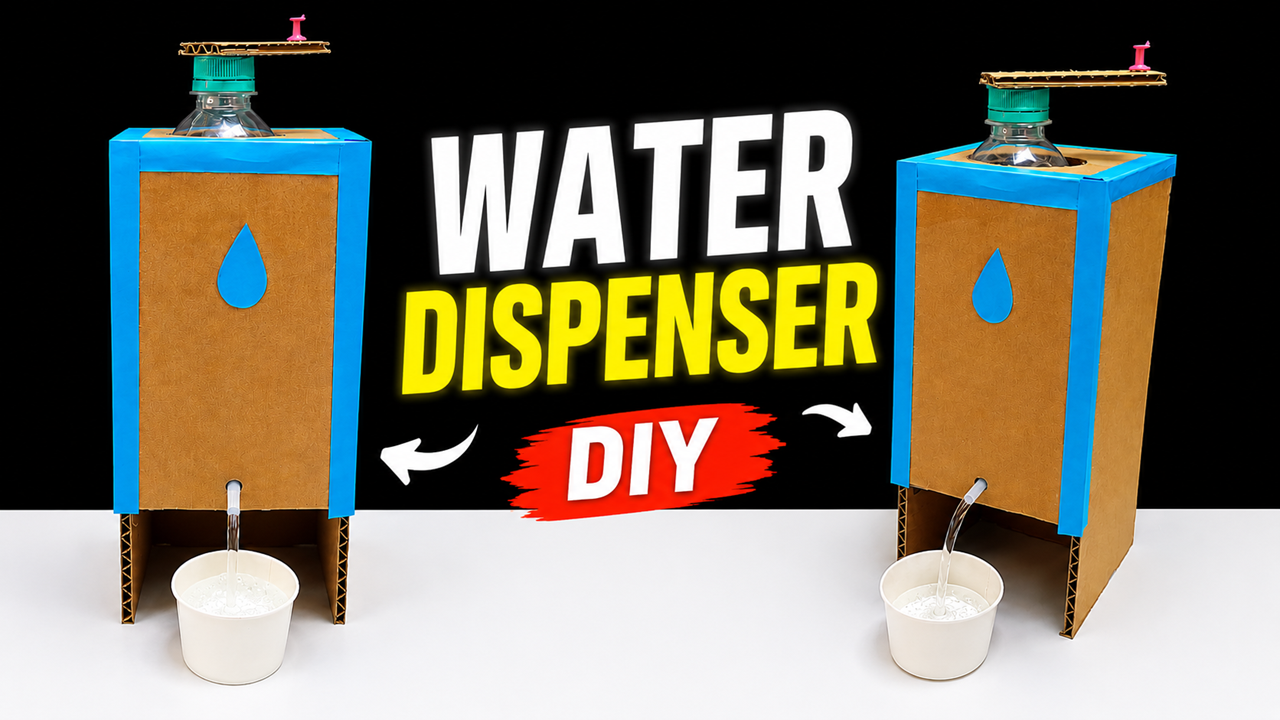
The Water Dispenser Working Model is a simple, creative, and practical science exhibition project that demonstrates how water can be dispensed using the principles of gravity, air pressure, and controlled water flow.
This DIY project is easy to make using cardboard, a plastic bottle, a small pipe or straw, and other inexpensive materials. It is an excellent project for school science exhibitions, STEM activities, engineering demonstrations, and DIY competitions because it explains basic scientific concepts through a useful everyday application.
A water dispenser is a device that stores water and releases it in a controlled manner whenever required. Water dispensers are commonly used in homes, schools, offices, hospitals, railway stations, and public places to provide clean drinking water. Some dispensers use electricity for cooling or heating water, while simple gravity-based dispensers work without electricity. This DIY model demonstrates the working principle of a gravity-fed water dispenser.
The model is built using a cardboard box that acts as the outer body of the dispenser. Inside the cardboard structure, a plastic bottle is placed upside down to serve as the water storage tank. A small outlet pipe or straw is fixed near the bottom of the dispenser to allow water to flow into a cup. The top of the bottle is fitted with a simple push mechanism that controls the flow of water.
The working principle of this model is based on gravity and air pressure. Water naturally flows downward because of gravity. However, when the outlet is closed, the water remains inside the bottle because air cannot freely enter to replace the water leaving the container. When the user presses the top mechanism or opens the outlet, air enters the bottle, reducing the pressure difference and allowing water to flow smoothly through the pipe into the cup. When the outlet is closed again, the flow of water stops automatically.
This simple mechanism demonstrates how pressure and gravity work together to control the movement of liquids. It also helps students understand why water does not continuously flow out of an inverted bottle unless air is allowed to enter. The model provides an excellent demonstration of basic physics concepts using easily available materials.
The DIY water dispenser also promotes water conservation. Since the water is released only when needed, it reduces unnecessary wastage. Students can explain the importance of using water wisely and encourage responsible water usage at home and in school. The project can also be connected with topics such as clean drinking water, public hygiene, and safe water storage.
Building this model improves practical and creative skills. Students learn measuring, cutting, assembling, and designing while working with cardboard and simple mechanical parts. Since the project does not require expensive materials or complex electronics, it is suitable for beginners and can be completed within a few hours. It is also environmentally friendly because most of the materials used can be recycled.
The water dispenser model demonstrates several scientific concepts, including gravity, air pressure, fluid pressure, flow control, and hydrostatic pressure. These principles are widely used in household appliances, water storage systems, and industrial fluid handling equipment. By presenting this model during a science exhibition, students can explain how science is applied in everyday life to make common tasks easier and more efficient.
Materials Required
- Cardboard sheets
- Plastic water bottle
- Drinking straw or plastic tube
- Craft glue or hot glue gun
- Cutter and scissors
- Ruler and pencil
- Colour paper or decorative tape
- Plastic cup
- Push pin or simple stopper (optional)
Working Principle
- Fill the plastic bottle with clean water.
- Place the bottle upside down inside the cardboard dispenser.
- Water is stored safely inside the bottle.
- Open or press the outlet mechanism.
- Air enters the bottle while gravity pulls the water downward.
- Water flows through the outlet pipe into the cup.
- Closing the outlet stops the water flow immediately.
Applications of Water Dispensers
- Homes and apartments
- Schools and colleges
- Offices and workplaces
- Hospitals and clinics
- Railway stations and airports
- Public drinking water facilities
Advantages of This Working Model
- Easy to build using recycled cardboard.
- Low-cost and eco-friendly.
- Demonstrates gravity and air pressure clearly.
- Helps students understand fluid mechanics.
- Encourages water conservation.
- Suitable for science exhibitions and STEM projects.
- Attractive, practical, and interactive.
Educational Benefits
- Explains how gravity and air pressure control water flow.
- Demonstrates real-life applications of physics.
- Improves creativity and engineering skills.
- Encourages hands-on learning through DIY activities.
- Develops presentation and communication skills.
In conclusion, the Water Dispenser Working Model is an excellent DIY science exhibition project that combines simple engineering with everyday usefulness. It clearly demonstrates how gravity and air pressure control the movement of water while promoting the importance of clean drinking water and water conservation. Made from inexpensive materials like cardboard and a plastic bottle, this project is easy to build, environmentally friendly, and highly educational. It is an ideal project for school science exhibitions because it helps students understand basic scientific principles while showing how simple designs can solve practical problems in daily life.