
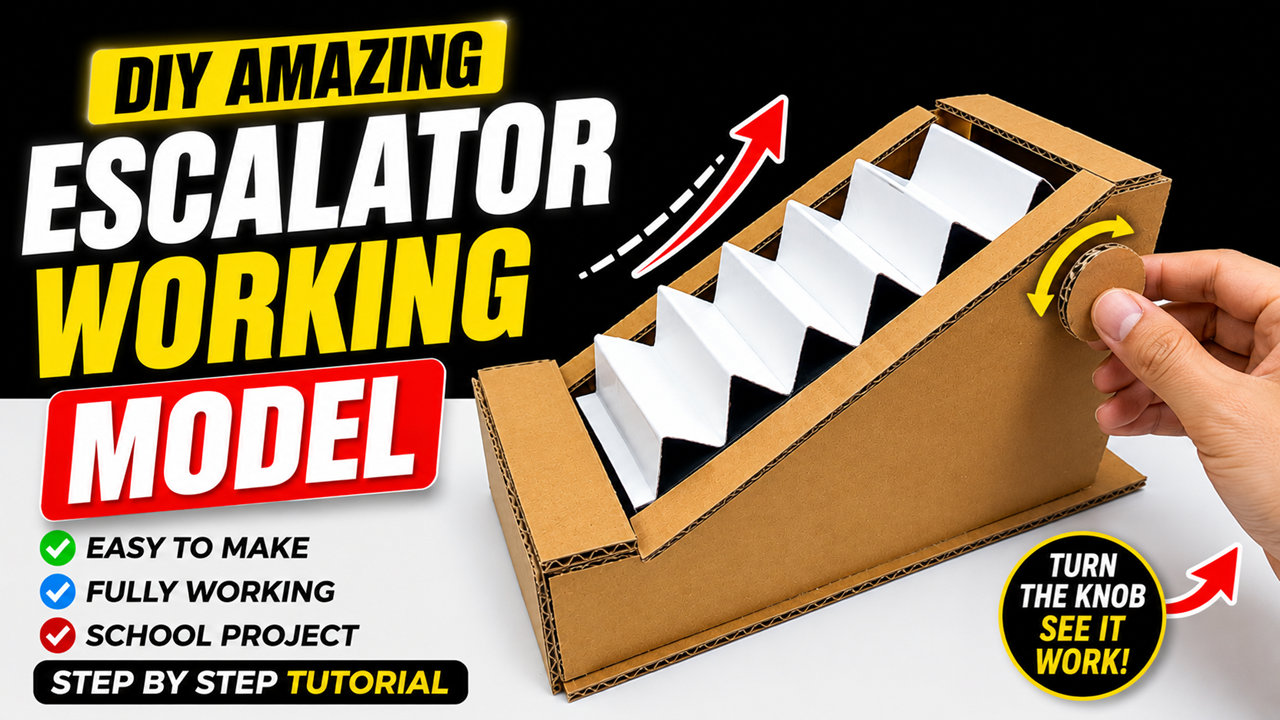
The DIY Amazing Escalator Working Model is a creative and educational engineering project that demonstrates the working principle of an escalator using simple cardboard mechanisms. Escalators are commonly found in shopping malls, airports, railway stations, metro stations, hospitals, and commercial buildings.
They make it easier for people to move between different floors without climbing stairs. This DIY project helps students understand the concepts of mechanical engineering, motion, gears, pulleys, and simple machines in an easy and practical way. It is an excellent choice for school science exhibitions, STEM projects, engineering fairs, and innovation competitions.
An escalator is a moving staircase that continuously carries people from one level to another. Unlike ordinary stairs, an escalator moves automatically using an electric motor and a chain mechanism. It saves time and reduces physical effort, especially in crowded public places where thousands of people travel every day.
In this DIY model, the escalator is made using cardboard, white chart paper, glue, and simple rotating parts. Instead of using an electric motor, the model uses a hand-operated rotating knob. When the knob is turned, it rotates the internal mechanism, causing the staircase steps to move upward continuously. This manual mechanism makes the working principle easy to observe and understand.
The main part of the model is the moving staircase. Each step is connected to the next using a flexible strip or chain made from cardboard. The steps are designed so that they always remain horizontal while moving. As the knob rotates, the chain pulls the steps upward along the inclined path. When the steps reach the top, they disappear inside the structure and return to the bottom through the hidden section. This creates a continuous loop, just like a real escalator.
The rotating knob acts as the driving mechanism. In a real escalator, an electric motor performs this function by rotating large gears and chains. In this model, the hand-operated knob replaces the motor and demonstrates how rotational motion is converted into continuous linear movement. Students can easily explain how turning the knob transfers motion through the mechanism to move all the steps together.
The inclined frame supports the moving staircase and keeps all the components aligned. It also represents the angle at which real escalators are installed. The cardboard side panels hide the return path of the steps, making the model look realistic while clearly showing the movement of the visible staircase.
The working principle of the escalator is based on mechanical motion. When the knob is turned, it rotates an axle connected to the chain. The chain moves around rollers or pulleys placed at the top and bottom of the escalator. Since each step is attached to the chain, all the steps move together. The special design of the step supports keeps every step level while moving upward, providing a safe surface for passengers. After reaching the top, the steps travel underneath the escalator and return to the starting position, completing one continuous cycle.
This project demonstrates several important scientific and engineering concepts, including rotational motion, linear motion, chain drive mechanisms, mechanical transmission, simple machines, and energy transfer. It helps students understand how machines convert one type of motion into another to perform useful work.
Escalators have many practical applications. They are installed in shopping malls, airports, railway stations, metro stations, hospitals, hotels, office buildings, and stadiums. They improve the movement of people, reduce congestion, and make transportation easier for elderly people, children, and passengers carrying luggage.
Building this model also improves creativity and practical skills. Students learn measuring, cutting, assembling, and designing techniques while developing problem-solving abilities. Since the project uses inexpensive materials like cardboard and paper, it is affordable and environmentally friendly.
Materials Required
- Cardboard sheets
- White chart paper
- Craft glue or hot glue
- Wooden skewers or sticks
- Cardboard rollers
- Cutter and scissors
- Ruler and pencil
- Decorative colour paper
Working Principle
- Turn the side knob manually.
- The knob rotates the internal axle.
- The axle moves the connected chain or belt.
- The chain pulls the staircase steps upward.
- The steps remain horizontal while moving.
- At the top, the steps move inside the structure and return to the bottom.
- The cycle repeats continuously, just like a real escalator.
Advantages of This Working Model
- Easy to build using cardboard.
- Demonstrates a real engineering mechanism.
- Improves understanding of motion and mechanical systems.
- Encourages creativity and hands-on learning.
- Suitable for STEM projects and science exhibitions.
- Low-cost, eco-friendly, and reusable.
- Attractive and interactive for judges and visitors.
Educational Benefits
- Explains how escalators work in everyday life.
- Demonstrates rotational and linear motion.
- Introduces chain drive and pulley mechanisms.
- Develops engineering and design skills.
- Encourages scientific thinking and innovation.
In conclusion, the DIY Amazing Escalator Working Model is an excellent engineering science project that demonstrates how a moving staircase operates using simple mechanical principles. By converting rotational motion into continuous step movement, the model clearly explains the working of an escalator in a practical and engaging way. This project combines science, engineering, and creativity while helping students understand real-world technology. It is an ideal choice for school science exhibitions because it is easy to build, visually impressive, educational, and highly interactive.