
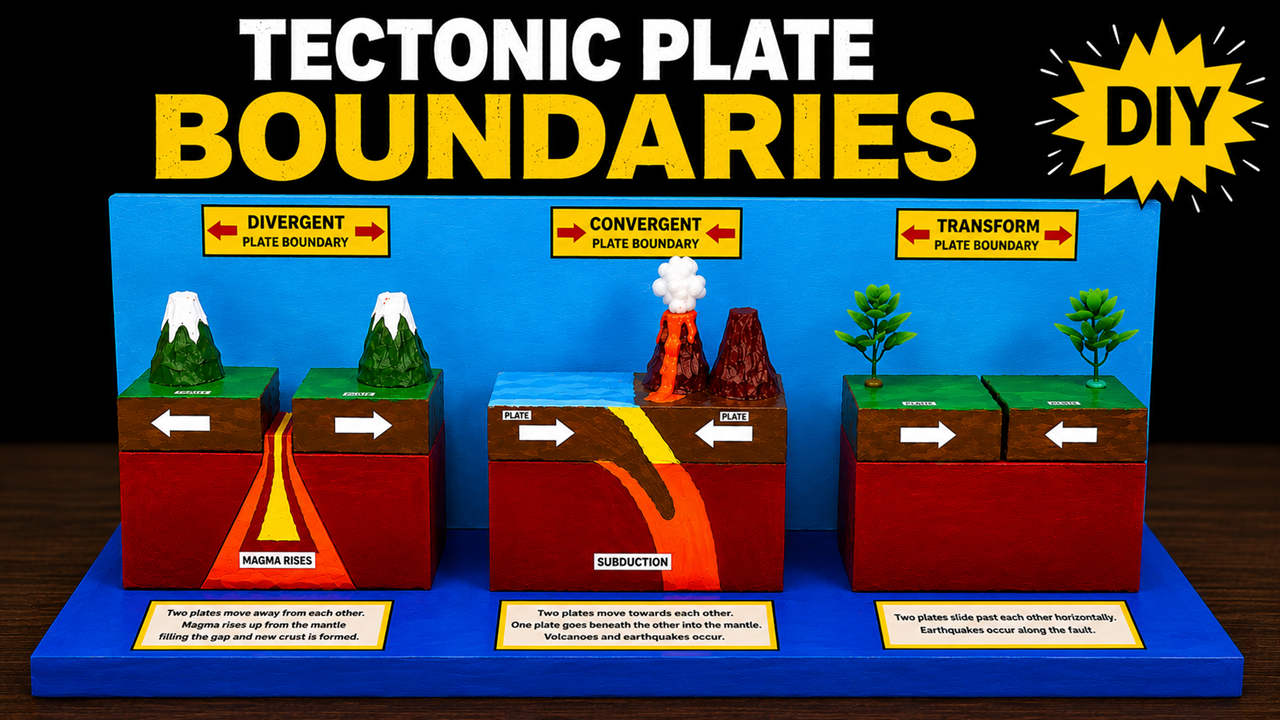
The Tectonic Plate Boundaries Working Model is an interesting and educational science exhibition project that helps students understand how the Earth’s surface changes over time. This model demonstrates the three main types of tectonic plate boundaries: Divergent Plate Boundary, Convergent Plate Boundary, and Transform Plate Boundary. It is an excellent DIY project for school science exhibitions, STEM activities, geography fairs, and Inspire Award competitions. The model can be easily made using cardboard, thermocol, colour paper, clay, acrylic paints, and other simple craft materials.
The Earth’s outer layer, called the lithosphere, is divided into several large and small pieces known as tectonic plates. These plates are not stationary. They move slowly over the semi-molten layer beneath them called the mantle. The movement of tectonic plates is caused by heat inside the Earth, which creates convection currents in the mantle. Although the plates move only a few centimetres each year, their movement has a huge impact on the Earth’s surface.
The first section of this working model shows the Divergent Plate Boundary. At a divergent boundary, two tectonic plates move away from each other. As the plates separate, hot molten rock called magma rises from the mantle to fill the gap. When the magma cools, it forms new crust. This process creates mid-ocean ridges, rift valleys, and sometimes volcanic activity. In the model, the rising magma is shown between two plates moving apart with arrows indicating the direction of movement. This helps students understand how new land is continuously created on the Earth’s surface.
The second section demonstrates the Convergent Plate Boundary. At this boundary, two tectonic plates move towards each other. Usually, the denser oceanic plate slides beneath the lighter continental plate in a process called subduction. As the plate sinks into the mantle, it melts due to intense heat and pressure. This melting forms magma, which rises and creates volcanoes. Convergent boundaries are also responsible for powerful earthquakes and the formation of mountain ranges such as the Himalayas. In the model, the subducting plate, volcano, and rising lava clearly explain how this natural process occurs.
The third section represents the Transform Plate Boundary. Here, two tectonic plates slide horizontally past one another. Unlike divergent and convergent boundaries, no new crust is created or destroyed. However, the friction between the plates causes stress to build up over time. When this stress is suddenly released, it results in earthquakes. Famous examples include the San Andreas Fault in California. The model illustrates the two plates sliding in opposite directions with arrows, making it easy to understand how transform boundaries generate earthquakes.
This working model demonstrates the complete process of tectonic plate movement in a simple and practical way. By moving the cardboard plates manually, students can clearly show how mountains, volcanoes, earthquakes, and new landforms are formed. The colourful labels, arrows, cross-sectional layers of the Earth, and volcano model make the project visually attractive and easy for judges and visitors to understand.
Understanding tectonic plate boundaries is very important because they explain many natural events that occur around the world. Earthquakes, volcanic eruptions, mountain formation, and the movement of continents are all related to tectonic plate activity. Scientists continuously study plate movements to improve earthquake monitoring, volcanic hazard prediction, and disaster preparedness.
This DIY project also helps students learn several important scientific concepts such as plate tectonics, mantle convection, magma formation, subduction, earthquake generation, volcanic eruptions, and continental movement. Since the model uses inexpensive materials like cardboard, clay, thermocol, and colour paper, it is suitable for students of all age groups.
Types of Plate Boundaries
- Divergent Boundary – Plates move apart, magma rises, and new crust is formed.
- Convergent Boundary – Plates move towards each other, causing subduction, volcanoes, mountains, and earthquakes.
- Transform Boundary – Plates slide past each other, producing earthquakes due to friction.
Advantages of This Working Model
- Easy to build using low-cost materials.
- Clearly explains the theory of plate tectonics.
- Demonstrates real geological processes through a working model.
- Attractive for science exhibitions and geography fairs.
- Improves understanding of earthquakes and volcanoes.
- Encourages practical learning and scientific thinking.
- Suitable for school, STEM, and Inspire Award projects.
In conclusion, the Tectonic Plate Boundaries Working Model is an informative and engaging science exhibition project that explains one of the most important concepts in Earth science. It shows how the continuous movement of tectonic plates shapes our planet by creating mountains, volcanoes, oceans, and earthquakes. Through simple demonstrations of divergent, convergent, and transform boundaries, students can easily understand complex geological processes in a practical and memorable way. This project not only develops scientific knowledge but also increases awareness about natural disasters and the dynamic nature of our Earth.