
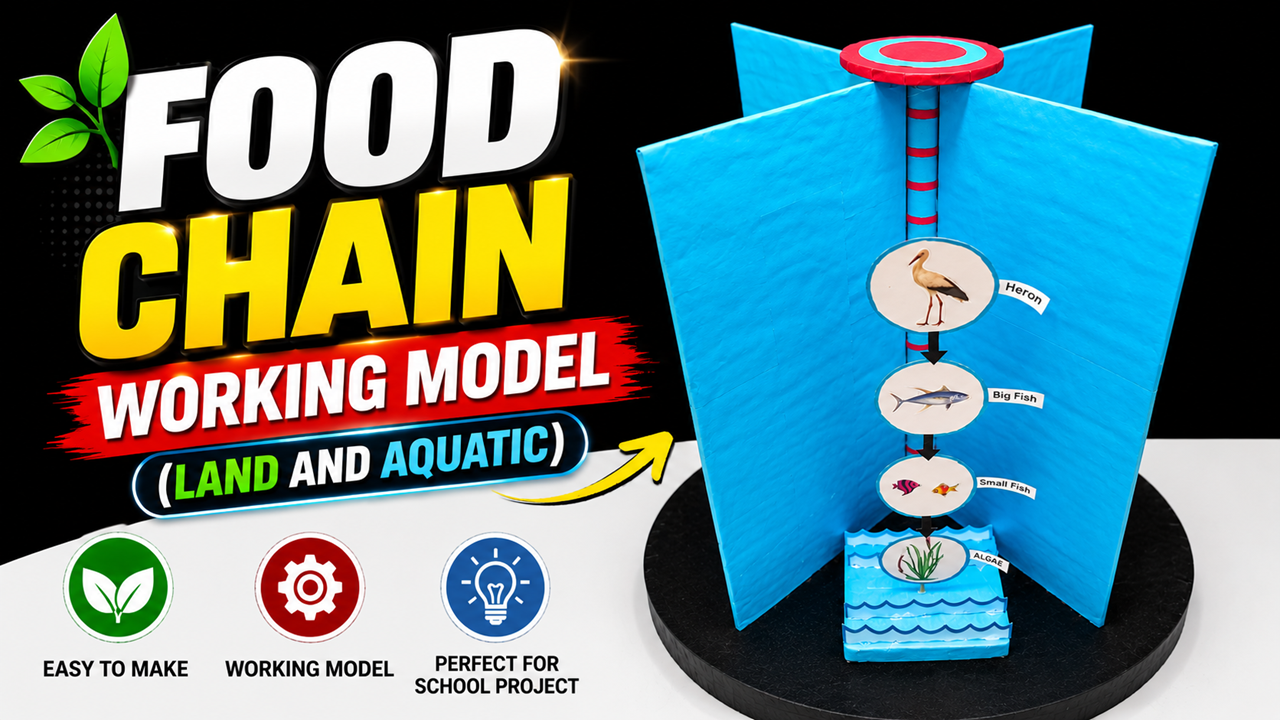
The Food Chain Working Model (Land and Aquatic) is a creative and educational science exhibition project that helps students understand how energy flows from one living organism to another in nature. It explains the relationship between producers, consumers, and decomposers, showing that every organism depends on another for food and survival. This DIY project is perfect for school science exhibitions, biology projects, STEM activities, and environmental awareness programs. It can be made easily using cardboard, colour paper, printed pictures of plants and animals, a rotating stand, and other simple craft materials.
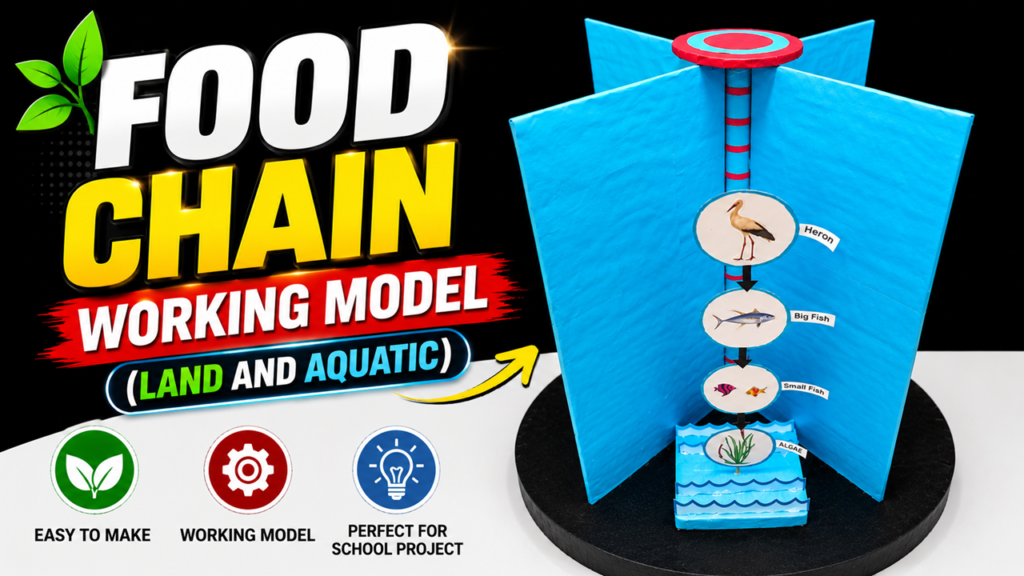
A food chain is the sequence through which energy passes from one organism to another. It always starts with plants or algae, known as producers, because they prepare their own food using sunlight through the process of photosynthesis. These producers form the foundation of every food chain and support all other living organisms.
In this working model, both land and aquatic food chains are demonstrated. The rotating design allows students to easily display different food chains and explain how energy flows through various ecosystems. The colourful pictures and rotating mechanism make the project attractive, interactive, and easy to understand.
The aquatic food chain begins with algae, which produce food using sunlight. Small fish feed on the algae. Bigger fish eat the small fish, and finally, birds such as the heron feed on the bigger fish. This sequence shows how energy moves from algae to fish and then to larger animals. Each organism depends on the one below it in the food chain for survival.
A land food chain can also be explained using the same rotating model. It starts with green plants or grass, which are eaten by grasshoppers or insects. Frogs eat the insects, snakes eat the frogs, and eagles or hawks feed on the snakes. This demonstrates that every organism has an important role in maintaining ecological balance.
The arrows shown in the model represent the direction of energy flow, not the movement of the organisms. Energy from the Sun is captured by plants during photosynthesis. Herbivores obtain this energy by eating plants, while carnivores receive energy by eating herbivores or other carnivores. At each stage, some energy is used by the organism for growth and movement, so only a small amount of energy is transferred to the next level.
Another important part of every ecosystem is the decomposer. Organisms such as bacteria and fungi break down dead plants and animals into simple nutrients. These nutrients return to the soil or water, where they are reused by plants. Although decomposers are not always shown in simple food chain models, they play a vital role in recycling nutrients and completing the natural cycle.
This working model helps students understand that all living organisms are connected. If one organism disappears from the food chain, it affects the entire ecosystem. For example, if small fish become scarce, bigger fish and birds may not find enough food. Similarly, if plants are destroyed, herbivores lose their food source, affecting all higher-level animals.
The model also teaches the importance of biodiversity and environmental conservation. Human activities such as pollution, deforestation, overfishing, and climate change can disturb food chains and threaten wildlife. Protecting forests, rivers, lakes, and oceans helps maintain healthy ecosystems and preserves the balance of nature.
Students can use this DIY project to explain important scientific concepts such as photosynthesis, energy transfer, ecosystems, producers, primary consumers, secondary consumers, tertiary consumers, food webs, and ecological balance. The rotating structure makes the demonstration engaging and allows multiple food chains to be presented using a single model.
Examples of Food Chains
Aquatic Food Chain
Algae → Small Fish → Big Fish → Heron
Land Food Chain
Grass → Grasshopper → Frog → Snake → Eagle
Advantages of This Working Model
- Easy to make using cardboard and colour paper.
- Demonstrates both land and aquatic food chains.
- Attractive rotating design for science exhibitions.
- Helps students understand energy flow in nature.
- Encourages environmental awareness and biodiversity conservation.
- Suitable for biology, environmental science, and STEM projects.
- Interactive and easy for judges and visitors to understand.
In conclusion, the Food Chain Working Model (Land and Aquatic) is an excellent science exhibition project that explains one of the most important concepts in biology. It demonstrates how energy flows through different organisms and how every living thing depends on others for survival. By showing both land and aquatic ecosystems, the model helps students understand ecological relationships, the importance of biodiversity, and the need to protect our environment. This simple DIY project combines creativity with scientific learning, making it an ideal choice for school science exhibitions and educational presentations.