
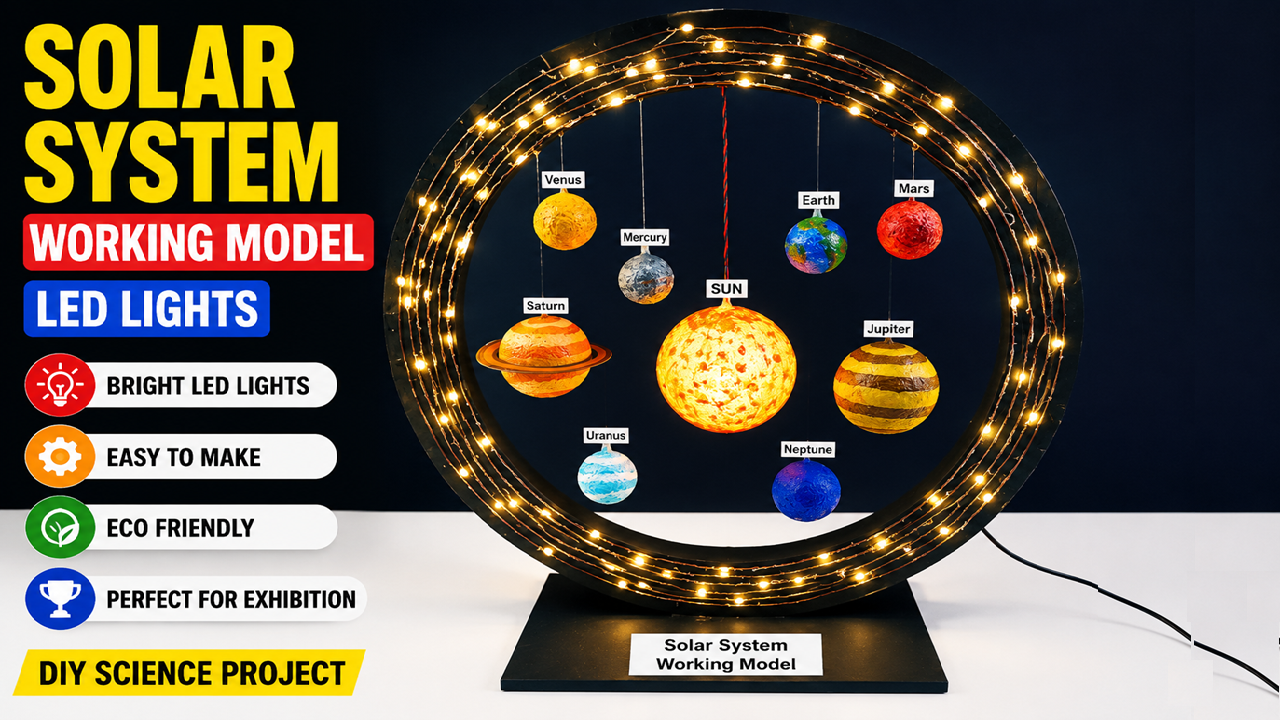
The Solar System Working Model with LED Lights is a creative and educational science exhibition project that helps students understand the structure of our Solar System in an attractive and interactive way. It demonstrates the Sun, the eight planets, and their arrangement using colourful thermocol balls, LED lights, cardboard, and simple craft materials. This DIY project is ideal for school science exhibitions, astronomy fairs, STEM activities, and Inspire Award competitions. It not only improves scientific knowledge but also develops creativity, model-making skills, and presentation abilities.
The Solar System consists of the Sun at the centre and eight planets that revolve around it due to the Sun’s gravitational force. The planets, in order from the Sun, are Mercury, Venus, Earth, Mars, Jupiter, Saturn, Uranus, and Neptune. Each planet moves around the Sun in its own orbit and also rotates on its own axis. The Sun contains about 99.8% of the total mass of the Solar System and provides the light and heat needed to support life on Earth.
In this working model, the Sun is placed at the centre and illuminated using bright LED lights to represent its enormous energy. Around the Sun, the eight planets are suspended inside a circular frame. Each planet is painted with its unique colours and size, making it easy to identify. The decorative LED lights around the circular frame create the appearance of stars in space and make the model attractive for science exhibitions.
The working principle of this model is simple. A battery or power supply provides electricity to the LED lights. When the switch is turned on, the LEDs glow, representing the bright Sun and the stars in the background. The planets are arranged in the correct order around the Sun. Some versions of this model can also include a small DC motor that slowly rotates the planets to demonstrate planetary motion around the Sun.
Each planet has its own unique characteristics. Mercury is the smallest and the closest planet to the Sun. Venus is the hottest planet because of its thick atmosphere. Earth is the only known planet that supports life because it has liquid water, oxygen, and a suitable temperature. Mars, also known as the Red Planet, is being explored for the possibility of future human missions.
The outer planets are called gas giants and ice giants. Jupiter is the largest planet in the Solar System and has a giant storm called the Great Red Spot. Saturn is famous for its beautiful rings made of ice and rock particles. Uranus rotates on its side, making it unique among all planets. Neptune is the farthest planet from the Sun and experiences extremely strong winds and very cold temperatures.
This DIY working model helps students understand several important scientific concepts, including gravity, planetary motion, rotation, revolution, astronomy, and the scale of the Solar System. The glowing LED lights make the model visually appealing and help attract the attention of judges and visitors during science exhibitions. Students can easily explain the order of the planets, their unique features, and the importance of the Sun while demonstrating the model.
The model also highlights the importance of space exploration. Scientists use powerful telescopes, satellites, and spacecraft to study planets, moons, asteroids, and comets. Missions conducted by organizations such as ISRO, NASA, and ESA have greatly increased our understanding of the Solar System. Studying space helps scientists learn about the origin of planets, the possibility of life beyond Earth, and future space travel.
Materials Required
- Cardboard or MDF base
- Thermocol balls of different sizes
- Acrylic colours and paint brushes
- LED fairy lights
- Battery or DC power supply
- Wires and switch
- Wooden sticks or thread
- Hot glue
- Colour paper and labels
Advantages of This Working Model
- Easy to build using simple craft materials.
- Attractive LED lighting enhances the presentation.
- Helps students understand the Solar System visually.
- Improves knowledge of planets and astronomy.
- Suitable for science exhibitions and STEM activities.
- Encourages creativity, scientific thinking, and public speaking.
- Can be upgraded with a motor for rotating planets.
Educational Benefits
- Demonstrates the arrangement of planets around the Sun.
- Explains the concepts of rotation and revolution.
- Introduces students to astronomy and space science.
- Makes learning interactive and enjoyable.
- Encourages curiosity about space exploration.
In conclusion, the Solar System Working Model with LED Lights is an excellent science exhibition project that combines creativity with scientific learning. It provides a clear understanding of the Sun, the eight planets, and their movement in a simple and engaging manner. The colourful planets, glowing Sun, and decorative LED lights make the model visually impressive while helping students explain important concepts such as gravity, planetary motion, and the structure of the Solar System. This DIY project is ideal for school exhibitions because it is easy to make, educational, and inspires curiosity about the wonders of space and our universe.