
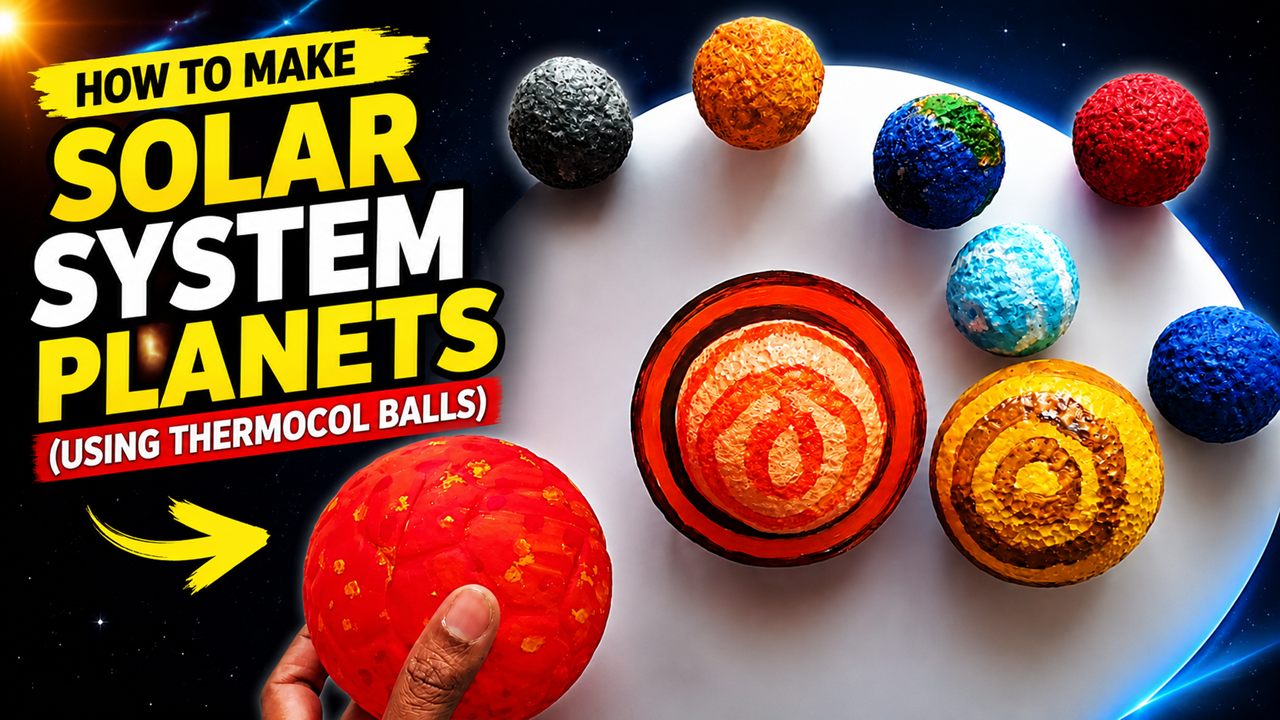
The Solar System Planets Using Thermocol Balls is one of the most popular and creative DIY science projects for school students. It helps children understand the planets, their colours, sizes, and positions in the Solar System through a fun hands-on activity. Since it uses inexpensive materials such as thermocol balls, acrylic paints, and simple craft supplies, it is easy to make at home or in school.
The Solar System consists of the Sun and eight planets that revolve around it because of the Sun’s gravitational force. The planets are arranged in the following order: Mercury, Venus, Earth, Mars, Jupiter, Saturn, Uranus, and Neptune. Each planet has its own size, colour, atmosphere, and unique features. By making colourful models of these planets, students can easily remember their names and understand their characteristics.
The first step in this DIY project is selecting thermocol balls of different sizes. Larger balls are used for the Sun, Jupiter, and Saturn, while smaller balls are used for Mercury, Venus, Earth, Mars, Uranus, and Neptune. The different sizes help represent the relative sizes of the planets, making the model more realistic.
After selecting the balls, each planet is painted using acrylic colours. Mercury is painted grey because of its rocky surface. Venus is coloured yellowish-orange due to its thick cloud cover. Earth is painted blue, green, and white to represent oceans, land, and clouds. Mars, known as the Red Planet, is painted red with dark patches. Jupiter, the largest planet, is decorated with brown, cream, and orange bands. Saturn is painted golden-yellow and fitted with a ring made from cardboard or foam sheet. Uranus is painted light blue, while Neptune is painted dark blue because of its cold atmosphere.
The Sun is the centre of the Solar System and should be the largest model. It can be painted with bright shades of yellow, orange, and red to create a glowing appearance. Some students add glitter or LED lights to make the Sun more attractive during science exhibitions. The Sun provides light and heat to all the planets and is the source of energy for life on Earth.
Once the planets are painted and dry, they can be mounted on sticks, thread, or wire depending on the type of display. Students can arrange them on a cardboard base with circular orbits or suspend them inside a circular frame for a hanging Solar System model. Labels can be added below each planet to help viewers identify them easily. This arrangement allows students to explain the correct order of the planets during their presentation.
This project also teaches several important scientific concepts. Students learn about gravity, planetary motion, rotation, revolution, and the structure of our Solar System. They understand that all the planets revolve around the Sun at different speeds and distances. Inner planets are rocky, while the outer planets are mainly made of gases and ice. They also discover that Earth is the only known planet that supports life because it has water, oxygen, and a suitable temperature.
Besides scientific learning, this DIY activity develops creativity and practical skills. Painting, colouring, cutting, and assembling the planets improve hand-eye coordination and artistic ability. It also encourages teamwork when completed as a group activity. Students gain confidence while explaining the project to teachers, judges, and visitors during science exhibitions.
Materials Required
- Thermocol balls of different sizes
- Acrylic paints
- Paint brushes
- Cardboard or foam sheet
- Wooden skewers or wire
- Hot glue or craft glue
- Black chart paper or cardboard base
- Marker pens and printed labels
- Scissors and ruler
Advantages of This DIY Project
- Easy to make using inexpensive materials.
- Helps students learn the names and order of the planets.
- Improves creativity and craft skills.
- Makes astronomy fun and interactive.
- Suitable for science exhibitions and classroom demonstrations.
- Attractive and colourful presentation.
- Encourages curiosity about space and the universe.
Educational Benefits
- Explains the structure of the Solar System.
- Helps understand the characteristics of each planet.
- Introduces basic astronomy concepts.
- Improves observation and presentation skills.
- Encourages scientific thinking through hands-on learning.
In conclusion, the Solar System Planets Using Thermocol Balls project is an excellent DIY science exhibition model that combines art, creativity, and science. It helps students understand the planets and their unique features in a simple and enjoyable way. By using low-cost materials and colourful designs, students can create an impressive model that is both educational and visually attractive. This project inspires young learners to explore astronomy, appreciate the wonders of space, and develop a lifelong interest in science.