
Introduction
Natural farming is an eco-friendly method of agriculture that works with nature instead of depending heavily on chemical fertilizers and pesticides.
It focuses on maintaining healthy soil, conserving water, using natural inputs, protecting biodiversity, and producing nutritious crops.
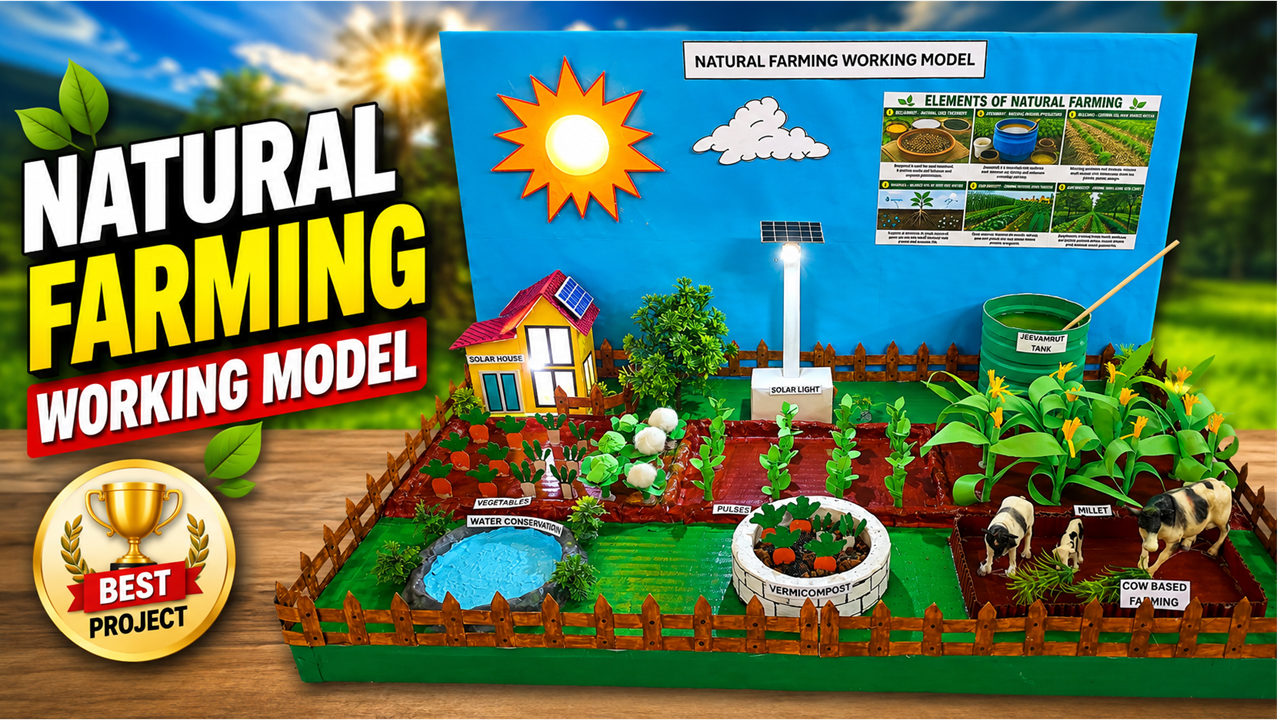
This working model demonstrates several important practices of natural farming, including cow-based farming, Jeevamrut, vermicompost, water conservation, solar energy, vegetables, pulses, and millet cultivation.
Main Concept of the Model
The model represents a small sustainable farm where different natural farming activities work together. The solar house and solar light demonstrate the use of renewable energy. Solar energy can provide electricity for farm lighting and other small requirements while reducing dependence on conventional energy sources.
The vegetable section shows crops grown using natural soil management and organic inputs. The pulse section represents crops such as beans, peas, and other legumes. Pulses are important because many legumes can contribute to soil fertility through their association with nitrogen-fixing bacteria.
The millet section demonstrates climate-friendly crops that generally require less water than many conventional cereal crops and can be suitable for dry conditions. The water-conservation pond stores water and demonstrates the importance of collecting and using rainwater efficiently.
The model also contains a vermicompost unit. Vermicomposting uses earthworms to convert suitable organic waste into nutrient-rich compost. This compost can improve soil structure and provide nutrients for plants.
The cow-based farming area represents the use of cattle-based resources in natural farming. Cow dung and urine can be used as ingredients in traditional natural farming preparations. The Jeevamrut tank represents a fermented natural input prepared from materials such as cow dung, cow urine, pulse flour, jaggery, and water. It is traditionally used to support soil biological activity.
Materials Required
For making this project, you will need a large cardboard or foam-board sheet, green and blue chart paper, cardboard boxes, thermocol or foam sheets, colored paper, small plastic containers, clay, wooden sticks, ice-cream sticks, glue, scissors, a cutter, paints, markers, small toy animals, artificial plants, LEDs, wires, and a small solar panel or paper solar-panel model. Recycled materials can be used to reduce the cost.
How to Make the Model
First, take a large rectangular cardboard sheet and cover it with green paper or paint to represent the farmland. Make a blue cardboard backdrop and write “NATURAL FARMING WORKING MODEL” at the top.
Create a small solar house using cardboard. Paint it and place a small solar panel on its roof. Add an LED light connected to a small battery or solar panel if you want the model to demonstrate lighting.
Next, divide the farm into separate crop beds. Use brown cardboard or painted clay for the soil and plant miniature vegetables, pulses, and millet crops. Add small labels such as “VEGETABLES,” “PULSES,” and “MILLET.”
For water conservation, make a small pond using a shallow plastic container or molded cardboard. Cover the inside with blue paper or paint and label it “WATER CONSERVATION.”
Make a circular vermicompost unit using cardboard or a plastic container. Fill it with dark-colored paper, soil, and small organic-waste pieces. Label it “VERMICOMPOST.” Create a green container for the Jeevamrut tank and place a small stick or pipe inside it.
Finally, make a small cow shelter or fenced area using wooden sticks and place toy cows inside. Connect the different sections visually with arrows to show how natural resources are reused around the farm. Add trees, fencing, crop labels, and an information chart to make the model attractive.
Conclusion
This project demonstrates that farming can be productive while protecting soil, water, animals, and the environment. Natural inputs, compost, water conservation, renewable energy, diverse crops, and responsible livestock management can work together to create a more sustainable farming system. The model shows the basic idea of “healthy soil, healthy crops, healthy food, and a healthy environment.”