
1. Introduction
Good morning, respected judges, teachers, and my dear friends.
Today, I am going to present my science project, “Medicine Reminder Box Working Model.”
Medicines are important for treating many illnesses. However, some people, especially elderly people and those who take multiple medicines, may forget to take their medicines at the correct time. Forgetting a dose or taking medicine at the wrong time can affect their treatment.
My project demonstrates a simple medicine reminder system that reminds users about their scheduled medicine times, such as morning, afternoon, evening, and night. The main purpose of this model is to promote timely medication and help people follow their prescribed schedules.
2. Aim of the Project
The main objectives of this project are:
- To demonstrate a medicine reminder system.
- To remind users about scheduled medicine times.
- To organise medicines into different time slots.
- To support elderly people and people who need regular medication reminders.
- To introduce students to basic electronics and healthcare technology.
3. Materials Required
The following materials are required to construct this model:
- Cardboard sheets for the main structure and base.
- Blue, red, yellow, green, and orange chart paper.
- Four LED lights or electronic indicator lamps.
- Four push buttons or switches.
- A suitable low-voltage battery or power supply.
- Connecting wires.
- Small plastic containers for medicine compartments.
- A buzzer for an audible reminder.
- Optional Arduino or programmable timer module.
- Glue, scissors, ruler, markers, and labels.
- Decorative paper and a medicine symbol for the front panel.
The components can be selected according to whether the model is a simple manual reminder or an automatic timed reminder.
4. Making Process
Step 1: Prepare the base
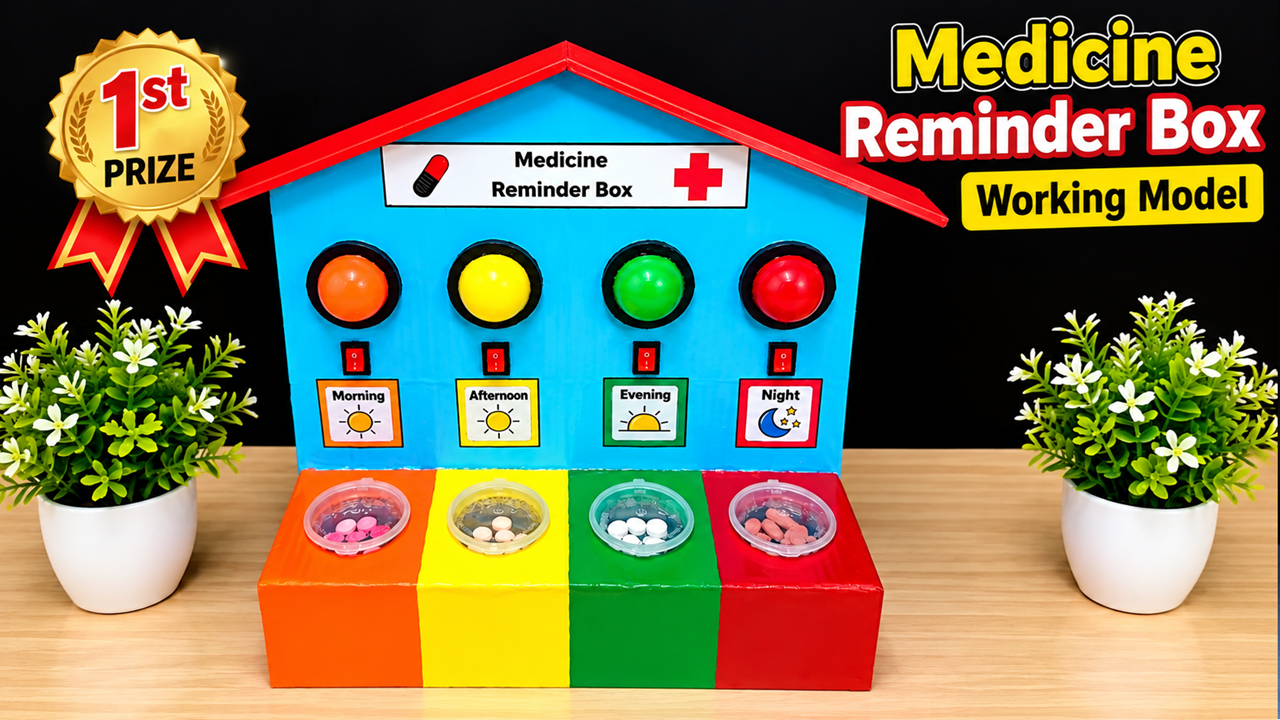
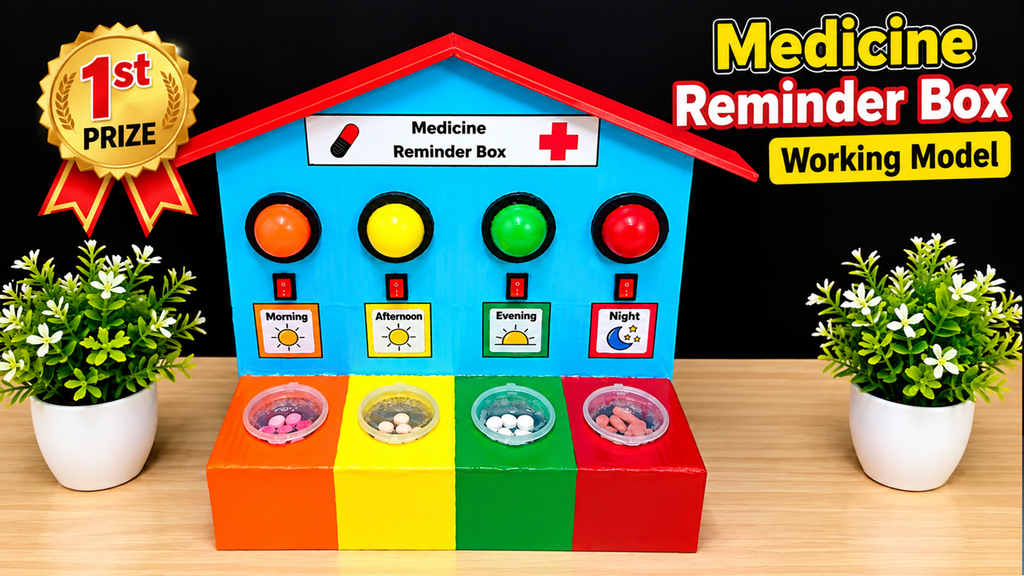
Take a thick piece of cardboard and cut it into a rectangular base. Cover the base with coloured paper. Divide the front section into four equal compartments using orange, yellow, green, and red paper to represent the four medicine time slots.
Step 2: Construct the main box
Cut cardboard pieces to make a rectangular upright panel. Attach it securely to the rear of the base. Create a triangular or sloping roof using cardboard to give the model the appearance of a small medicine station.
Cover the front panel with blue chart paper and attach a label reading “Medicine Reminder Box.”
Step 3: Make four medicine compartments
Prepare four small plastic containers and place them on the base. Label them:
- Morning
- Afternoon
- Evening
- Night
These compartments represent the different scheduled medicine times. In a real device, the compartments should be clearly labelled and designed to prevent medicines from being mixed up.
Step 4: Install the indicator lights
Make four circular openings or raised holders on the upright panel. Install one LED or suitable indicator lamp for each time slot. Use different colours to distinguish the indicators.
For example, orange can represent morning, yellow afternoon, green evening, and red night. These colours are illustrative and should not be confused with medical instructions.
Step 5: Connect the switches
Install a small switch below each indicator. Connect each switch to its corresponding light using suitable low-voltage wiring and an appropriate power supply.
In a simple demonstration, pressing a switch can turn on its indicator. This shows how the user can select or acknowledge a scheduled medicine time.
Step 6: Add an automatic reminder feature
For an advanced version, connect the system to a programmable timer or microcontroller. Program it to activate the correct indicator at preset times. A buzzer can also sound when a reminder is due.
The program should allow the user to acknowledge the reminder. A basic circuit with manual switches will not automatically keep time unless a timer or controller is added.
Step 7: Finish the model
Secure all the components, cover exposed cardboard edges, and attach clear labels. Check that the switches, indicators, and buzzer work correctly before presenting the model.
5. Working Principle
The working principle of this model is based on scheduled reminders and visual or audible alerts.
In the basic version, the user presses a switch to activate the indicator associated with a particular medicine time. For example, pressing the morning switch turns on the morning indicator.
In an automatic version, a timer or programmed controller keeps track of the preset schedule. When the morning reminder time arrives, the corresponding indicator turns on and the buzzer may sound. Similar reminders can be programmed for afternoon, evening, and night.
After checking the reminder, the user can acknowledge it using a button. Depending on the design, the indicator may then turn off.
The system is intended to remind users about a schedule prescribed by a healthcare professional. It does not decide which medicine a person should take or determine the correct dosage.
6. Demonstration at the Exhibition
During the exhibition, I will first introduce the four medicine compartments and explain their purpose.
Next, I will demonstrate the manual switches. When I press the morning switch, the morning indicator lights up. I will repeat the process for afternoon, evening, and night.
If the model includes an automatic timer, I will demonstrate how the controller activates an indicator at a programmed time and sounds the buzzer.
I will explain that the compartments should be filled according to the person’s prescribed medication plan. Medicines should not be taken simply because a light turns on; users must follow the instructions given by their doctor or pharmacist.
7. Advantages and Applications
The Medicine Reminder Box has several potential benefits:
- Helps users remember scheduled medicine times.
- Provides clear visual reminders.
- Can provide audible alerts for users who may not notice a light.
- Helps organise medicines into separate time slots.
- Demonstrates the use of electronics in healthcare.
- Can be developed into a more advanced device with a timer, display, or mobile notification.
This concept may be useful for elderly people, caregivers, and individuals who follow regular medication schedules. A real device should include clear labelling, safe storage, reliable alerts, and a way to handle missed reminders.
8. Safety Precautions and Conclusion
Medicines must always be stored according to their packaging instructions and kept away from children. The correct medicine, dose, and timing must be confirmed with a healthcare professional. The reminder system should never replace medical advice.
To conclude, my Medicine Reminder Box Working Model demonstrates how a simple electronic system can support medication routines. By combining separate compartments, indicator lights, switches, and an optional automatic timer, this project shows how technology can help people manage everyday healthcare tasks.
My message is: “The Right Medicine, at the Right Time, According to the Right Prescription.”
Thank you, everyone!
Learn, Create, and Innovate!