
Good morning everyone.
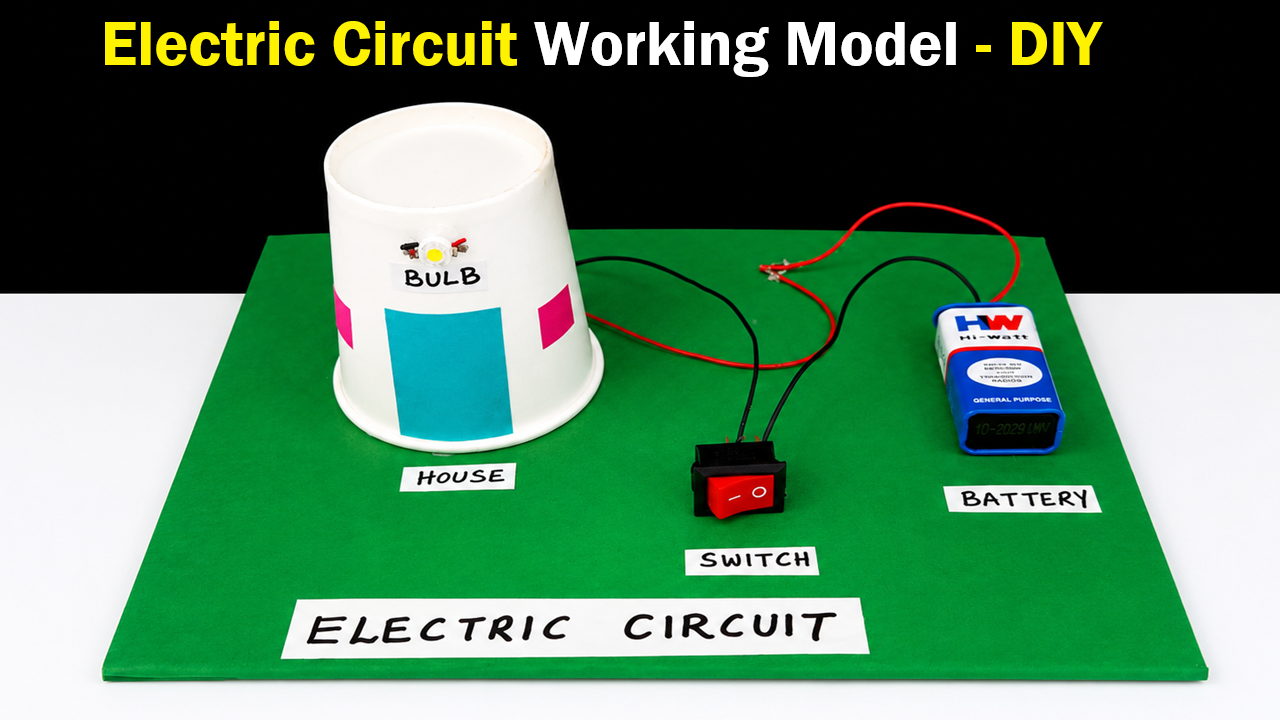
Today I am going to explain my science exhibition project on “Electric Circuit Working Model.” This is a simple DIY project that demonstrates how electricity flows in a closed circuit to light a bulb.
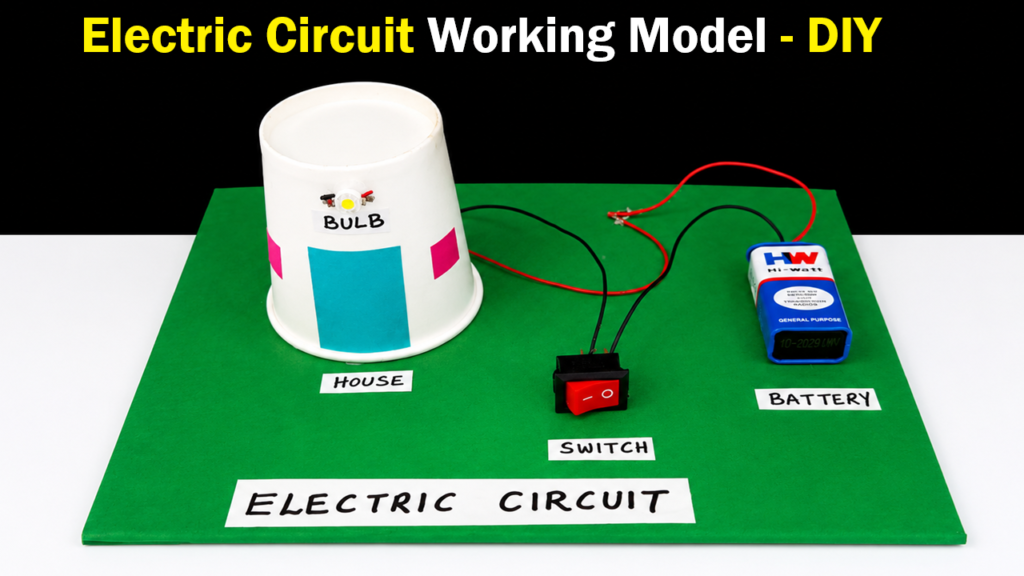
An electric circuit is a path through which electric current flows from a power source to an electrical device and back to the source. This project helps students understand the basic concepts of electricity, switches, wires, and circuits in an easy and practical way.
This is one of the most important beginner science projects because it explains the foundation of all electrical systems used in daily life.
Aim of the Project
The main aim of this project is:
- To demonstrate the working of an electric circuit
- To understand the flow of electric current
- To explain open and closed circuits
- To learn the role of switches and batteries
Explanation of the Model
The model contains:
- Battery
- Bulb
- Switch
- Connecting wires
- House model
When the switch is turned ON, the electric circuit becomes complete and the bulb glows. When the switch is turned OFF, the circuit breaks and the bulb stops glowing.
This demonstrates how electricity works in homes and electronic devices.
Parts of the Electric Circuit Model
1. Battery
The battery is the power source of the circuit.
Function:
- Supplies electrical energy
- Pushes electric current through the wires
The battery converts chemical energy into electrical energy.
2. Bulb
The bulb is the output device.
Function:
- Produces light using electricity
- Converts electrical energy into light energy
When current flows through the bulb filament or LED, it glows.
3. Switch
The switch controls the flow of current.
Function:
- Opens the circuit
- Closes the circuit
When the switch is ON:
- Current flows
- Bulb glows
When the switch is OFF:
- Current stops
- Bulb turns OFF
4. Connecting Wires
The wires connect all components together.
Function:
- Carry electric current
- Complete the circuit path
Copper wires are good conductors of electricity.
5. House Model
The house model represents real-life home electricity systems where switches control lights and appliances.
Working Principle
This project works on the principle of:
Electric Current Flow in a Closed Circuit
Electric current flows only when:
- The circuit is complete
- All components are connected properly
If the circuit is broken, current cannot flow.
Working of the Electric Circuit
Step 1 – Battery Supplies Power
The battery provides electrical energy.
Step 2 – Switch is Turned ON
The switch completes the circuit.
Step 3 – Current Flows Through Wires
Electric current moves through the wires.
Step 4 – Bulb Glows
The bulb lights up because electricity reaches it.
Step 5 – Switch is Turned OFF
The circuit breaks and the bulb turns OFF.
Scientific Concepts Used
This project explains:
- Electric current
- Conductors and insulators
- Open and closed circuits
- Energy conversion
- Electrical connections
Real-Life Applications
Electric circuits are used in:
- Homes
- Schools
- Mobile phones
- Computers
- Fans
- Televisions
- Street lights
Every electrical device works using circuits.
Materials Used
This DIY project is made using:
- 9V battery
- LED bulb or small bulb
- Switch
- Connecting wires
- Cardboard base
- Paper cup for house model
- Glue gun or tape
How to Make the Model
Step 1 – Prepare the Base
Take a cardboard base for mounting components.
Step 2 – Create the House
Use a paper cup or cardboard to make a house model.
Step 3 – Install the Bulb
Fix the bulb on the house model.
Step 4 – Connect the Circuit
Connect:
- Battery
- Switch
- Bulb
using wires.
Step 5 – Test the Circuit
Turn the switch ON and OFF to observe the bulb.
Advantages of the Project
- Easy beginner science project
- Low-cost materials
- Practical demonstration
- Improves understanding of electricity
- Attractive for exhibitions
Educational Importance
This project helps students:
- Understand basic electricity
- Learn circuit connections
- Improve practical knowledge
- Develop STEM learning skills
It forms the foundation for advanced electronics and electrical engineering.
Safety Precautions
- Use low-voltage batteries only
- Avoid touching bare wires
- Do not short-circuit the battery
- Keep connections secure
Conclusion
In conclusion, this Electric Circuit Working Model is a simple and educational DIY project that demonstrates how electricity flows through a closed circuit to operate a bulb.
The project explains important concepts like electric current, switches, and energy conversion in an easy and practical way. It is an excellent project for science exhibitions and beginner electronics learning.