
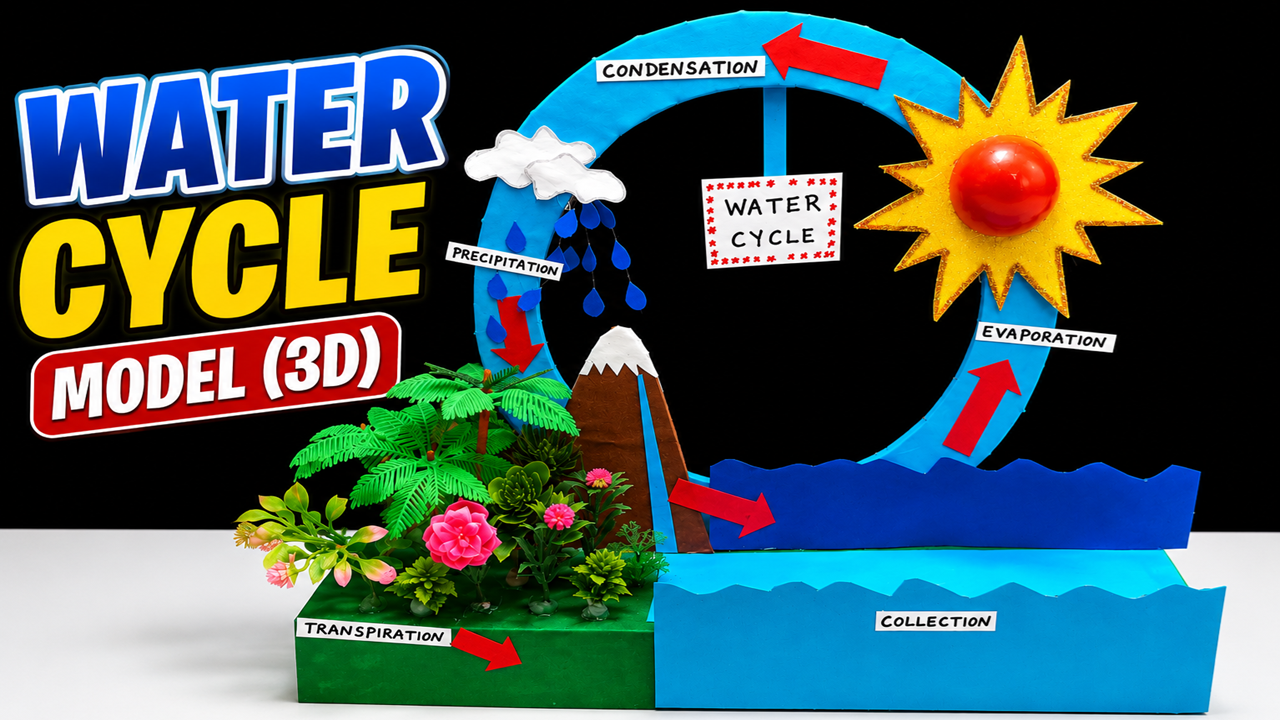
The Water Cycle 3D Model is a creative and educational science project that demonstrates the continuous movement of water between the Earth’s surface and the atmosphere. This model is ideal for a school science exhibition, geography project, environmental science activity, STEM project, or classroom demonstration.
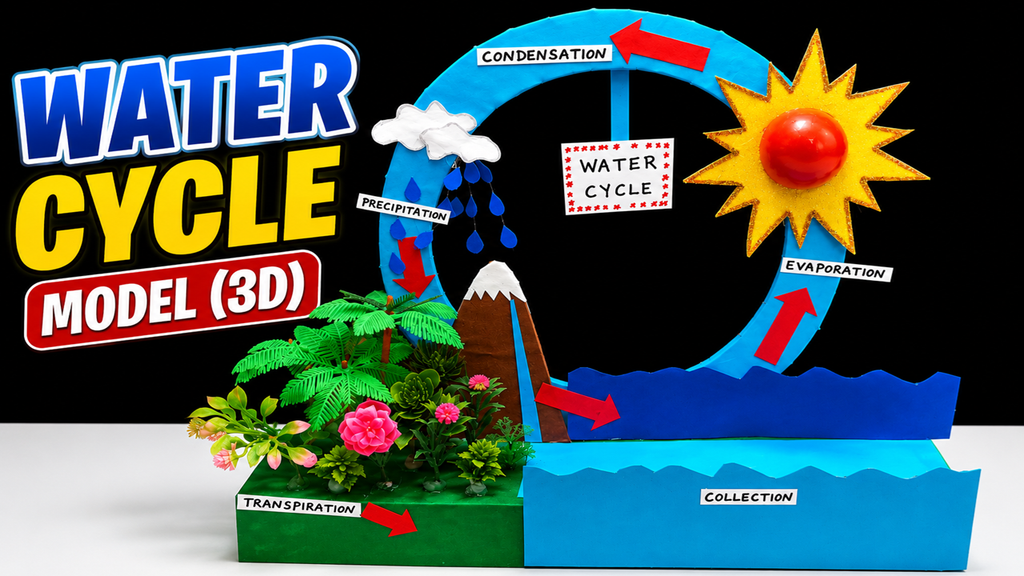
Water is essential for all living organisms. The water we use today has been moving through nature for millions of years. It continuously changes its form and location through processes such as evaporation, condensation, precipitation, collection, and transpiration. This continuous movement is called the water cycle or hydrological cycle.
The 3D model makes these processes easy to understand by presenting them visually with a Sun, clouds, mountains, plants, water bodies, arrows, and clearly labelled stages.
Objective of the Project
The main objective of this project is to explain how water moves through the environment in a continuous cycle.
The model helps students understand:
- Evaporation
- Condensation
- Precipitation
- Collection
- Transpiration
- The role of the Sun
- Movement of water through the environment
- Importance of the water cycle for life on Earth
Materials Required
This model can be made using simple and inexpensive craft materials:
- Cardboard or foam board
- Chart paper
- Coloured paper
- Thermocol
- Modelling clay
- Cotton
- Glue
- Scissors
- Paint
- Wooden sticks
- Artificial plants
- Small decorative materials
- Blue paper for water
- Red arrows for showing movement
- Labels for different stages
Students can modify the design according to the materials available at home or school.
How the Water Cycle Works
The water cycle is powered mainly by solar energy.
The Sun heats water present in oceans, rivers, lakes, ponds, and other water bodies. When water receives enough heat, some of it changes from liquid water into water vapour. This process is called evaporation.
Plants also contribute water vapour to the atmosphere through a process called transpiration.
The water vapour rises into the atmosphere. As it reaches cooler areas, it loses heat and changes into tiny water droplets. This process is called condensation.
The tiny droplets collect together and form clouds.
When the water droplets become sufficiently large and heavy, they fall back to Earth’s surface as precipitation. Precipitation can occur as rain, snow, sleet, or hail depending on atmospheric conditions.
The water then collects in oceans, rivers, lakes, ponds, and underground reservoirs. Some water flows over the land while some infiltrates into the soil. Eventually, water can return to larger water bodies, and the cycle continues.
Evaporation
In the model, the Sun represents the main source of energy.
Sunlight heats water in oceans, lakes, and other water bodies. The water changes from liquid into water vapour and rises into the atmosphere.
The red upward arrow in the model represents this movement.
Water + Heat → Water Vapour
Evaporation is an important stage because it moves water from Earth’s surface into the atmosphere.
Transpiration
Plants also play an important role in the water cycle.
Plants absorb water from the soil through their roots. Some of this water eventually escapes from tiny openings in plant leaves as water vapour. This process is called transpiration.
In the model, the plants represent vegetation contributing moisture to the atmosphere.
Evaporation and transpiration together are often referred to as evapotranspiration.
Condensation
As water vapour rises higher into the atmosphere, it encounters cooler air.
The vapour cools and changes into tiny liquid water droplets. These droplets gather around tiny particles in the atmosphere and contribute to cloud formation.
This process is called condensation.
The blue curved arrow at the top of the model shows the movement toward the condensation stage.
Precipitation
When clouds become filled with enough water droplets or ice particles, water eventually falls back toward Earth’s surface.
This is called precipitation.
Rain is the most familiar form of precipitation. Depending on temperature and atmospheric conditions, precipitation can also occur as snow, sleet, or hail.
The falling blue water droplets shown in the model represent rainfall.
Collection
After precipitation reaches the ground, water collects in different locations.
It may collect in:
- Oceans
- Rivers
- Lakes
- Ponds
- Reservoirs
- Glaciers
- Soil
- Groundwater
The large blue section at the bottom of the model represents a water body where water is collected.
From there, water can once again be heated by the Sun, beginning another cycle.
Importance of the Water Cycle
The water cycle is essential for life on Earth.
It helps distribute freshwater throughout the environment and supports plants, animals, agriculture, ecosystems, and human activities.
The cycle also plays an important role in weather and climate. Without the continuous movement of water between the land, oceans, and atmosphere, Earth’s ecosystems would not function as they do today.
Exhibition Explanation
A student can explain the model like this:
“This is a 3D Water Cycle Model. The water cycle is the continuous movement of water between Earth’s surface and the atmosphere. The Sun heats water in oceans, rivers, and lakes, causing evaporation. Plants release water vapour through transpiration. The water vapour rises and cools, causing condensation and cloud formation. When the droplets become heavy, they fall to Earth as precipitation. The water then collects in rivers, lakes, oceans, soil, and groundwater. The cycle continues again and again.”
Educational Value
This project converts an important textbook topic into a three-dimensional visual experience. Instead of simply memorizing definitions, students can observe the sequence of processes and understand how each stage is connected.
The arrows and labels make it particularly useful during science exhibitions because visitors can follow the complete cycle easily.
Conclusion
The Water Cycle 3D Model is an attractive, inexpensive, and informative science exhibition project. It clearly demonstrates the interconnected processes of evaporation, transpiration, condensation, precipitation, and collection.
The central message of the project is:
“Water continuously moves through nature in a never-ending cycle.”
By building this model, students can develop their understanding of environmental science while also improving their creativity, presentation skills, and knowledge of how Earth’s water resources are naturally recycled.