
1. Introduction
Good morning, respected judges, teachers, and my dear friends.
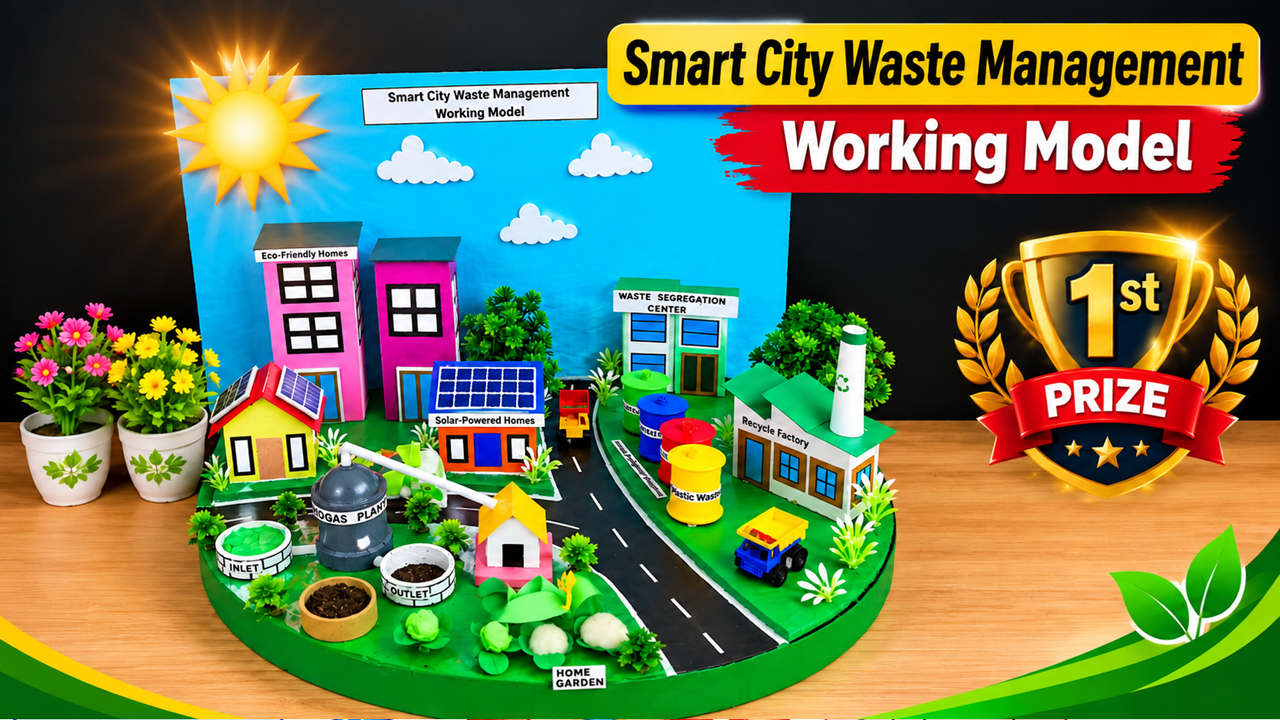
Today, I am going to present my science project, “Smart City Waste Management Working Model.”
Waste management is one of the major challenges faced by modern cities. Every day, homes, schools, markets, offices, and industries produce large amounts of waste. If waste is not collected, separated, and processed properly, it can cause air pollution, water pollution, soil pollution, and health problems.
My model demonstrates how a smart city can manage waste using waste segregation, recycling, biogas production, solar energy, and organic gardening. The main aim is to reduce waste and create a clean, green, and sustainable environment.
2. Aim of the Project
The main objectives of this project are:
- To demonstrate proper waste segregation.
- To explain recycling and reuse of materials.
- To show how biodegradable waste can be converted into biogas and compost.
- To demonstrate the use of solar energy in a smart city.
- To encourage citizens to reduce waste and keep their surroundings clean.
3. Materials Required
The following materials are used to make this model:
- Cardboard sheets for the base, houses, and buildings.
- Green chart paper or foam sheets for parks and gardens.
- Blue chart paper for the background.
- Black paper for roads and white strips for road markings.
- Coloured paper for houses and recycling centres.
- Small plastic containers or cardboard cylinders for waste bins.
- Small boxes for the recycling factory and waste segregation centre.
- A small container to represent a biogas plant.
- A miniature solar panel or cardboard solar-panel model.
- Artificial plants, small trees, and decorative flowers.
- Miniature vehicles and houses.
- Glue, scissors, ruler, markers, and labels.
Optional electrical components can be added to demonstrate solar-powered lights or moving vehicles.
4. Making Process
Step 1: Prepare the base
Take a strong cardboard sheet and cut it into a suitable shape. Cover the top with green paper to represent land. Divide the base into different areas for houses, roads, waste collection, recycling, the biogas plant, and the garden.
Step 2: Make the city background
Create a blue background using chart paper. Add a sun, clouds, and a title board reading “Smart City Waste Management Working Model.” Construct small houses and buildings using cardboard and colourful paper. Label the homes and other important locations.
Step 3: Construct the roads
Cut black chart paper into strips and paste them onto the base to create roads. Add white markings to make the roads look realistic. Place miniature vehicles on the roads to represent waste collection and transportation.
Step 4: Make waste segregation bins
Prepare three or more bins using small containers or cardboard cylinders. Label them according to the waste categories.
- Green bin: Wet and biodegradable waste, such as vegetable peels and food scraps.
- Blue bin: Dry recyclable waste, such as paper, cardboard, and suitable plastic or metal packaging.
- Separate hazardous-waste collection: Batteries, chemicals, and other hazardous items should be kept separate and handled through appropriate collection systems.
Explain that waste segregation at the source makes recycling and safe disposal easier.
Step 5: Build the waste segregation centre
Construct a small building using cardboard and label it “Waste Segregation Centre.” This represents a facility where collected waste is sorted into suitable categories before being sent for recycling, composting, or authorised disposal.
Step 6: Construct the recycling factory
Make a small factory using cardboard boxes. Label it “Recycle Factory.” This facility represents the processing of suitable recyclable materials into new products. For example, waste paper can be processed into recycled paper, and suitable plastics can be processed into new plastic products.
Step 7: Make the biogas plant
Use a small container or cardboard cylinder to represent a biogas plant. Label its inlet and outlet. Explain that biodegradable organic waste can be processed by microorganisms in an oxygen-free environment to produce biogas and digestate. The gas can be used as fuel in suitable systems, while properly treated digestate may be used as a soil amendment.
Step 8: Add solar-powered homes
Create small houses and place miniature solar panels on their roofs. Solar panels convert sunlight into electricity, which can power suitable lights and electrical devices. This represents the use of renewable energy to reduce dependence on conventional electricity sources.
Step 9: Create a home garden
Make a small garden using green paper, artificial plants, and miniature vegetables. Explain that properly prepared compost from suitable organic waste can improve soil quality and support plant growth.
Step 10: Add labels and decorations
Place labels on all important parts, including the solar-powered homes, waste bins, segregation centre, recycling factory, biogas plant, and home garden. Add plants and trees to make the city look green and attractive.
5. Working Principle
The model works on the principle of segregation, recycling, resource recovery, and sustainable energy use.
First, waste is separated at homes into biodegradable waste, recyclable dry waste, and other waste requiring special handling.
Next, biodegradable waste is sent for composting or suitable biogas processing. Recyclable materials are collected and sent to recycling facilities. Residual waste that cannot be recovered safely must be sent to authorised treatment or disposal facilities.
The biogas plant demonstrates how organic waste can be converted into useful fuel under controlled conditions. The solar panels represent the generation of clean electricity from sunlight. Compost produced from suitable organic materials can be used to support the home garden.
Together, these processes reduce the amount of waste sent to landfills and help conserve natural resources.
6. Demonstration at the Exhibition
During the exhibition, I will first show the miniature houses and explain how waste is generated in homes.
Next, I will demonstrate how waste is separated into different bins. I will then explain how recyclable materials travel to the recycling factory and how biodegradable waste can be processed in a biogas plant or composting unit.
After that, I will point to the solar-powered houses and explain how sunlight can be converted into electricity. Finally, I will show the home garden and explain how properly prepared compost can support plant growth.
This demonstration explains how different waste-management methods can work together in a sustainable city.
7. Advantages and Applications
The main advantages of this model are:
- Reduces the amount of waste sent to landfills.
- Encourages recycling and reuse.
- Demonstrates resource recovery from biodegradable waste.
- Explains renewable energy through solar panels.
- Promotes cleaner streets and healthier surroundings.
- Encourages responsible waste disposal and environmental awareness.
- Demonstrates the importance of sustainable city planning.
This concept can be applied in residential communities, schools, apartments, public places, markets, and municipal waste-management systems.
8. Conclusion
To conclude, my Smart City Waste Management Working Model demonstrates how waste segregation, recycling, biogas production, composting, and solar energy can contribute to a cleaner and more sustainable city.
Waste should not always be treated as useless material. When it is properly separated and processed, many resources can be recovered and reused. Every citizen has an important role in keeping the environment clean.
My message is: “Reduce Waste, Reuse Resources, Recycle Materials, and Build a Greener Future.”
Thank you, everyone!
HowToFunda – Learn, Create, and Innovate!