
Introduction
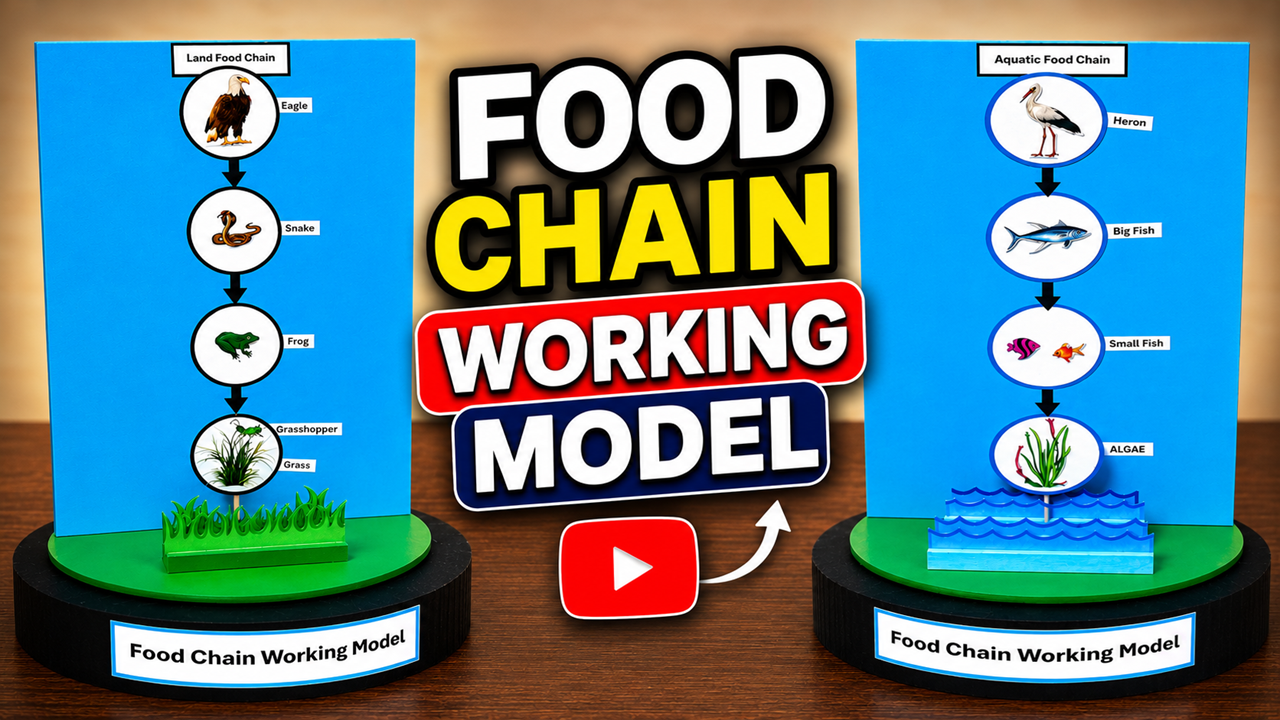
The Food Chain Working Model is an educational science project that demonstrates how energy flows from one living organism to another in nature. Every ecosystem depends on a food chain, where plants produce food using sunlight, herbivores eat plants, and carnivores feed on other animals.
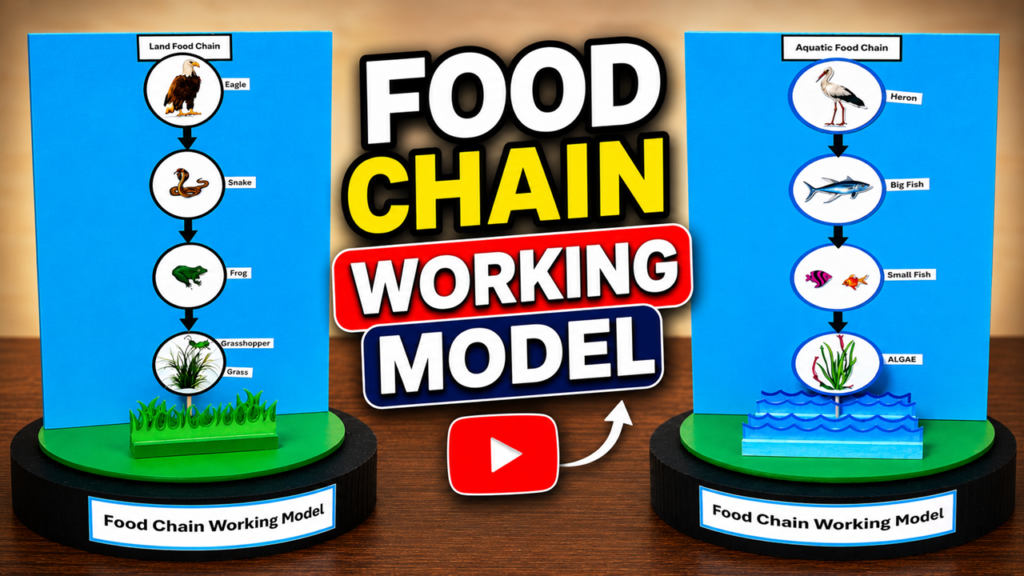
This model displays both the Land Food Chain and the Aquatic Food Chain, helping students understand the balance of nature and the interdependence of living organisms.
This project is ideal for science exhibitions, biology classes, and environmental awareness programs.
Aim
To demonstrate the flow of energy through the Land Food Chain and Aquatic Food Chain using a simple working model.
Objective
- To understand the concept of a food chain.
- To explain how energy is transferred from producers to consumers.
- To compare land and aquatic food chains.
- To understand the importance of ecological balance.
Materials Required
- Thick cardboard or foam board
- Circular cardboard base
- Blue and green chart paper
- White chart paper
- Printed pictures of plants and animals
- Black marker
- Hot glue gun
- Fevicol
- Double-sided tape
- Cutter
- Scale
- Compass
- Colored foam sheets (optional)
- Wooden sticks or cardboard strips
- Labels for organisms
- Decorative grass and wave cut-outs
Theory
A food chain is a sequence of organisms in which each organism obtains food from the one before it. It shows the movement of energy and nutrients through an ecosystem.
Every food chain begins with producers, such as green plants or algae, which prepare their own food through photosynthesis. Herbivores eat the producers, and carnivores feed on herbivores or other carnivores. When organisms die, decomposers break them down and return nutrients to the soil.
Scientific Principle
Sunlight → Producers → Primary Consumers → Secondary Consumers → Tertiary Consumers → Decomposers
Energy decreases at every level because some energy is lost as heat during life processes.
Land Food Chain
Sequence
Grass → Grasshopper → Frog → Snake → Eagle
Explanation
- Grass is the producer and makes food through photosynthesis.
- Grasshopper is the primary consumer that feeds on grass.
- Frog is the secondary consumer that eats insects.
- Snake is the tertiary consumer that feeds on frogs.
- Eagle is the top predator that feeds on snakes.
Aquatic Food Chain
Sequence
Algae → Small Fish → Big Fish → Heron
Explanation
- Algae are the producers in aquatic ecosystems.
- Small Fish feed on algae.
- Big Fish eat smaller fish.
- Heron is the top predator that feeds on big fish.
How to Make the Model
Step 1: Prepare the Base
- Cut two circular cardboard bases.
- Cover them with black chart paper.
- Attach labels:
- Food Chain Working Model
Step 2: Make the Background
Cut two rectangular cardboard sheets.
Cover them using:
- Sky blue chart paper for both models.
Fix them vertically on the bases.
Step 3: Create the Land Food Chain
Print or draw the following pictures:
- Eagle
- Snake
- Frog
- Grasshopper
- Grass
Cut circular frames and paste each picture inside.
Arrange them vertically.
Draw downward arrows between each organism.
Add the heading:
Land Food Chain
Decorate the bottom with artificial grass.
Step 4: Create the Aquatic Food Chain
Print or draw:
- Heron
- Big Fish
- Small Fish
- Algae
Paste them inside circular frames.
Arrange them vertically.
Connect them using arrows.
Add the heading:
Aquatic Food Chain
Decorate the bottom using blue paper waves.
Step 5: Add Labels
Label every organism clearly.
Example:
- Eagle
- Snake
- Frog
- Grasshopper
- Grass
and
- Heron
- Big Fish
- Small Fish
- Algae
Step 6: Final Decoration
- Make arrows bold and easy to follow.
- Ensure pictures are colorful.
- Keep spacing equal.
- Secure all parts firmly with glue.
Working
The model demonstrates how food and energy move through different organisms.
Land Food Chain
- Grass uses sunlight to prepare food.
- Grasshopper eats the grass.
- Frog eats the grasshopper.
- Snake eats the frog.
- Eagle eats the snake.
Aquatic Food Chain
- Algae produce food through photosynthesis.
- Small fish eat algae.
- Big fish eat small fish.
- Heron catches and eats big fish.
The arrows show the direction of energy transfer, moving from producers to consumers.
Scientific Concept
Food chains maintain ecological balance by regulating populations and transferring energy. Producers capture solar energy, which passes through consumers at different trophic levels. Since energy is lost at each stage, higher-level consumers receive less energy than organisms below them. This explains why there are fewer top predators than producers in an ecosystem.
Importance of Food Chains
- Maintains ecological balance.
- Shows energy flow in ecosystems.
- Controls animal populations.
- Helps scientists study biodiversity.
- Demonstrates the interdependence of living organisms.
Advantages
- Easy to understand.
- Attractive visual learning model.
- Low-cost science project.
- Suitable for school exhibitions.
- Helps explain ecosystem relationships.
- Encourages environmental awareness.
Applications
- Science exhibitions
- Biology classes
- Environmental science education
- Nature study projects
- Classroom demonstrations
- Wildlife conservation awareness programs
Conclusion
The Food Chain Working Model is a simple yet effective science project that explains how energy flows through living organisms in both land and aquatic ecosystems.
By illustrating the sequence from producers to top consumers, the model helps students understand ecological balance, biodiversity, and the interdependence of life.
It is an excellent project for school science exhibitions, making complex environmental concepts easy to understand through an attractive and interactive display.