
Introduction
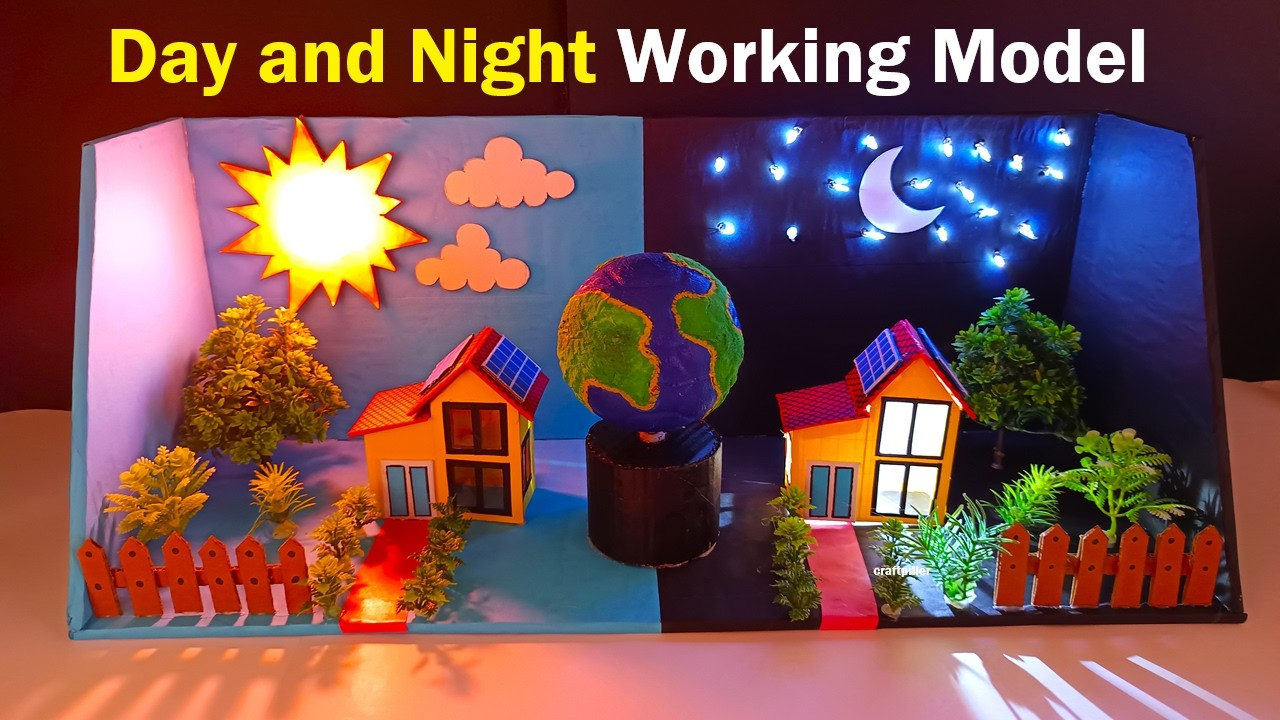
The Day and Night Working Model demonstrates how the Earth rotates on its axis, causing day and night. The side of the Earth facing the Sun experiences daytime, while the opposite side experiences nighttime. This simple working model helps students understand one of the most important natural phenomena in an interactive and attractive way.
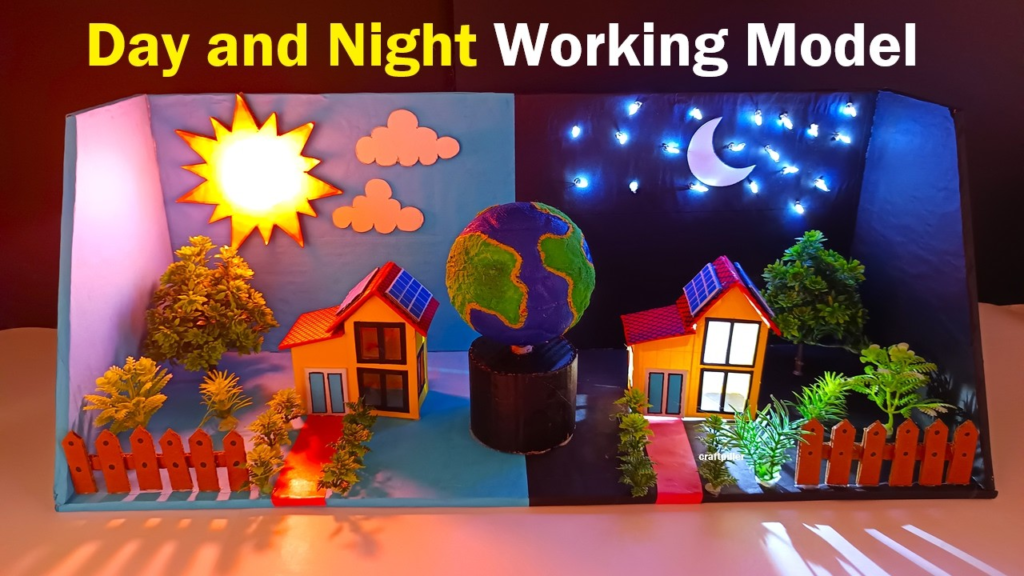
This project is ideal for school science exhibitions, STEM fairs, and classroom demonstrations.
Aim
To demonstrate how the rotation of the Earth causes day and night using a simple working model with lights.
Materials Required
- Cardboard sheets
- Foam board or thermocol sheet
- Colored chart papers (Blue and Black)
- Plastic or thermocol ball (Earth)
- Small model houses
- Artificial plants and trees
- Wooden ice cream sticks (Fence)
- Yellow acrylic sheet or chart paper (Sun)
- White chart paper (Moon and Clouds)
- Blue and White LED lights
- 9V Battery or Power Bank
- LED Strip/Wire LEDs
- DC Motor (Slow RPM)
- Battery Holder
- Switch
- Hot Glue Gun
- Paints
- Cutter
- Scale
- Compass
- Double-sided tape
Theory
The Earth rotates from west to east once every 24 hours.
- The side facing the Sun experiences Day.
- The opposite side experiences Night.
- As the Earth rotates continuously, different places experience sunrise and sunset.
This rotation is responsible for the cycle of day and night.
Working Principle
The model contains:
- A rotating Earth in the center.
- A Day scene on the left.
- A Night scene on the right.
- LED lights represent sunlight and stars.
- A slow-speed motor rotates the Earth continuously.
When the switch is turned ON:
- The motor rotates the Earth.
- Yellow LED lights illuminate the Day side.
- Blue/White LEDs illuminate the Night side.
- The rotating Earth shows how different regions move from day to night.
How to Make the Model
Step 1: Prepare the Base
- Cut a cardboard base.
- Cover the left half with light blue chart paper.
- Cover the right half with black chart paper.
Step 2: Make the Background
Day Side
- Paste a large Sun.
- Add white clouds.
- Decorate with trees.
Night Side
- Paste a Moon.
- Fix small white LEDs as stars.
- Decorate with trees and plants.
Step 3: Build the Houses
- Make two small cardboard houses.
- Paint them.
- Add solar panels using blue paper.
- Place one house on each side.
Step 4: Make the Earth
- Paint a thermocol ball.
- Draw continents.
- Insert a wooden stick through the center.
- Fix it on the motor shaft.
Step 5: Install the Motor
- Fix a slow RPM DC motor below the base.
- Connect it to the Earth.
- Ensure smooth rotation.
Step 6: Install the LEDs
Day Side
- Install Yellow LEDs behind the Sun.
Night Side
- Install White or Blue LEDs behind the stars.
Step 7: Electrical Connections
Connect
Battery → Switch → Motor
Battery → Switch → Day LEDs
Battery → Switch → Night LEDs
Secure all wires using hot glue.
Step 8: Final Decoration
- Add fences.
- Paste artificial grass.
- Arrange trees and plants.
- Hide all wiring neatly.
Working
- Turn ON the switch.
- The LEDs glow.
- The Earth starts rotating slowly.
- Students observe:
- One side facing the Sun has daylight.
- The opposite side experiences night.
- Continuous rotation demonstrates the day-night cycle.
Scientific Concept
The Earth rotates around its own axis.
- Rotation Time = 24 Hours
- Rotation Direction = West to East
- Rotation causes:
- Day
- Night
- Sunrise
- Sunset
- Different time zones
Advantages
- Easy to understand.
- Attractive working model.
- Demonstrates Earth’s rotation clearly.
- Low-cost project.
- Suitable for all school levels.
- Reusable for classroom teaching.
Applications
- Science exhibitions
- Geography classes
- Astronomy demonstrations
- STEM education
- Classroom activities
Learning Outcomes
Students will understand:
- Earth’s rotation
- Day and night formation
- Direction of Earth’s movement
- Importance of sunlight
- Difference between day and night
- Basic astronomy concepts
Precautions
- Fix the motor firmly.
- Use a slow RPM motor for smooth rotation.
- Connect LEDs with the correct polarity.
- Secure all electrical connections.
- Keep wiring hidden for a neat appearance.
- Handle the cutter and hot glue gun carefully.
Conclusion
The Day and Night Working Model is an engaging and educational science project that visually explains how Earth’s rotation creates day and night. By combining a rotating Earth, illuminated Sun and stars, and realistic scenery, the model makes learning fun and easy to understand. It is an excellent project for school science exhibitions, helping students explain an important astronomical concept with confidence.