
Good morning everyone.
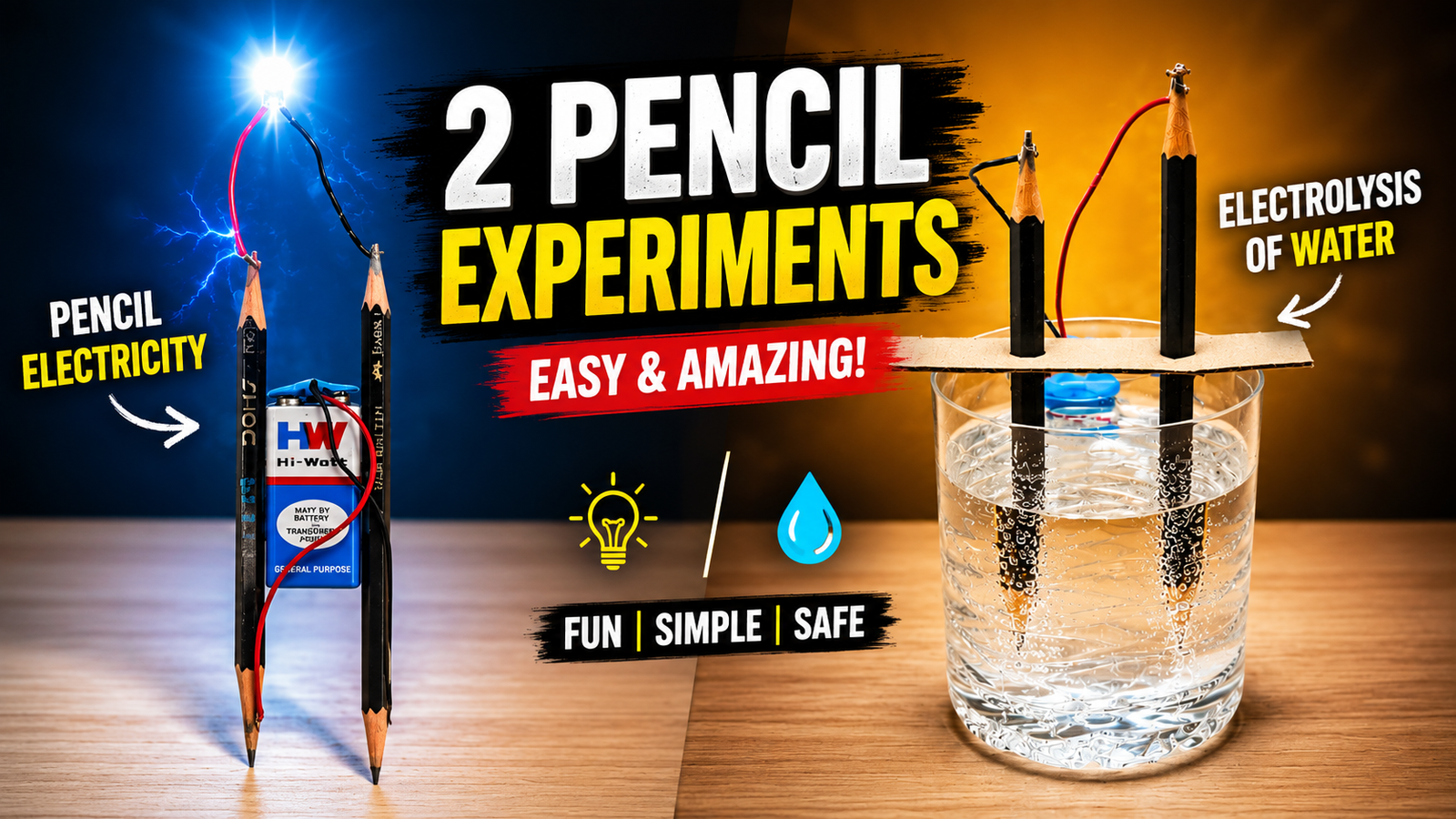
Today I am going to explain my science exhibition project on “2 Pencil Experiments.” These are simple and interesting experiments that demonstrate important scientific concepts using ordinary pencils.
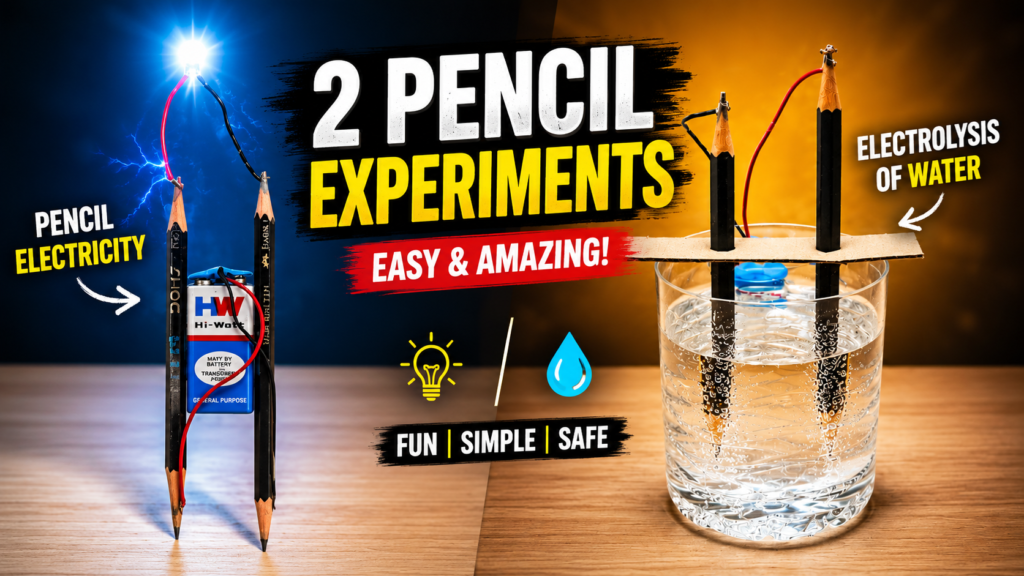
The two experiments are:
- Pencil Electricity Experiment
- Electrolysis of Water Experiment
Both experiments use pencil graphite as a conductor of electricity. Graphite is a form of carbon that allows electric current to pass through it.
These projects are easy, safe, low-cost, and perfect for science exhibitions and STEM learning.
Experiment 1 – Pencil Electricity
Aim of the Experiment
The aim of this experiment is:
- To demonstrate electrical conductivity
- To show how graphite conducts electricity
- To light an LED using pencil graphite
Materials Required
- 2 pencils
- Battery
- LED light
- Connecting wires
- Tape or clips
Explanation of the Experiment
In this setup, two pencils are connected to a battery using wires. The graphite inside the pencils acts as a conductor.
When the electrical circuit is completed:
- Current flows through the graphite
- The LED bulb glows
This proves that graphite can conduct electricity.
Working Principle
This experiment works on the principle of:
Electrical Conductivity
Materials that allow electric current to pass through them are called conductors.
Graphite in pencils is a good conductor because it contains free electrons that carry electricity.
Steps to Perform
Step 1
Sharpen both pencils from both ends.
Step 2
Connect the pencils to the battery using wires.
Step 3
Attach the LED bulb in the circuit.
Step 4
Complete the circuit carefully.
Step 5
Observe the LED glowing.
Scientific Concepts Used
- Electric circuits
- Conductors and insulators
- Graphite conductivity
- Flow of electric current
Real-Life Applications
Graphite is used in:
- Batteries
- Electrodes
- Electrical industries
- Carbon brushes in motors
Experiment 2 – Electrolysis of Water
Aim of the Experiment
The aim of this experiment is:
- To explain electrolysis
- To separate water into gases
- To demonstrate chemical changes using electricity
Materials Required
- 2 pencils
- Glass of water
- Battery
- Wires
- Cardboard support
- Salt or baking soda (optional)
Explanation of the Experiment
In this experiment, two pencils are dipped in water and connected to a battery.
When electricity passes through water:
- Tiny bubbles form around the pencil tips
- Water splits into hydrogen and oxygen gases
This process is called Electrolysis of Water.
Working Principle
This experiment works on:
Electrolysis
Electrolysis is the chemical decomposition of a substance using electricity.
Water contains hydrogen and oxygen. Electric current breaks water molecules into these gases.
Chemical Equation
2H2O→2H2+O2
Steps to Perform
Step 1
Fill a glass with water.
Step 2
Add a little salt or baking soda to improve conductivity.
Step 3
Insert two pencils into the water using cardboard support.
Step 4
Connect the pencils to a battery.
Step 5
Observe bubbles forming around the pencil tips.
Observation
- Hydrogen gas forms at the negative electrode.
- Oxygen gas forms at the positive electrode.
- Small bubbles appear continuously.
Scientific Concepts Used
- Electrolysis
- Chemical reactions
- Conductivity of water
- Electrodes
- Electric current
Advantages of These Experiments
- Easy to perform
- Low-cost materials
- Safe and educational
- Improves practical understanding
- Attractive for exhibitions
Educational Importance
These projects help students:
- Understand electricity concepts
- Learn chemical reactions practically
- Improve scientific thinking
- Develop STEM skills
The experiments combine physics and chemistry in a fun and interactive way.
Safety Precautions
- Use low-voltage batteries only
- Do not touch bare wires
- Perform carefully under supervision
- Avoid short circuits
Conclusion
In conclusion, these 2 Pencil Experiments are simple yet powerful science demonstrations that explain electrical conductivity and electrolysis using everyday materials.
The first experiment shows how graphite conducts electricity, while the second experiment demonstrates how electricity can split water into gases.
These projects are creative, educational, and perfect for science exhibitions because they make science easy to understand through practical activities.