
1. Introduction
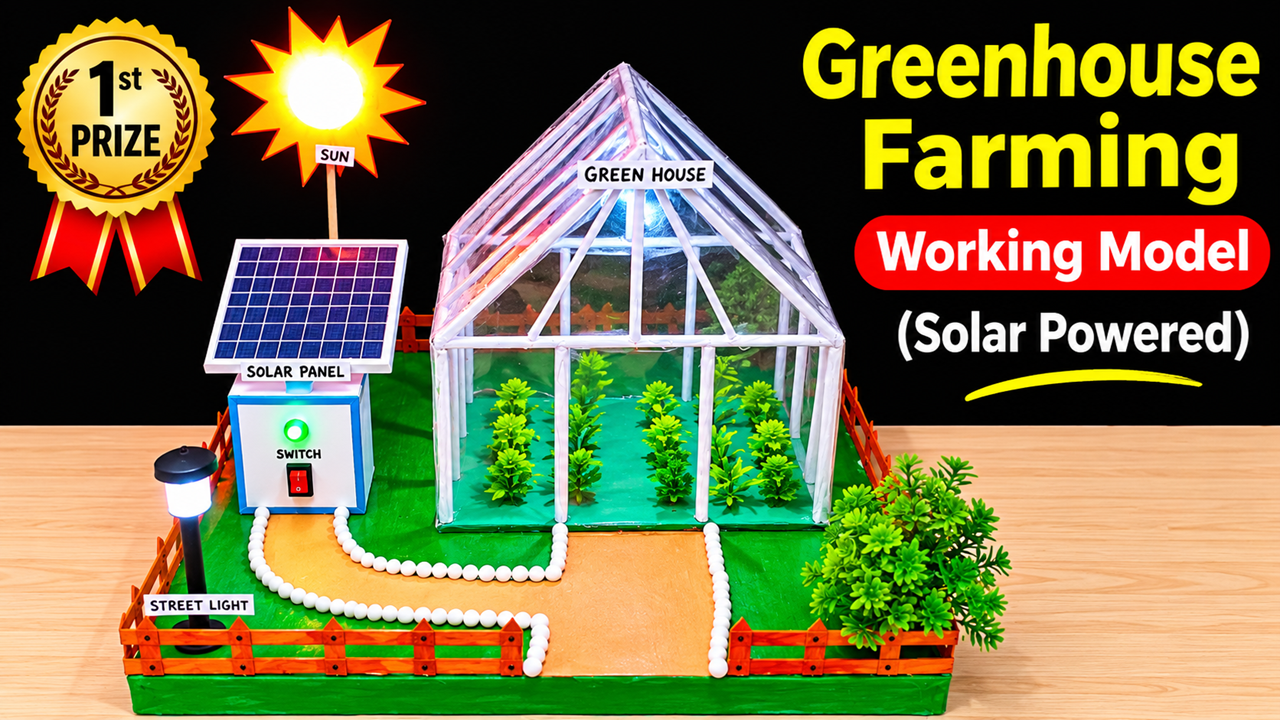
Greenhouse farming is a modern agricultural technique in which plants are grown inside a specially designed structure covered with transparent materials such as plastic sheets, glass or polycarbonate sheets.
The main purpose of greenhouse farming is to create a controlled environment for plants by managing temperature, humidity, sunlight and water. It protects crops from heavy rain, strong winds, insects and extreme weather conditions.
In this project, we demonstrate a solar-powered greenhouse farming system. Solar energy is used to generate electricity for operating small electrical components such as lights and other greenhouse equipment. This model explains how renewable energy and modern agricultural technology can work together to improve farming.
2. Materials Required
To prepare this working model, we need the following materials:
- Large cardboard or thermocol sheet for the base.
- Green colour paper or artificial grass.
- Transparent plastic sheets or clear packaging sheets.
- Ice cream sticks or thin wooden strips.
- White straws or plastic pipes for the greenhouse frame.
- Small artificial plants or handmade paper plants.
- Small solar panel (6V or suitable voltage).
- Rechargeable battery, if energy storage is required.
- Small LED lights.
- DC wires and connecting cables.
- ON/OFF switch.
- Small DC fan (optional).
- Small DC water pump (optional).
- Small garden light or LED streetlight.
- Red, brown and yellow colour papers.
- Glue gun, scissors, cutter and adhesive tape.
- Small decorative trees and fencing materials.
3. How to Make the Model
Step 1: Prepare the Base
Take a large rectangular cardboard or thermocol sheet. Cover the entire surface with green colour paper or artificial grass to represent agricultural land. Create a small pathway using yellow or brown chart paper. Make a boundary fence using ice cream sticks or cardboard strips.
Step 2: Construct the Greenhouse Frame
Take thin wooden sticks, straws or plastic pipes. First, make a rectangular frame using these materials. Fix four vertical supports at the corners and connect them horizontally. Now create a sloping roof by joining the upper supports to form a triangular or pyramid-shaped structure.
Make sure the frame is strong enough to support the transparent covering.
Step 3: Cover the Greenhouse
Take transparent plastic sheets and cover the sides and roof of the structure. Use glue or transparent tape to fix the sheets properly.
Leave a small opening to represent the greenhouse entrance. The transparent covering allows sunlight to enter and helps maintain a suitable growing environment inside the greenhouse.
Step 4: Prepare the Agricultural Area
Place small artificial plants or handmade paper plants inside the greenhouse. Arrange them in neat rows to represent crop cultivation. You can also use small containers filled with soil and grow real seedlings for a more realistic demonstration.
Step 5: Install the Solar Panel
Take a small solar panel and fix it on a cardboard stand near the greenhouse. Position it towards the sunlight. Connect the positive and negative terminals of the solar panel to the electrical circuit.
Step 6: Connect the Electrical Components
Connect the solar panel to a suitable rechargeable battery or solar charge controller if energy storage is required. Connect the output to an ON/OFF switch and then to the LED lights.
You can also connect a small DC fan for ventilation or a small water pump for irrigation, provided the solar panel and power supply are suitable for the load.
Step 7: Install the Streetlight
Place a small LED streetlight near the pathway. Connect it to the solar-powered electrical circuit. Add a switch to demonstrate how solar electricity can operate lighting.
Step 8: Add Final Decorations
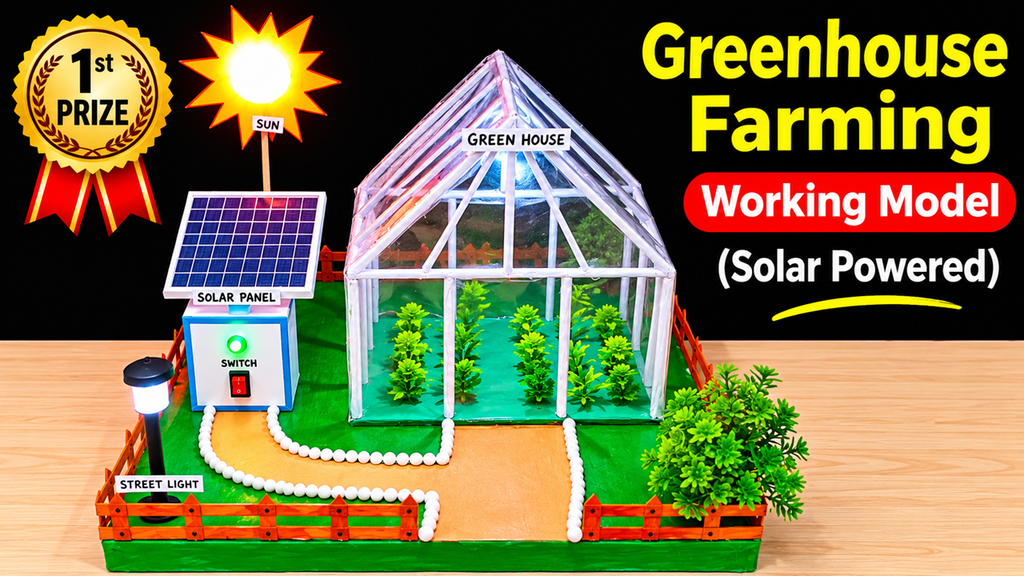
Place small trees, fencing, pathways and garden areas around the greenhouse. Add labels such as SOLAR PANEL, GREENHOUSE, SWITCH, SUN and STREET LIGHT. Your solar-powered greenhouse farming working model is now ready.
4. How Does the Working Model Work?
The working process begins with sunlight falling on the solar panel.
The solar panel contains photovoltaic cells that convert sunlight directly into electrical energy.
This electricity can be used to operate different electrical components in the greenhouse.
When we switch ON the system, electrical energy flows from the solar panel or battery to the connected LED lights.
The lights glow and demonstrate how solar energy can provide electricity for greenhouse operations.
If we connect a small DC fan, it can circulate air inside the greenhouse. Proper ventilation helps control temperature and humidity.
Similarly, a small DC water pump can be used to demonstrate an automatic or controlled irrigation system. Water can be supplied to the plants through small pipes.
The transparent greenhouse covering allows sunlight to enter. Some of the solar energy is absorbed by the soil, plants and internal surfaces and converted into heat. The covering helps reduce heat loss and creates a warmer environment, although proper ventilation is necessary to prevent overheating.
Therefore, greenhouse farming helps farmers grow crops in a more controlled environment, while solar energy can reduce dependence on conventional electricity.
5. Applications of Greenhouse Farming
- Growing vegetables such as tomatoes, capsicum and cucumbers.
- Growing flowers and ornamental plants.
- Cultivating crops throughout different seasons.
- Protecting plants from heavy rain and strong winds.
- Growing high-value agricultural crops.
- Raising seedlings in nurseries.
- Supporting modern and precision agriculture.
- Using solar energy for irrigation and ventilation.
6. Advantages of This Project
- Protects crops from unfavourable weather conditions.
- Helps maintain a controlled growing environment.
- Supports year-round cultivation of suitable crops.
- Demonstrates renewable energy applications in agriculture.
- Can reduce conventional electricity consumption.
- Helps improve water management when combined with drip irrigation.
- Encourages sustainable and modern farming practices.
7. Conclusion
Our Solar-Powered Greenhouse Farming Working Model demonstrates how modern agricultural technology and renewable energy can be combined to improve farming.
Greenhouse structures help protect plants and create suitable growing conditions. Solar panels generate clean electricity that can operate lights, fans and water pumps.
This technology can help farmers improve crop management, conserve resources and reduce their dependence on conventional energy sources.
In the future, greenhouse farming can become an important part of sustainable agriculture, especially when combined with solar power, smart sensors, automatic irrigation and temperature control.
Our message is: SAVE ENERGY, GROW MORE FOOD AND SUPPORT SMART FARMING!
8. Science Exhibition – Short Presentation Script
Good morning, respected judges, teachers and my dear friends.
My project name is Solar-Powered Greenhouse Farming Working Model.
Greenhouse farming is a modern agricultural method in which plants are grown inside a transparent structure. It helps protect crops from extreme weather conditions and creates a suitable environment for plant growth.
In our model, we have constructed a greenhouse using transparent plastic sheets and supporting frames.
Here, we have installed a solar panel that converts sunlight into electrical energy.
When I switch ON the system, the electricity generated by the solar panel operates the LED lights. We can also connect a small fan and water pump to demonstrate ventilation and irrigation.
The transparent roof allows sunlight to enter and helps maintain warmth inside the greenhouse. Farmers can use this technology to grow vegetables, flowers and other crops under controlled conditions.
The biggest advantage is that we can use renewable solar energy to support agricultural activities and reduce electricity consumption.
My message is: SOLAR ENERGY + SMART FARMING = A BETTER AGRICULTURAL FUTURE!
Thank you!