
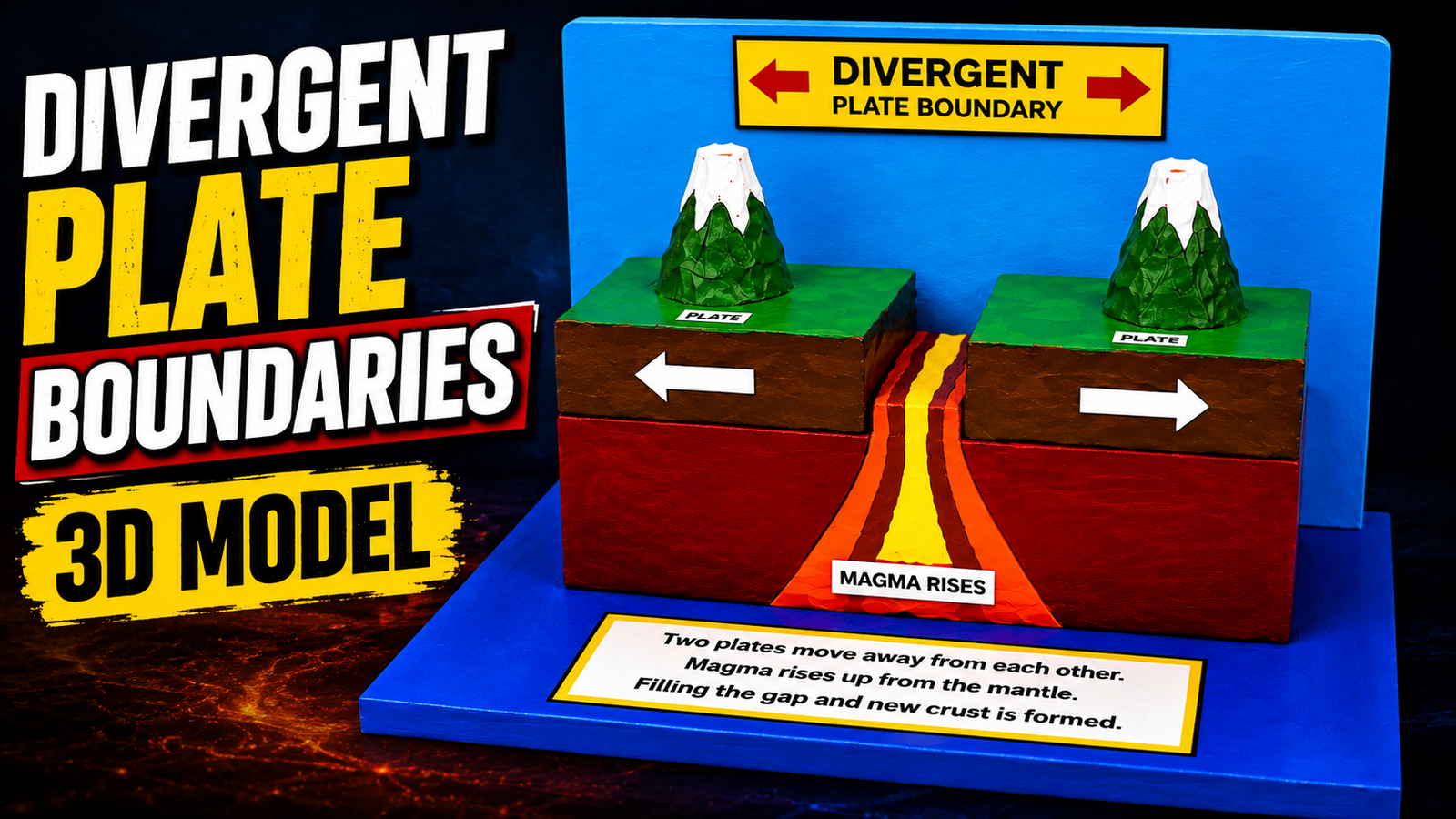
A Divergent Plate Boundary 3D Model is an excellent geography and earth science working model for a school science exhibition. This creative DIY project demonstrates what happens when two tectonic plates move away from each other and magma rises from the Earth’s mantle to form new crust.
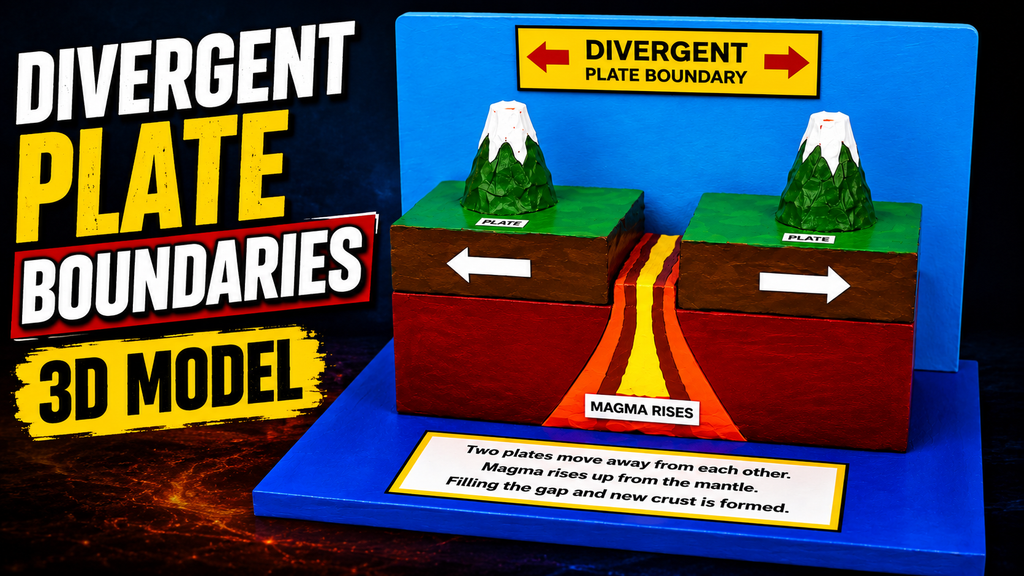
The model makes the concept of plate tectonics easy to understand because students can visually show the movement of two plates, the rising of magma, and the formation of new crust.
What is a Divergent Plate Boundary?
A divergent plate boundary is a location where two tectonic plates move away from each other.
As the plates separate, a gap develops between them. Hot material from the Earth’s mantle rises toward the surface through this opening. When the magma cools and solidifies, it forms new crust.
The basic process can be represented as:
Two Plates Move Apart → Magma Rises → Magma Cools → New Crust Forms
Divergent boundaries are commonly associated with mid-ocean ridges in oceans and rift valleys on continents.
Materials Required
To make a model similar to the one shown, you can use:
- Cardboard or foam board
- Thermocol sheets
- Green craft paper
- Brown and red chart paper
- Orange and yellow paper
- Clay or modelling material
- Glue
- Scissors
- Paint
- Wooden sticks
- Marker pens
- Small artificial mountains or clay volcano shapes
- White paper for labels
The project can be made using inexpensive materials, making it suitable for students.
How to Make the Model
Start by preparing a strong rectangular base using cardboard or foam board. Cover the base with blue or green paper to represent the Earth’s surface.
Create two separate blocks to represent the tectonic plates. Place them with a clear gap between them. The arrows on the two blocks should point away from each other to clearly demonstrate plate movement.
Use brown material on the sides of the blocks to represent the Earth’s crust and green material on top to represent the land surface.
In the centre, create a vertical opening between the two plates. Use orange and yellow paper or clay to represent hot magma rising from below.
You can add mountains on the top of each plate to make the model visually attractive.
Finally, add labels such as:
- Divergent Plate Boundary
- Plate
- Magma Rises
- New Crust
- Plates Move Apart
How Does the Model Work?
The model demonstrates the movement of tectonic plates.
The two blocks represent separate tectonic plates. The arrows show that they are moving away from one another.
As the plates separate, magma from beneath the crust rises into the space created between them. When this magma reaches cooler surroundings, it gradually cools and solidifies.
Over time, repeated magma movement can create new oceanic crust.
This process is called seafloor spreading when it occurs at an oceanic divergent boundary.
Science Behind the Model
The Earth’s outer rigid layer is divided into large tectonic plates. These plates move slowly over the underlying hotter, weaker part of the Earth’s mantle.
At divergent boundaries, the plates move apart.
The rising magma is supplied by material from the mantle. As it cools, it becomes solid rock and contributes to the formation of new crust.
One of the best-known examples is the Mid-Atlantic Ridge, a long underwater mountain system where new oceanic crust is continuously formed as plates separate.
On continents, divergence can produce rift zones. If continental rifting continues for a very long period, it can eventually contribute to the formation of a new ocean basin.
Why Is This Project Useful?
This 3D model helps students understand an otherwise difficult geological process. Instead of simply memorizing the definition of a divergent boundary, students can demonstrate:
Plate movement + Magma movement + New crust formation
It is particularly useful for a geography project, earth science exhibition, STEM activity, or school working model.
Advantages
- Easy to understand
- Low-cost DIY project
- Attractive 3D presentation
- Suitable for science exhibitions
- Demonstrates plate tectonics visually
- Helps explain seafloor spreading
- Can be made using recycled materials
- Easy for students to present
Exhibition Explanation
A student can explain the model like this:
“This is a model of a divergent plate boundary. Here, two tectonic plates are moving away from each other. As they separate, a gap is formed between them. Hot magma from the Earth’s mantle rises through this gap. When the magma cools and solidifies, it forms new crust. This process is especially important at mid-ocean ridges and is called seafloor spreading.”
Conclusion
The Divergent Plate Boundaries 3D Model is a simple yet effective way to demonstrate one of the important processes of plate tectonics. The model clearly shows two plates moving apart, magma rising from the mantle, and new crust forming between them.
By building this DIY model, students can learn about Earth’s dynamic structure while developing creativity, scientific thinking, and presentation skills. It is an excellent choice for a school science exhibition or geography working model.