
Introduction
Water is one of the most important natural resources on Earth. All living organisms—humans, animals, and plants—depend on water for survival. However, in many parts of the world, water scarcity is becoming a major problem.
Rapid population growth, climate change, urbanisation, and overuse of groundwater have increased pressure on our water resources. Therefore, we need advanced water management systems that help us use water more efficiently and sustainably.
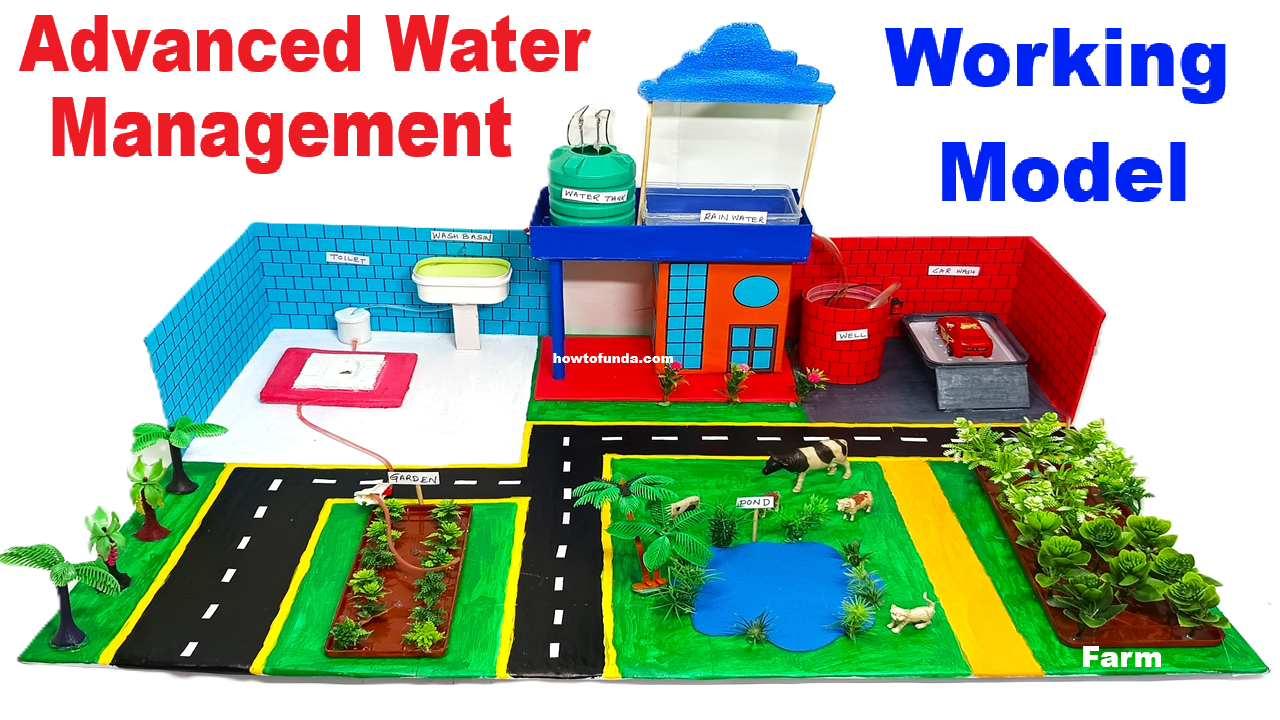
An Advanced Water Management Working Model shows how modern technology and smart methods can be used to collect, store, purify, distribute, conserve, and recycle water.

This model is designed in a simple way so that high school students can easily understand how a real-world water management system works.
Concept of Advanced Water Management
Advanced water management means using smart techniques and technology to reduce water wastage and increase water efficiency. Unlike traditional methods, advanced systems use:
- Sensors
- Automatic pumps
- Rainwater harvesting
- Filtration units
- Greywater recycling
- Leak detection devices
- Solar power
These features help create a sustainable water cycle for homes, schools, industries, and even entire cities.
Main Components of the Working Model
Your model will include the following sections:
1. Water Source
This is the starting point of the system. You can represent a river, lake, or borewell using a small plastic container. Water from this source enters the system for treatment and distribution.
2. Rainwater Harvesting Unit
This is one of the most important parts of modern water management.
It consists of:
- A small roof made from cardboard
- A pipe that carries water into a storage tank
- A first-flush filter to remove dust and leaves
Rainwater harvesting helps reduce dependence on groundwater.
3. Water Treatment & Filtration Plant
Before water can be used, it needs to be cleaned. A simple treatment plant in the model can have three chambers:
- Sedimentation tank – mud and heavy particles settle down.
- Filtration tank – gravel, sand, and charcoal remove impurities.
- Disinfection chamber – water is made safe for use (symbolic in the model).
This part explains how clean and safe water is produced.
4. Automated Pumping System
A modern water system uses pumps to move water from the ground to a storage tank.
In the working model:
- A mini motor pump
- Pipes to carry water
- A small battery
can be used to demonstrate how water is pushed to the overhead tank.
5. Overhead Storage Tank
This tank stores the treated water at a height.
Due to gravity, water naturally flows down to homes, schools, or farms without wasting energy.
A plastic bottle placed on a stand works well for this part.
6. Smart Distribution Network
Pipelines carry water from the tank to houses and buildings.
You can show:
- Main pipeline
- Branch pipelines
- Valves
- Small model houses
Advanced systems also include pressure management valves to maintain the right speed and flow.
7. Greywater Recycling Unit
Greywater is the wastewater from sinks, washbasins, and bathrooms.
This water is not dirty like sewage and can be reused after simple treatment.
Your model can include:
- A small chamber
- Cotton + gravel filter
- Storage tank for reused water
Recycled water can be used for gardening and cleaning.
8. Leak Detection System (Modern Feature)
Modern cities use sensors to detect leaks in pipes.
You can show this with:
- A moisture sensor
- LED light or buzzer
If water leaks, the buzzer beeps.
This helps save huge amounts of water.
9. Smart Water Metering
Smart water meters measure how much water a household uses. In the model, you can make a simple cardboard meter with a moving pointer or use a small display if available.
10. Solar Power Support
Using solar panels to run pumps saves electricity and makes the system eco-friendly.
In your model, you can show a small solar panel symbol or use a mini solar cell.
How the Model Works (Working Principle)
Water enters the system either from a natural source or rainwater harvesting unit.
- It passes through sedimentation, where heavy particles settle down.
- The water moves to the filtration chamber, where sand, gravel, and charcoal clean the water.
- Filtered water is then disinfected and stored temporarily.
- A pump moves this clean water to the overhead storage tank.
- Through gravity, the water flows down through the distribution network.
- Sensors in the system detect if the tank is full, if there is leakage, or if pressure is low.
- Used water from sinks (greywater) enters a recycling filter unit.
- Cleaned greywater is stored and reused for gardening or flushing.
- Solar power can be used to support the pump or sensors.
Through these steps, the system ensures that every drop of water is collected, treated, used wisely, and reused whenever possible.
Advantages of the Advanced Water Management Model
- Reduces water wastage
- Saves groundwater
- Ensures clean and safe water
- Encourages recycling and reuse
- Helps in detecting leaks early
- Uses renewable solar energy
- Shows real-life technology in a simple way
- Teaches students about sustainability
- Can be applied in schools, homes, and cities