
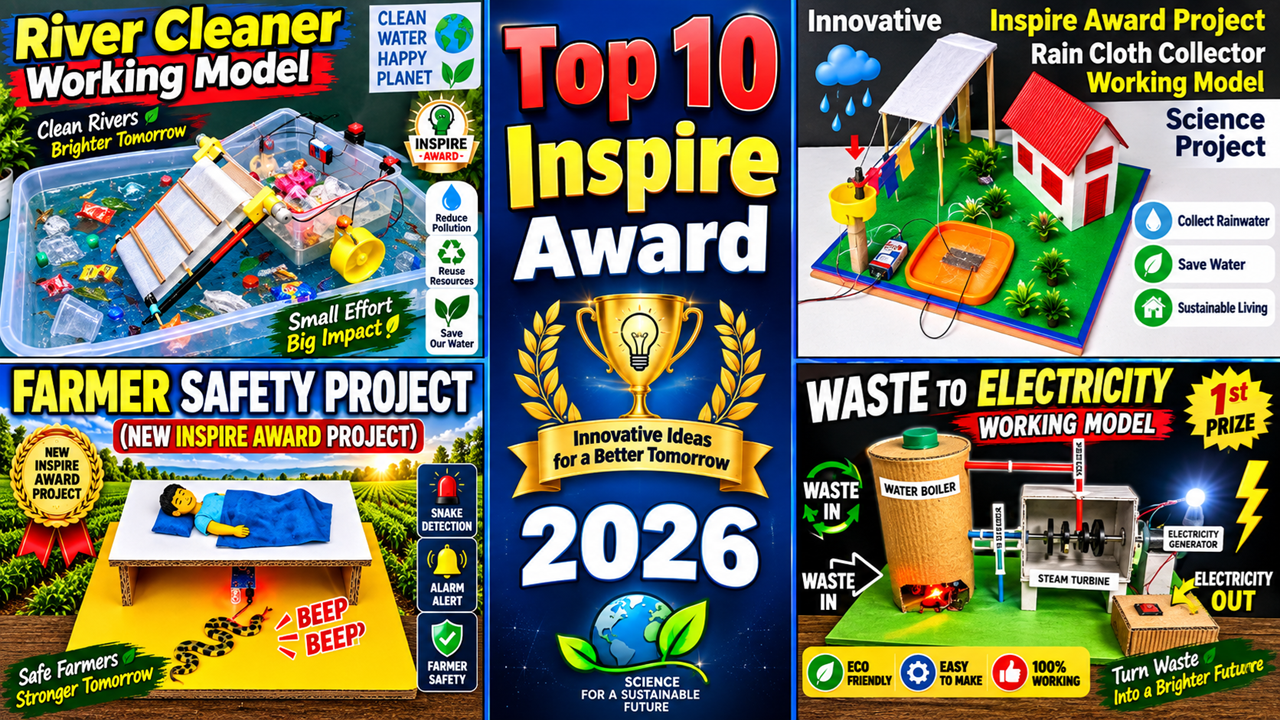
Are you searching for creative, innovative and award-winning INSPIRE Award project ideas that can actually be useful to people? A successful science exhibition project should not simply be a decorative model. The best projects identify a real-life problem, develop an affordable solution and demonstrate that solution through a working prototype.
For students preparing for INSPIRE Awards, school science exhibitions and innovation competitions, practical projects related to farmers, disaster management, transportation, renewable energy, pollution control and environmental protection can provide excellent opportunities to demonstrate creativity.
DIY Pandit brings you these Top 10 INSPIRE Award project ideas, along with one additional bonus idea. These projects can be developed using simple materials such as cardboard, colour paper, plastic bottles, tubes, small DC motors, pumps, sensors, LEDs, Arduino boards and other low-cost components.
1. Rain Detector – Automatic Cloth Collector
Rain Detector – Cloth Collect Project
Sudden rain can spoil clothes that have been placed outside for drying. This project provides a simple and practical solution: automatically detect rain and move the clothes to a protected location.
A rain sensor detects water droplets. Once rain is detected, the sensor can send a signal to a controller, which activates a small motor. The motor can pull a clothesline, move a tray or close a protective roof.
This is an excellent exhibition project because its operation can be demonstrated in real time. The student can simply place a few drops of water on the rain sensor and show the automatic movement.
Innovation: Add a rechargeable battery or solar panel so that the system can operate independently.
Social benefit: Protects clothes, saves time and reduces the need for constant monitoring.
2. Farmer Safety from Snakes
Farmer Safety from Snakes Project
Farmers and agricultural workers may encounter snakes while working in fields, especially around vegetation, stored materials and irrigation areas. A science project addressing this problem can focus on early detection and warning rather than harming or killing snakes.
A model can demonstrate a sensor-based warning system that detects movement or the presence of an object in a designated area and activates a buzzer or warning light.
The system could be placed near farm paths, storage areas or other locations where accidental encounters may occur.
Innovation: Combine motion detection with an alarm and a flashing warning light.
Social benefit: Provides an early warning mechanism that can encourage people to move away from a potentially dangerous area.
3. Hydraulic Brakes
Hydraulic Brakes Working Model
Hydraulic braking is an excellent physics and engineering topic for a science exhibition. The project demonstrates how pressure applied to a fluid can transmit force.
A simple working model can use syringes, transparent tubes and water to demonstrate the principle. When one syringe is pressed, hydraulic pressure moves another piston, representing the operation of a braking system.
Students can connect the demonstration to automobiles and explain why reliable braking systems are important for road safety.
Innovation: Create a miniature vehicle with hydraulic brakes and demonstrate stopping action.
Social benefit: Helps visitors understand an important technology that contributes to vehicle safety.
4. Hydroelectricity Working Model
Hydroelectricity Working Model
Hydroelectric power demonstrates how the energy of moving water can be converted into electrical energy.
A miniature dam, reservoir, water channel and turbine can be constructed from cardboard and other inexpensive materials. Water flowing through the channel rotates a small turbine connected to a generator, which can illuminate an LED.
This is a visually attractive working model because the movement of water and turbine can be clearly seen.
Innovation: Add a water-storage tank and demonstrate how controlled water flow affects the turbine.
Social benefit: Introduces students to renewable electricity generation and the importance of using natural energy resources efficiently.
5. Thermal Electricity Working Model
Thermal energy can be converted into electrical energy using suitable thermoelectric technology. A school project can demonstrate this concept without using dangerous high-temperature equipment.
A thermoelectric module can be placed between a warm surface and a cooler surface. The temperature difference can produce a small electrical output capable of powering an LED or other low-power demonstration.
Students can explain the relationship between temperature difference and electrical generation.
Innovation: Demonstrate how waste heat from certain processes could potentially be recovered for useful low-power applications.
Social benefit: Encourages students to think about energy conservation and recovery of otherwise wasted energy.
6. Carbon Absorption – Smoke Purification
Carbon Absorption – Smoke Purification Project
Air pollution is a major environmental challenge. A smoke-purification demonstration can show how polluted air may be passed through different treatment stages.
The model can include a small fan, transparent chambers and demonstration filter materials. Smoke or another safe visual substitute can be used only under appropriate supervision to demonstrate movement through the system.
Students should explain that different pollutants require different control technologies and that a small exhibition prototype cannot represent complete industrial-scale pollution control.
Innovation: Add an air-quality sensor to demonstrate changes in measured air conditions.
Social benefit: Creates awareness about air pollution and pollution-control technologies.
7. Flood Water Pumping from Basement
Flood Water Pumping from Basement Project
Urban flooding can cause water to accumulate in basements, underground parking areas and low-lying buildings. Removing water quickly can help reduce damage and improve safety.
This project can demonstrate an automatic drainage pump. A miniature basement is filled with water, and a water-level sensor detects when the level rises. The pump then removes water into a separate storage area.
This is an excellent working model because judges can immediately see the problem and solution.
Innovation: Use multiple water-level thresholds—for example, warning at low level and automatic pumping at a higher level.
Social benefit: Demonstrates a practical approach to managing unwanted water accumulation.
8. Crop Protection from Animals
Crop Protection from Animals Project
Animals entering agricultural fields can damage crops and cause financial losses for farmers. Instead of using harmful methods, students can design a humane crop-protection system.
A model field can contain a motion sensor. When movement is detected, the system can activate a flashing light, buzzer or other non-harmful deterrent.
The system can be designed to operate only when movement is detected, helping reduce unnecessary power consumption.
Innovation: Add solar power and an automatic day/night mode.
Social benefit: Helps farmers protect crops while promoting safer and more responsible wildlife management.
9. Automatic Cloth Protection from Rainwater
Cloth Protection from Rain Water Project
This project addresses the same everyday problem of sudden rainfall but can be designed as a different mechanism. Instead of moving the clothes, the system can automatically deploy a protective canopy.
A rain sensor detects the first drops of rain and activates a motor. The motor extends a lightweight roof over the drying area. When the weather becomes dry, the roof can return to its original position.
Innovation: Add a manual override switch so users can open or close the roof whenever required.
Social benefit: Provides a low-cost automation solution for households and small businesses.
10. River Cleaning Working Model
Plastic bottles, floating waste and other debris can pollute rivers and waterways. A river-cleaning model can demonstrate how floating waste can be collected before it travels further downstream.
A miniature river can be created using a large tray. A conveyor belt, rotating collection wheel or floating barrier can guide waste toward a collection container.
The model can be made highly interactive by adding a small DC motor to move the collection mechanism.
Innovation: Combine floating barriers with an automatic conveyor system powered by solar energy.
Social benefit: Promotes awareness about plastic pollution and responsible waste management.
Bonus Project: Automatic Agriculture Crop Protection – Anti-Bird System
Automatic Agriculture Crop Protection Anti Birds System Project
Birds can sometimes damage seeds, fruits and ripening crops. A smart crop-protection system can use sensors to detect activity and activate a non-harmful deterrent.
A miniature farm can include a motion sensor, warning light, buzzer or moving visual deterrent. The system can remain inactive when there is no detected activity, helping conserve energy.
Innovation: Combine motion detection, solar power and automatic activation into a single system.
Social benefit: Helps demonstrate how farmers can use automation to reduce crop losses without relying on harmful methods.
Final Thoughts
These Top 10 INSPIRE Award project ideas from DIY Pandit, along with the bonus anti-bird crop-protection concept, cover important areas including farmer safety, agriculture, renewable energy, flood management, pollution control, transportation safety and environmental protection.
Hashtags
#top10 #inspireawardproject #scienceexhibition #awardwinning #diypandit #bestproject #inspireprojectideas #inspireaward #workingmodel #scienceproject #schoolproject #innovation #studentinnovation #scienceexhibitionideas #firstprize #creativeproject #usefulproject #agricultureproject #environmentalproject #technologyproject