
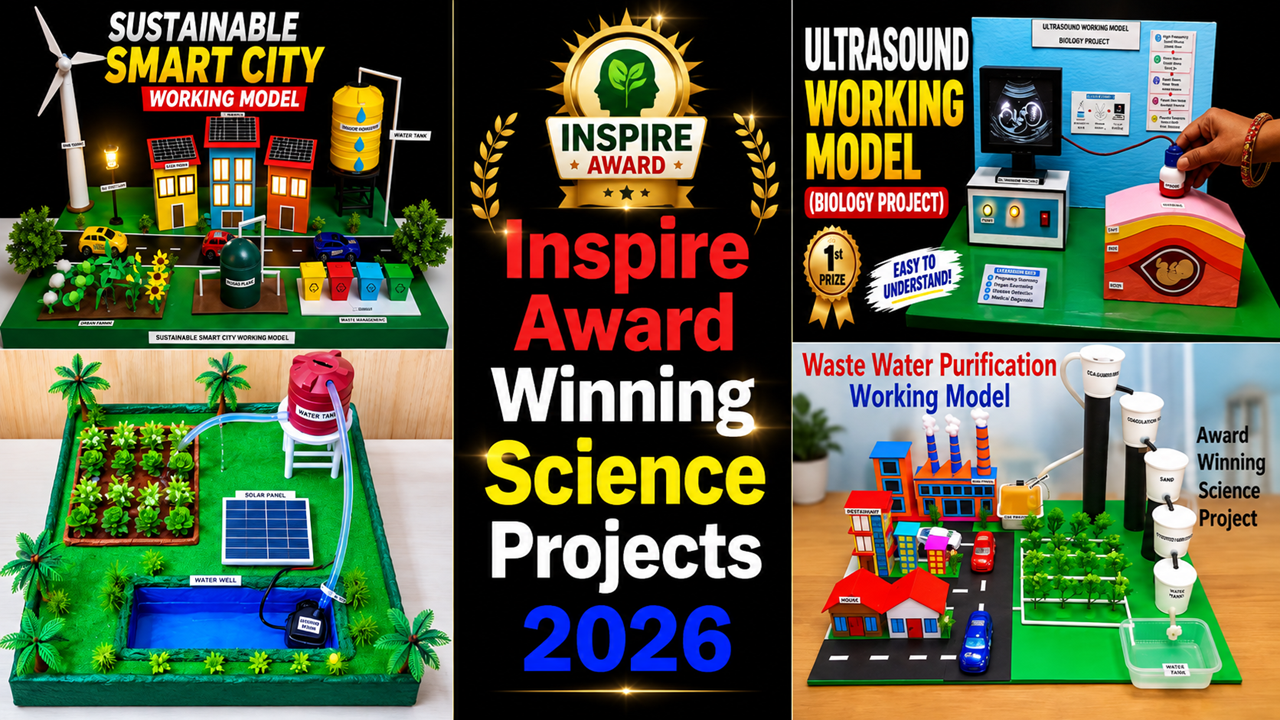
Are you looking for creative, innovative and award-winning INSPIRE Award project ideas for your next school science exhibition? A successful science exhibition project should do more than look attractive—it should identify a real-world problem and demonstrate a practical solution through a working model.
For students preparing for INSPIRE Awards, science exhibitions, school-level competitions and innovation fairs, working projects involving sensors, motors, pumps, renewable energy, healthcare and environmental protection can make a strong impression. Craftpiller presents these Top 10 INSPIRE Award project ideas that combine science, technology, creativity and social usefulness.
The following projects can also be adapted using affordable materials such as cardboard, colour paper, plastic containers, LEDs, Arduino boards, sensors, small DC motors, pumps and simple electronic components.
1. Rain Detector and Automatic Cloth Collector
Rain Detector and Cloth Collector Project – Craftpiller
Imagine leaving clothes outside to dry and suddenly it starts raining. Instead of running outside to collect them, an automatic system can detect rainfall and protect the clothes.
This project uses a rain sensor to detect water droplets. When rain is detected, the sensor sends a signal to a controller, which activates a motor. The motor can pull the clothes under a protective roof or move a drying rack to a covered area.
The model is simple but highly practical for homes, hostels, farms and other places where clothes or materials are dried outdoors.
Innovation: The project can be enhanced with a moisture sensor, automatic roof, buzzer or rechargeable solar power.
2. Carbon Purification Working Model
Carbon Purification Working Model – Craftpiller
Air pollution is one of the major environmental challenges facing modern society. A carbon purification working model can demonstrate the basic concept of treating polluted air before it reaches the atmosphere.
The model can be designed with several chambers representing different purification stages. A small fan moves air through the system, while demonstration filter materials represent pollution-control stages.
Students can explain how industrial and vehicle emissions contribute to air pollution and how filtration and treatment technologies can reduce certain pollutants.
Innovation: Add an air-quality sensor and LED indicators to show different air-quality conditions.
The important point is to explain that a school prototype demonstrates the principle of air purification and is not equivalent to a full-scale industrial pollution-control system.
3. Solar-Powered Irrigation Working Model
Solar Powered Irrigation Working Model – Craftpiller
Agriculture requires large amounts of water and electricity. A solar-powered irrigation system combines renewable energy with smart water management.
Solar panels generate electricity that can power a small water pump. Water can be transferred from a storage tank to miniature crop fields through pipes. Students can add a soil-moisture sensor so that irrigation occurs only when the soil becomes dry.
This makes the project particularly useful for demonstrating how technology can help farmers save water, reduce electricity consumption and automate irrigation.
Innovation: Combine solar power, soil-moisture sensing, automatic pumping and rain detection in one system.
4. Sustainable City Working Model
Sustainable City Working Model – Craftpiller
A sustainable city model can demonstrate how future cities can use resources more efficiently while reducing pollution.
The model can include solar-powered buildings, rainwater harvesting, waste segregation, electric vehicles, green spaces, smart streetlights and water recycling.
Instead of making only a decorative city, students can make each component functional. For example, a water-level sensor can control a pump, solar panels can illuminate streetlights, and separate waste bins can demonstrate waste segregation.
Innovation: Create two sections—an ordinary city and a sustainable smart city—to visually compare resource use and environmental impact.
This type of model allows students to combine multiple scientific concepts into one exhibition project.
5. Renewable Energy Working Model
Renewable Energy Working Model – Craftpiller
Renewable energy is an excellent topic for a science exhibition because it addresses energy security and environmental sustainability.
A working model can combine solar and wind energy. Solar panels generate electricity from light, while a small wind turbine can generate electricity when its blades rotate.
The generated electricity can be used to power LEDs representing homes or streetlights.
Students can explain the difference between renewable and non-renewable energy and show how combining multiple energy sources can provide a more resilient energy system.
Innovation: Build a hybrid controller that automatically selects available solar or wind power and stores excess energy in a rechargeable battery.
6. Artificial Kidney Working Model
Artificial Kidney Working Model – Craftpiller
The human kidney performs several important functions, including filtering waste products from the blood and helping maintain the body’s fluid and chemical balance.
An artificial kidney model can demonstrate the basic concept of filtration using tubes, containers, membranes or suitable classroom-safe materials.
The model can visually show how a fluid mixture enters the system, passes through a filtering stage and produces a separated output.
This project is excellent for students interested in biology, human anatomy and biomedical engineering.
Innovation: Use transparent chambers and coloured liquids to make the filtration process easy for judges and visitors to observe.
7. Waste Water Purification Working Model
Waste Water Purification Working Model – Craftpiller
Water pollution is a serious environmental problem. A wastewater purification model can demonstrate how contaminated water can pass through multiple treatment stages.
The model can include screening, sedimentation, filtration and other demonstration stages. Different containers can show how water changes as it moves through the treatment process.
Students can explain that real wastewater-treatment plants use sophisticated physical, biological and chemical processes, while the exhibition model demonstrates the basic principles.
Innovation: Add a turbidity sensor to compare water quality before and after the demonstration treatment.
8. Ultrasound Machine Working Model
Ultrasound Machine Working Model – Craftpiller
Ultrasound technology is widely used in medical imaging. A school model can explain how high-frequency sound waves are used to obtain information about structures inside the body.
Students can create a model containing a probe, display screen and simulated internal structures. When the probe is moved over different sections, the display can change to represent different imaging results.
The project combines physics, electronics, medicine and computer technology.
Innovation: Use an Arduino, LEDs or a small display to create an interactive simulated scan.
9. Hemodialysis Working Model
Hemodialysis Working Model – Craftpiller
Hemodialysis is an important medical treatment for people whose kidneys cannot adequately remove waste and excess fluid from the blood.
A working exhibition model can demonstrate the basic concept using two fluid circuits, tubing, a filtering chamber and a small pump. Coloured water can be used to visually represent the movement of blood and dialysis fluid.
The project gives students an opportunity to explain how biomedical technology can help patients when their kidneys are not functioning adequately.
Innovation: Add labels and flow indicators showing the movement of fluid through the simulated dialysis system.
10. X-Ray Machine Working Model
X-Ray Machine Working Model – Craftpiller
X-rays are an important medical imaging technology used to help doctors examine bones and certain internal structures.
For a school exhibition, students can create a safe simulated X-ray machine rather than producing actual X-rays. The model can include an X-ray tube representation, patient table, detector panel and display screen.
LEDs and a small electronic circuit can simulate the scanning process. A transparent or removable model can demonstrate how different structures might appear on an imaging screen.
Innovation: Add a selector switch for different simulated scans, such as hand, leg or chest, and display the corresponding image.
What Makes an INSPIRE Project Award-Worthy?
Simply building a complicated model does not guarantee a prize. Judges are often interested in the problem, innovation, usefulness and practicality behind the project.
A strong project should answer five important questions:
1. What problem are you solving?
Clearly identify a real problem faced by people, farmers, patients or communities.
2. What is your innovation?
Explain what is different about your solution compared with existing approaches.
3. Does the model actually work?
A working sensor, motor, pump, LED or mechanical system can make the demonstration much more convincing.
4. Is it affordable?
An excellent student innovation should ideally be capable of being developed using low-cost and locally available materials.
5. Can it help society?
The project should have a clear potential benefit—saving water, protecting crops, improving safety, reducing pollution, supporting healthcare or conserving energy.
Final Thoughts
These Top 10 INSPIRE Award project ideas cover a wide range of areas, including environmental protection, agriculture, renewable energy, sustainable cities, medical science and automation.
For the best chance of standing out at a science exhibition, don’t concentrate only on making the model beautiful. Make it functional, innovative, affordable and easy to explain. A simple project that solves a genuine problem and works reliably can be more impressive than a complicated model that only looks attractive.
The winning approach is:
Real Problem → Creative Idea → Working Prototype → Testing → Improvement → Social Benefit.
With the right presentation, clear explanation and a genuinely functional prototype, these ideas can become excellent starting points for an INSPIRE Award, school science exhibition or innovation competition.
Hashtags
#top10 #inspireawardproject #inspireaward #projectideas #scienceexhibition #creative #innovative #awardwinning #workingmodel #scienceproject #studentinnovation #schoolproject #inspiremanak #craftpiller #scienceexhibitionideas #firstprize