
Good morning everyone.
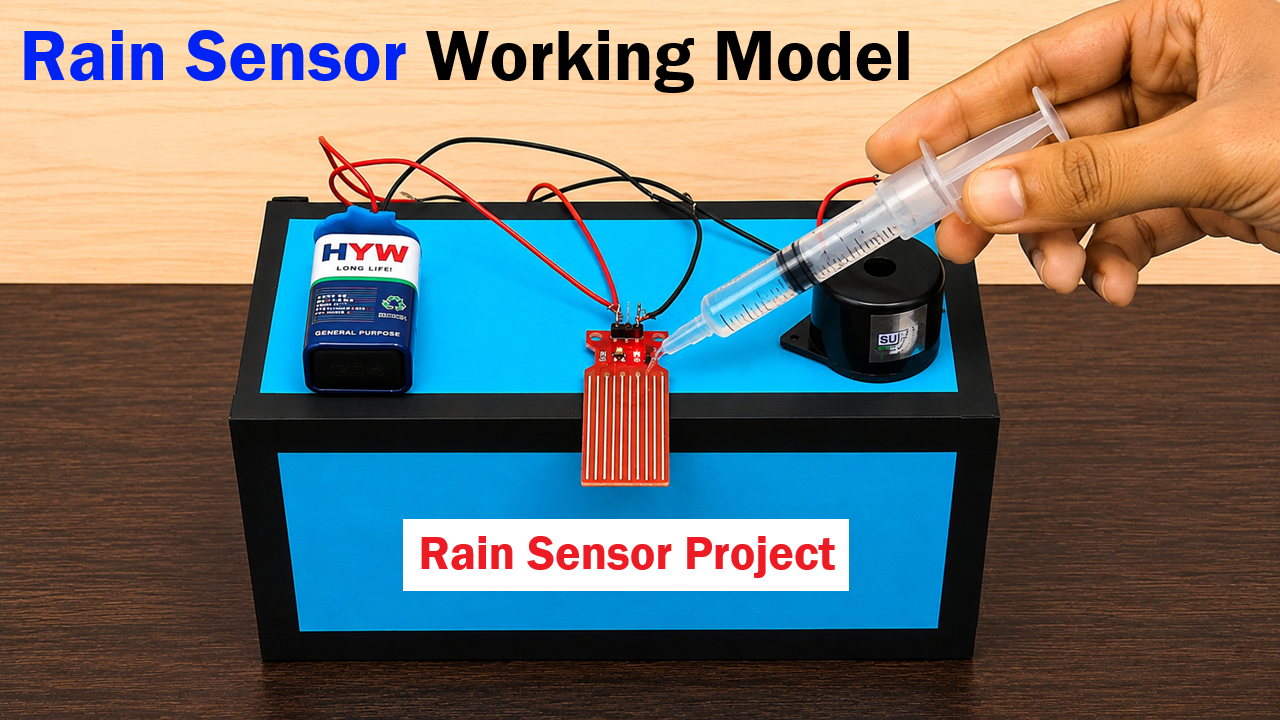
Today I am going to explain my science exhibition project on “Rain Sensor Working Model.” This is a simple and useful DIY electronics project that detects rain or water using a rain sensor module.
The project demonstrates how sensors can automatically detect water and activate an alarm system. Rain sensors are widely used in smart devices, weather monitoring systems, agriculture, and automatic safety systems.
This project is easy to make and helps students understand the basics of sensors, electrical circuits, and automation.
Aim of the Project
The main aim of this project is:
- To detect rainwater automatically
- To understand sensor technology
- To demonstrate alarm systems
- To learn simple electronics and automation
Explanation of the Model
The model contains:
- Rain sensor plate
- Buzzer alarm
- Battery
- Connecting wires
- Water source
When water falls on the sensor plate, the circuit detects moisture and activates the buzzer alarm.
This shows how automatic rain detection systems work.
Parts of the Rain Sensor Model
1. Rain Sensor Plate
The red-colored sensor plate is the main component of the project.
It contains conductive metal tracks.
When water drops fall on the plate:
- Water connects the metal lines
- Electrical conductivity increases
- The sensor detects rain
2. Battery
The battery provides electrical power to the circuit.
It supplies current to:
- The sensor
- The buzzer
- The connecting wires
3. Buzzer Alarm
The black circular component is the buzzer.
When rain is detected:
- The buzzer turns ON
- It produces a sound alert
This acts as an automatic warning system.
4. Connecting Wires
The wires connect all components together and complete the electrical circuit.
Working Principle
This project works on the principle of:
Conductivity of Water
Pure water is a weak conductor, but normal water containing minerals can conduct electricity.
When water touches the sensor:
- It creates a conductive path
- The sensor detects the change
- The alarm system activates
Working of the Rain Sensor
Step 1 – Power ON
The battery powers the circuit.
Step 2 – Water Falls on Sensor
Water is dropped onto the rain sensor plate.
Step 3 – Sensor Detects Moisture
The conductive tracks sense water presence.
Step 4 – Circuit Activates
The sensor sends a signal to the buzzer.
Step 5 – Alarm Sounds
The buzzer produces sound indicating rainfall detection.
Scientific Concepts Used
This project explains:
- Sensors
- Electrical conductivity
- Electronic circuits
- Automation systems
- Alarm mechanisms
Real-Life Applications
Rain sensors are used in:
- Automatic car wipers
- Smart irrigation systems
- Weather stations
- Rain alarms
- Smart home systems
- Industrial safety systems
These systems help reduce human effort and improve automation.
Materials Used
This DIY project is made using:
- Rain sensor module
- Buzzer
- 9V battery
- Wires
- Cardboard base
- Glue gun or tape
How to Make the Model
Step 1 – Prepare the Base
Take a cardboard or plastic base.
Step 2 – Fix Components
Attach the battery, sensor, and buzzer.
Step 3 – Connect the Circuit
Use wires to connect:
- Battery
- Sensor
- Buzzer
Step 4 – Test the Model
Drop water on the sensor plate and observe the buzzer sound.
Advantages of the Project
- Easy and low-cost project
- Useful for beginners
- Demonstrates automation
- Practical real-life application
- Attractive for exhibitions
Educational Importance
This project helps students:
- Learn electronics basics
- Understand sensors
- Improve practical skills
- Develop interest in automation technology
It combines science with real-world technology.
Safety Precautions
- Keep the battery dry
- Avoid touching bare wires
- Use low-voltage batteries only
- Dry the sensor after use
Conclusion
In conclusion, this Rain Sensor Working Model is a simple and educational DIY electronics project that demonstrates automatic rain detection using a water sensor.
The project explains how sensors and circuits work together to create smart systems used in everyday life. It is an excellent project for science exhibitions and STEM learning.