
Introduction
Braking systems are essential for controlling and stopping vehicles safely. One of the most effective braking systems used in cars and bikes is the hydraulic brake system. This system uses fluid pressure to transfer force from the brake pedal to the wheels.
The Hydraulic Brakes Working Model is a simple and innovative science project that demonstrates how hydraulic systems work using basic materials like syringes and tubes. It is an excellent project for science exhibitions and helps students understand real-life applications of physics.
Materials Required
This project can be made using easily available materials:
- Two syringes
- Plastic tubing
- Colored water (or oil)
- Cardboard base
- Small wheel (for demonstration)
- DC motor (optional)
- Battery and switch
- Glue and cutter
Working Principle
The hydraulic brake system works on Pascal’s Law, which states that:
“Pressure applied to a confined fluid is transmitted equally in all directions.”
- When force is applied to one syringe (master cylinder), it creates pressure in the fluid.
- This pressure is transmitted through the liquid in the tube to the second syringe (slave cylinder).
- The second syringe then moves outward, applying force to stop the wheel.
This principle allows a small force to be converted into a larger force, making braking efficient and effective.
Working Model Explanation
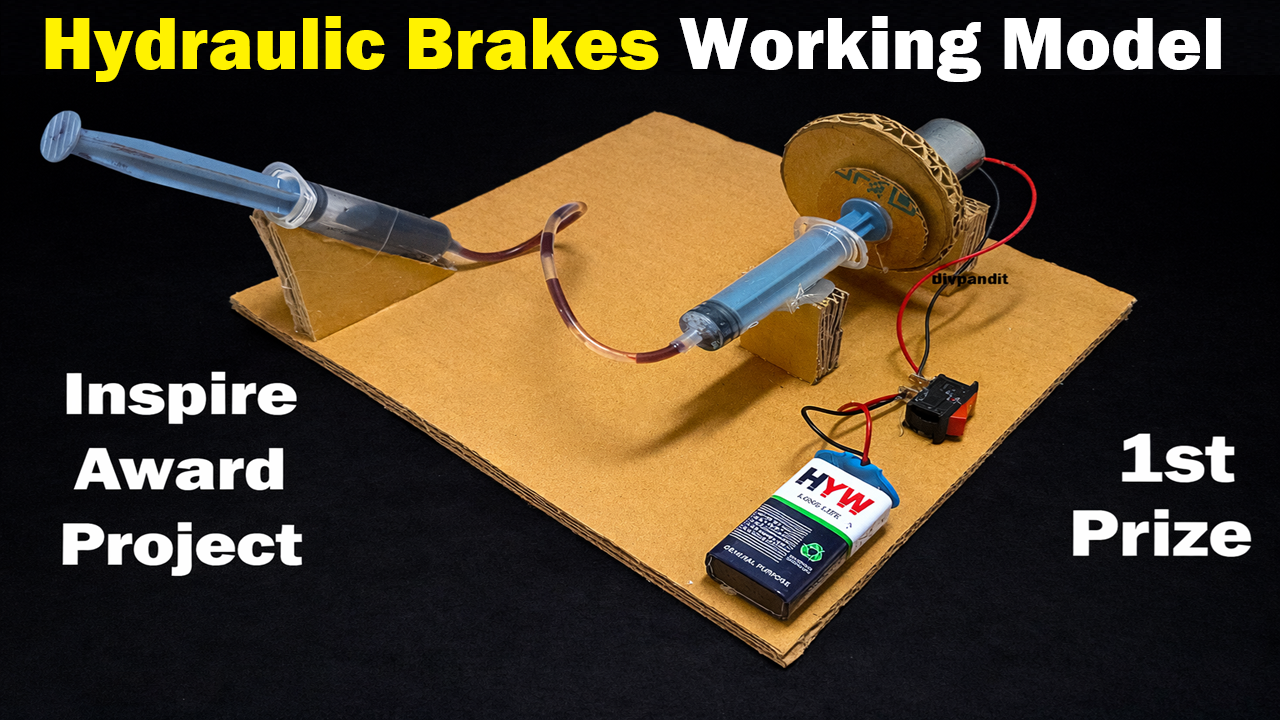
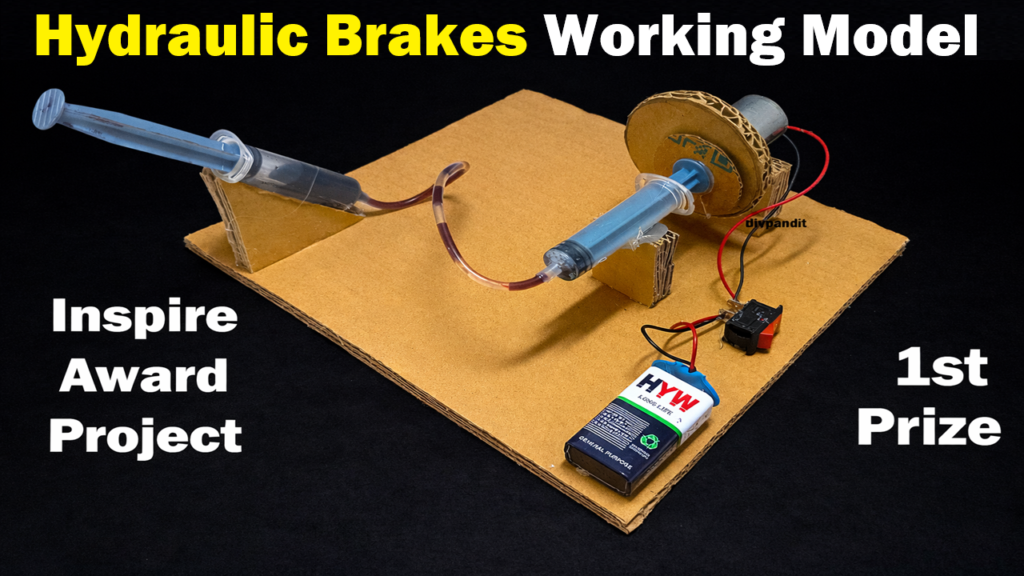
The model consists of two syringes connected by a plastic tube filled with liquid.
- One syringe acts as the input (brake pedal).
- The second syringe acts as the output (brake mechanism).
- A wheel is attached near the second syringe to demonstrate braking.
- When the first syringe is pushed, fluid pressure increases in the tube.
- This pressure pushes the second syringe, which presses against the wheel.
- As a result, the wheel slows down or stops.
If a motor is connected to rotate the wheel, the braking effect becomes more visible and realistic.
Advantages
- Demonstrates real-life braking system clearly
- Easy to understand physics concept
- Low-cost and simple materials
- Ideal for science exhibitions
- Practical demonstration of Pascal’s Law
Educational Value
This project helps students learn:
- Pascal’s Law and fluid pressure
- Force transmission in liquids
- Application of physics in automobiles
- Basics of hydraulic systems
It also improves hands-on learning and creativity.
Applications
- Car and bike braking systems
- Hydraulic lifts and jacks
- Heavy machinery and industrial equipment
- Aircraft braking systems
Limitations
- Requires proper sealing to prevent leakage
- Works only if fluid is air-free
- Limited to demonstration scale
Conclusion
The Hydraulic Brakes Working Model is a simple yet powerful demonstration of how modern braking systems function. By using basic materials, this project effectively explains the concept of fluid pressure and force transmission.
It shows how a small input force can control large mechanical systems, making it highly useful in real-life applications.
This project not only enhances understanding of physics but also inspires students to explore engineering concepts. It is a perfect choice for science exhibitions and a great way to connect theoretical knowledge with practical use.