
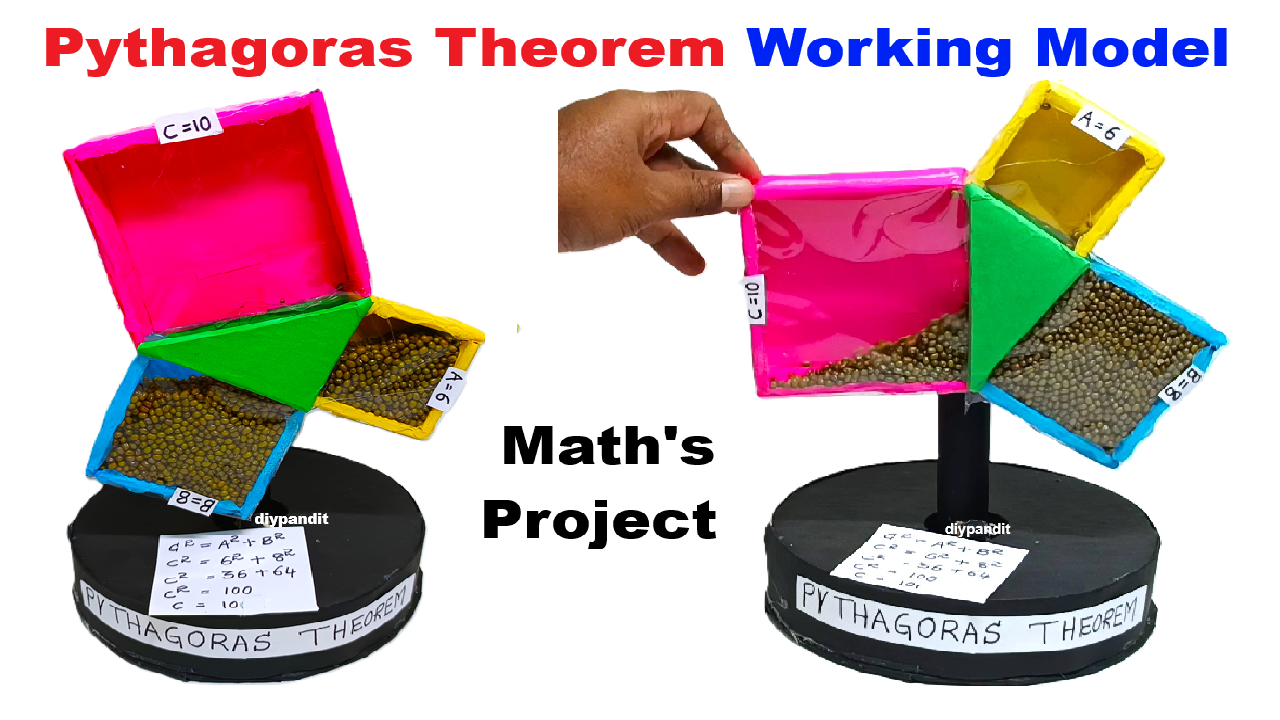
This model shows that in a right-angled triangle, the area of the square on the hypotenuse (10 cm) is equal to the sum of the areas of the other two squares (6 cm and 8 cm).
- I made a right-angled triangle using cardboard.
- On each side, I attached square boxes:
- Square on 6 cm side → 6 ×6 = 36 filled with small seeds
- Square on 8 cm side → 8 ×8 = 64 filled with small seeds
- Square on 10 cm side → 10 × 10 = 100 filled with small seeds
- Each square box is filled with small seeds, and I covered the top with a transparent sheet so the seeds do not fall out but remain visible.
- When you see the model, which proves:
(6)² + (8)² = (10)²
36 + 64 = 100
Steps to Make the Model
- Cut a right-angled triangle (6 cm, 8 cm, 10 cm sides) from cardboard.
- Make three cardboard square boxes of sizes:
- 6 cm ×6 cm
- 8 cm × 8 cm
- 10 cm × 10 cm
- Attach each box to the corresponding side of the triangle.
- Fill the boxes with seeds, grains, beads, or pulses.
- Cover each box with a transparent plastic sheet and tape it tightly.
- Label them: 6² = 36, 8² = 64 10² = 100.
- Finally write the equation:
Area of 6² + Area of 8² = Area of 10²