
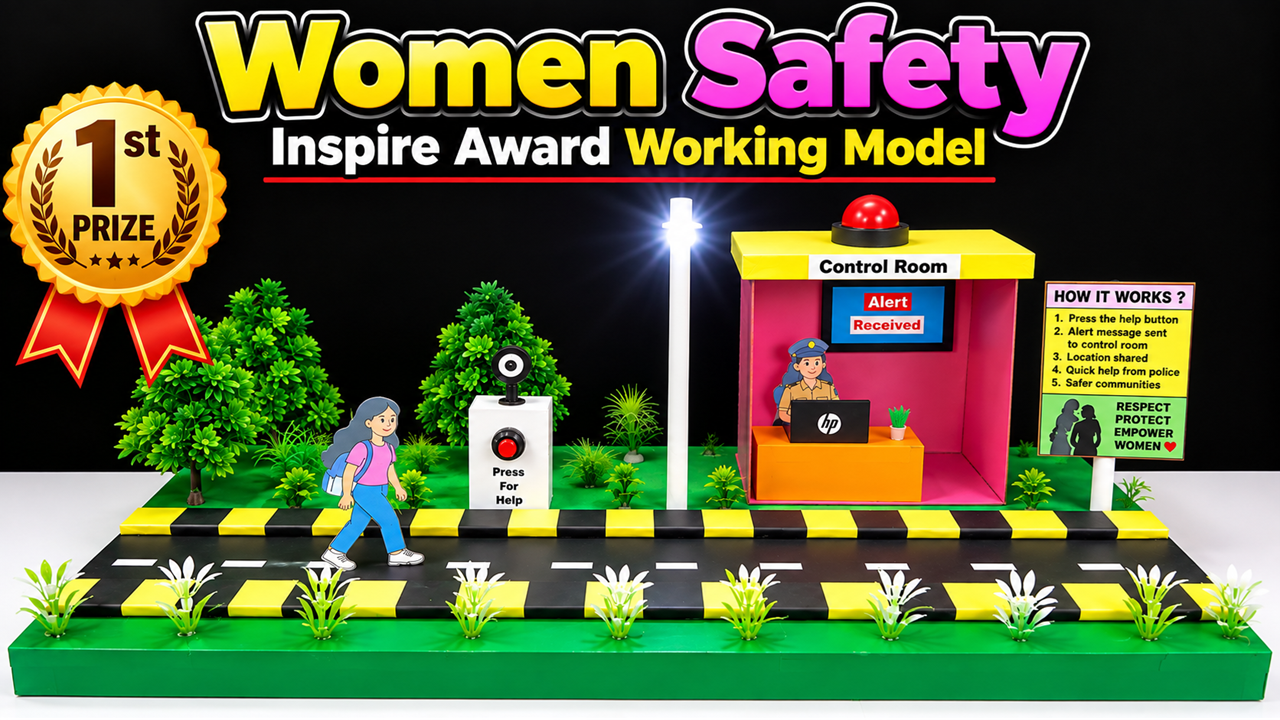
“Good morning, respected judges. Today, I am proud to present our project: the Smart Women Safety and Community Alert System.
Ensuring public safety for women remains one of the most critical challenges of our time. While smartphones offer safety apps, in sudden, high-stress emergencies, unlocking a phone, opening an app, or finding a signal is often impossible.
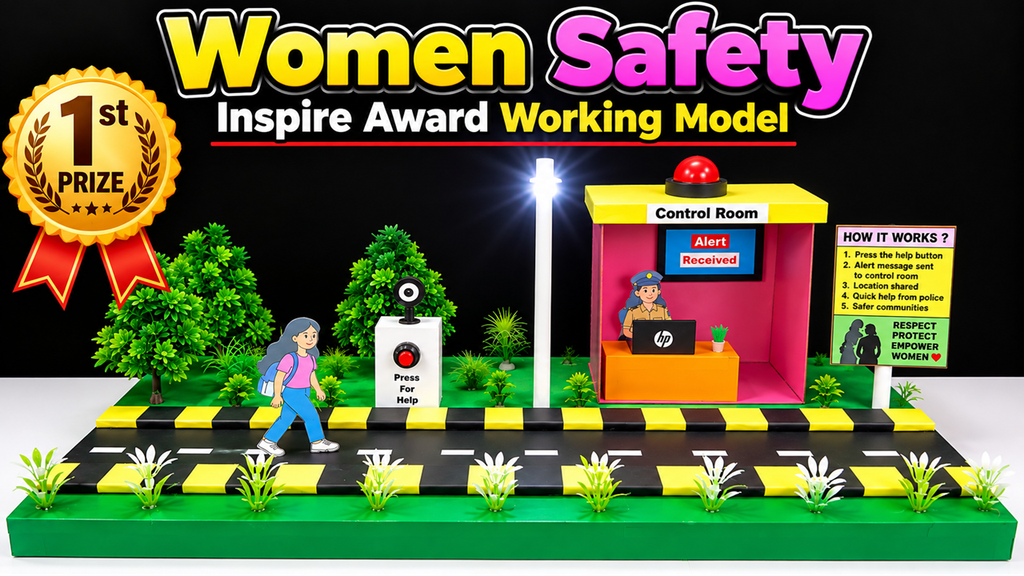
Our project bridges this gap by introducing an immediate, physical, and localized infrastructure solution that requires zero effort from a person in distress, ensuring that help is always just a single button press away.”
Project Overview & Core Components
“As you can see from our working model, this system simulates a typical smart city street or neighborhood. The layout is divided into three primary zones that interact seamlessly in real time:
- The Distress Zone: This features a prominent, highly visible public safety kiosk or ‘Press For Help’ pillar. It is equipped with a large, tactile emergency button and an overhead camera or sensor module to capture situational data immediately.
- The Transmission Link: This serves as the wireless or wired communication link, represented by the smart streetlight, symbolizing an interconnected urban grid that transmits data instantly to authorities.
- The Control Room & Monitoring Hub: This simulates the local police station or security center. It features an automated physical alert system (a bright red strobe light/buzzer) and a digital dashboard displaying live system updates like ‘Alert Received’.”
How the System Works
“When a woman or any citizen feels threatened, the system operates in a highly efficient, multi-step pipeline:
- Immediate Activation: The user presses the manual emergency button on the kiosk. This bypasses the need for personal mobile phones or internet connectivity.
- Instant Visual & Audio Alerts: Activating the button instantly triggers the localized alarm system. In the control room, the red beacon light flashes rapidly, and a buzzer sounds to grab the immediate attention of the duty officers.
- Data Transmission & Screen Update: Simultaneously, the digital display switches to show ‘Alert Received’. In a full-scale deployment, this screen immediately showcases the exact GPS coordinates and the specific kiosk ID number.
- Live Monitoring: The integrated camera system on the pillar activates live video streaming directly to the control room dashboard, allowing police to assess the threat level, eliminate false alarms, and prepare the right response.”
Innovation, Uniqueness, and Real-World Impact
“What makes this model stand out—and why it is highly relevant for initiatives like the Inspire Award—is its practical, community-centric design:
- Inclusivity: It works for everyone. Children, the elderly, or those who do not own a smartphone can use it effortlessly.
- Deterrence Factor: The visible presence of these physical safety pillars in dark alleys, bus stops, and parks acts as a powerful psychological deterrent against potential criminals.
- Rapid Response Time: By creating a direct line to the nearest local patrol room rather than a centralized national hotline, we minimize emergency response times down to minutes.
Conclusion & Future Scalability
Looking forward, this system is designed to scale easily. In the future, we can integrate AI-based acoustic sensors that automatically trigger alerts upon hearing screams or gunshots, eliminating the need to even press a button. It can also be powered completely by solar panels attached to the streetlights, making it self-sustaining.
Our project demonstrates how simple, robust technology can be deployed to create a safer environment, ensuring that our communities respect, protect, and truly empower women every single day. Thank you, judges. I am now open to any questions you may have.”