
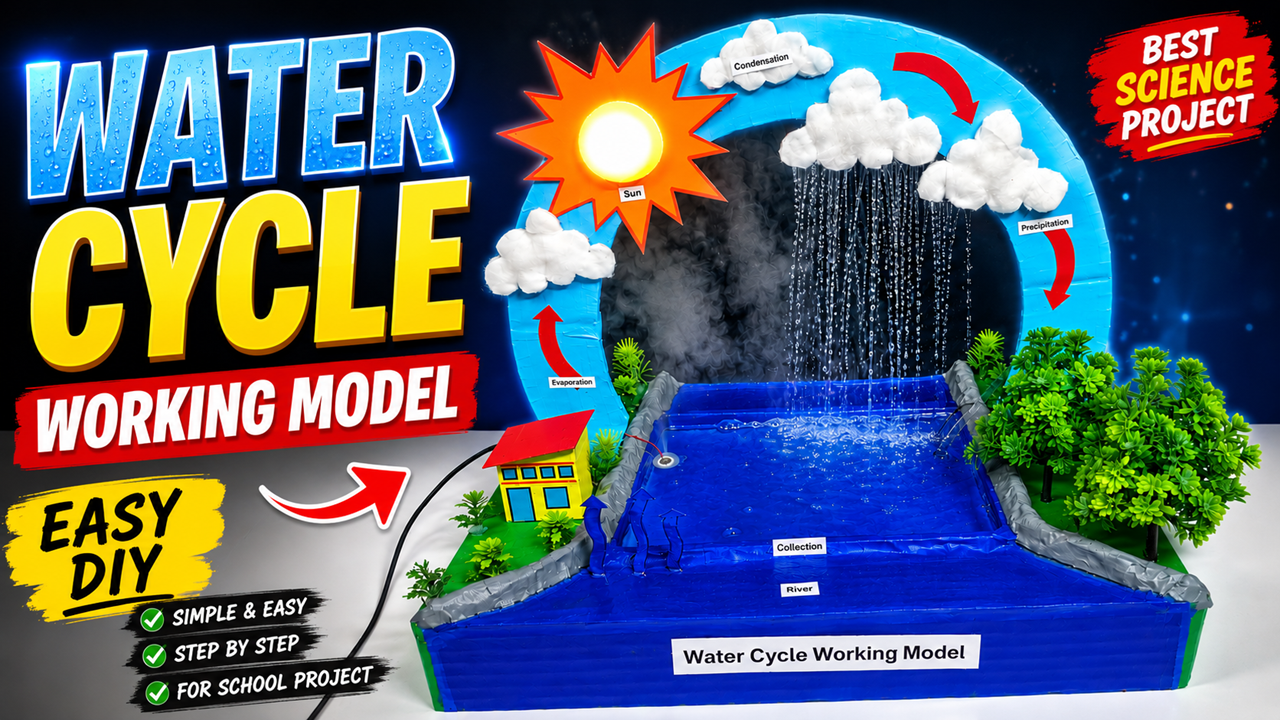
The Water Cycle Working Model is one of the most creative and educational science exhibition projects for school students. It helps explain how water continuously moves between the Earth’s surface and the atmosphere through a natural process called the water cycle.
This working model is easy to build using cardboard, thermocol, colour paper, cotton, LED lights, a small water pump or mist maker, and other simple craft materials. It is ideal for students and is perfect for science fairs, exhibitions, and competitions.
The model begins with the Sun, which is the primary source of energy for the water cycle. The Sun heats the water present in rivers, lakes, ponds, and oceans. Due to this heat, the water changes into water vapour through a process called evaporation. In the working model, the Sun is shown with an LED light to represent solar energy, while mist or smoke effects can be used to demonstrate evaporation.
As the warm water vapour rises into the atmosphere, it cools down at higher altitudes. This cooling process changes the water vapour into tiny water droplets, forming clouds. This stage is called condensation. In the model, cotton is used to represent clouds, making it easy for students to understand how clouds are formed naturally.
When the clouds become heavy with water droplets, they release the water back to the Earth in the form of rain, snow, or hail. This process is known as precipitation. The working model beautifully demonstrates rainfall using transparent strings, water droplets, or a small water circulation system to create a realistic rain effect. This makes the project visually attractive and helps students clearly understand the concept.
After rainfall, the water collects in rivers, lakes, ponds, reservoirs, and oceans. This stage is called collection. Some of the rainwater also seeps into the soil through a process called infiltration, where it becomes groundwater. Plants absorb some of this water through their roots and later release water vapour into the atmosphere through a process known as transpiration. Together, evaporation and transpiration help maintain the continuous movement of water in nature.
The water cycle is extremely important because it provides fresh water for drinking, agriculture, industries, and ecosystems. It also helps regulate the Earth’s climate and supports the survival of all living organisms. Without the water cycle, there would be no continuous supply of fresh water, leading to severe environmental problems and affecting life on Earth.
This DIY working model is not only educational but also interactive. Students can explain each stage of the water cycle step by step while demonstrating the movement of water. The rotating arrows, bright Sun, realistic clouds, flowing river, trees, and rain effect make the model attractive and easy to understand. It encourages students to learn scientific concepts through practical demonstrations instead of only reading textbooks.
Main Stages of the Water Cycle
- Evaporation – Sun heats water and changes it into water vapour.
- Condensation – Water vapour cools and forms clouds.
- Precipitation – Clouds release rain, snow, or hail.
- Collection – Water gathers in rivers, lakes, ponds, and oceans.
- Infiltration – Water enters the soil and becomes groundwater.
- Transpiration – Plants release water vapour back into the atmosphere.
Advantages of This Working Model
- Easy to make using low-cost materials.
- Attractive and realistic for science exhibitions.
- Clearly explains the complete water cycle.
- Improves scientific understanding through demonstration.
- Suitable for school competitions and science fairs.
- Encourages environmental awareness and water conservation.
In conclusion, the Water Cycle Working Model is an excellent science exhibition project that combines creativity with learning. It helps students understand one of nature’s most important processes in a simple and practical way. By demonstrating evaporation, condensation, precipitation, collection, infiltration, and transpiration, this model shows how water is continuously recycled on Earth. It is an engaging DIY project that enhances presentation skills, scientific thinking, and environmental awareness, making it an ideal choice for school science exhibitions.