
Introduction
“Good morning, respected judges. Today, I am proud to present our project: the Smart Automatic Car Parking and Toll Gate System.
As global urban centers expand, traffic congestion at entry points like parking garages, malls, and toll plazas continues to escalate.
Traditional manual boom barriers rely heavily on human operators, leading to slow processing times, long vehicle queues, and an increased risk of human error.
Our project introduces a working solution to this problem by demonstrating an automated, touchless gate system that accurately detects incoming traffic and controls access dynamically using micro-controller technology.”
Project Overview & Core Components
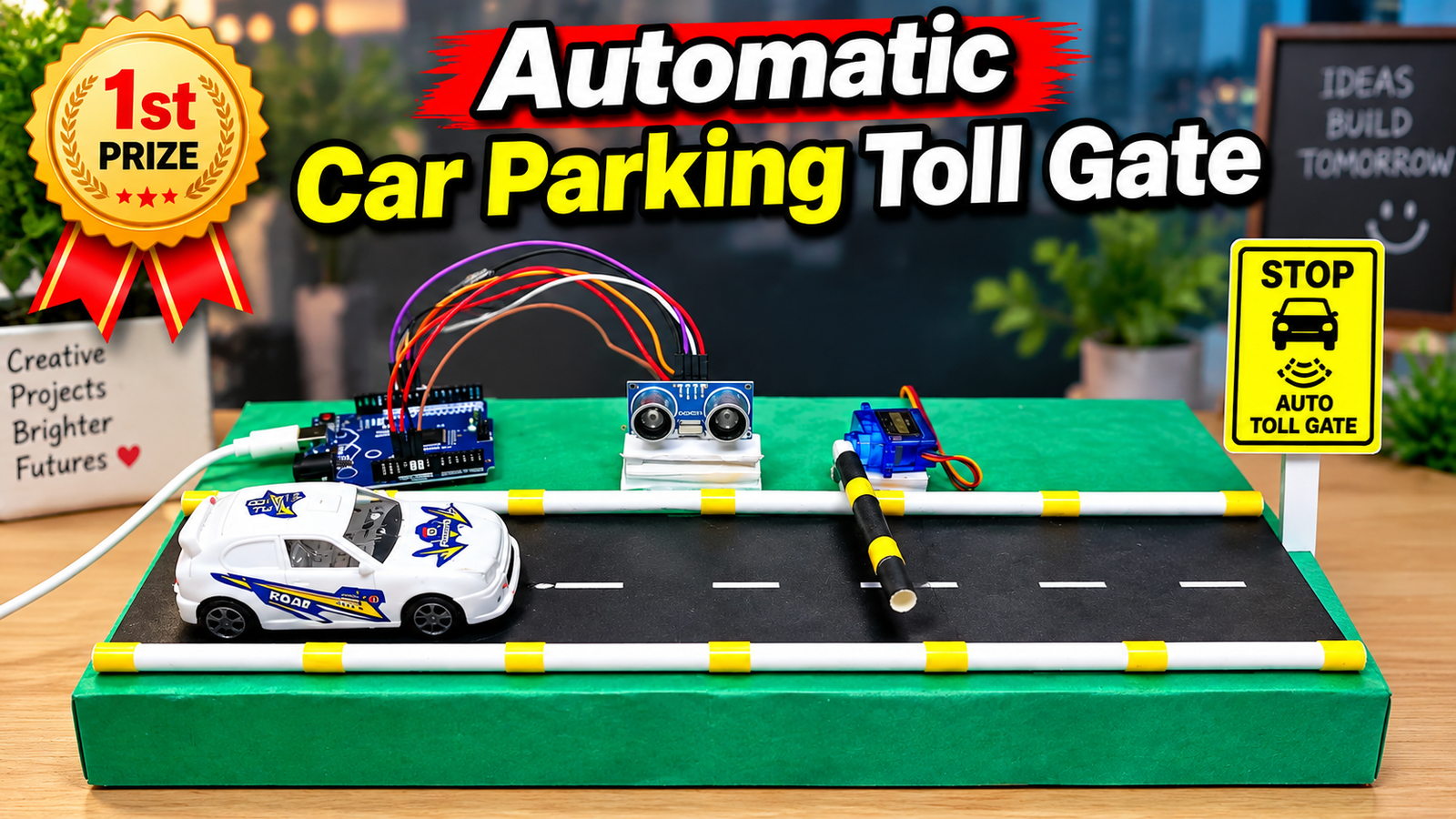
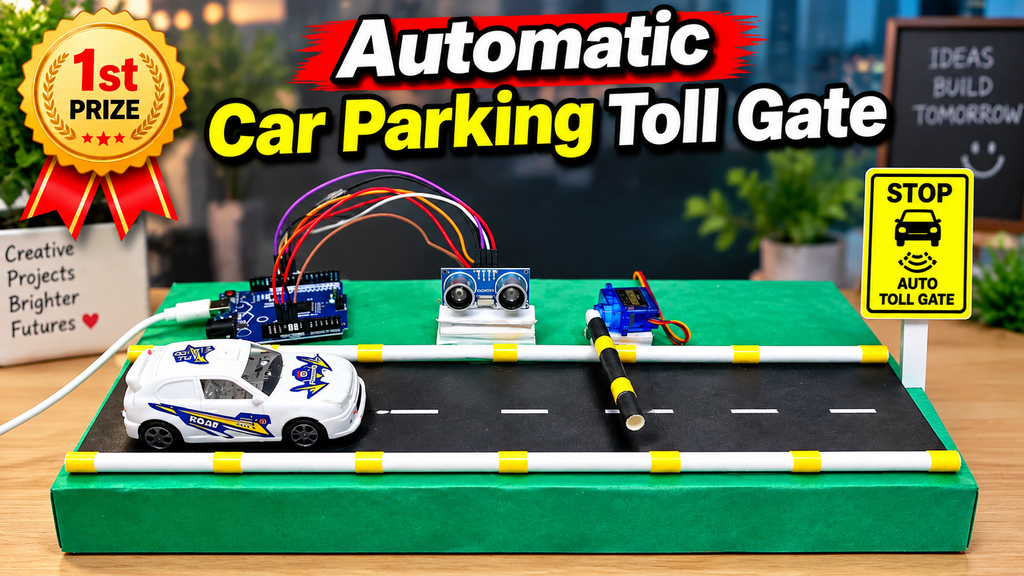
“As you can see from our working model, this setup simulates a modern smart checkpoint or parking lane. The entire automation ecosystem relies on three core hardware elements working together in harmony:
- The Arduino Uno Micro-controller: This serves as the brain of our project. It continuously reads incoming data from sensors, processes the built-in control logic, and sends precise commands to the physical actuators.
- The HC-SR04 Ultrasonic Sensor: Positioned right next to the incoming lane, this acts as the system’s eyes. It emits high-frequency sound waves to measure the exact distance of an approaching vehicle.
- The Micro Servo Motor (SG90): This serves as the physical actuator or muscle of the project. Connected directly to the gate barrier, it opens and closes the boom arm smoothly on command.
- Power & Indicator System: The model is powered securely via a USB link, ensuring steady voltage delivery across the entire sensor grid.”
How the System Works
“When a vehicle approaches the gate, the system operates through a highly efficient, automated code loop:
- Continuous Scanning: The ultrasonic sensor constantly transmits ultrasonic bursts. It calculates the time it takes for the echo to bounce back, calculating the distance to any object in the lane.
- Threshold Detection: If the lane is clear, the vehicle distance reads as a high value, and the gate remains down. The moment a toy car approaches and crosses our pre-set threshold (e.g., within 10 centimeters), the Arduino registers a vehicle presence.
- Gate Activation: The Arduino immediately processes this signal and commands the servo motor to rotate 90 degrees. This swings the boom barrier upward, clearing the path for the driver.
- Automatic Clearance Delay: The program runs a built-in time delay (or utilizes a second exit sensor verification) to ensure the vehicle has completely cleared the gate area safely.
- Secure Reset: Once the car passes through, the servo motor rotates back to its baseline position of 0 degrees, lowering the barrier to secure the checkpoint for the next incoming vehicle.”
Real-World Impact and Future Scalability
“What makes this model highly relevant for smart city initiatives is its immediate capability to scale up for real-world municipal infrastructure:
- Congestion Reduction: Eliminating physical ticket-handing or manual handovers speeds up vehicle processing times dramatically.
- Energy Efficiency: Reducing idling times at barriers directly lowers carbon emissions inside enclosed parking garages.
- Integration Flexibility: In a commercial deployment, this simple barrier setup can be seamlessly integrated with RFID scanners, FASTag readers, or AI-powered automated license plate recognition (ANPR) cameras for touchless digital payments.
By introducing affordable automated checkpoints, we can transform stressful urban bottlenecks into smooth, self-sustaining transit points.”
Conclusion
“Our project proves that combining simple sensors with micro-controllers can easily solve everyday urban problems. By turning a static parking gate into an intelligent assistant, we take a meaningful step toward smarter, more efficient cities. Thank you, judges. I am now open to any questions you may have about our hardware or logic.”