
Introduction
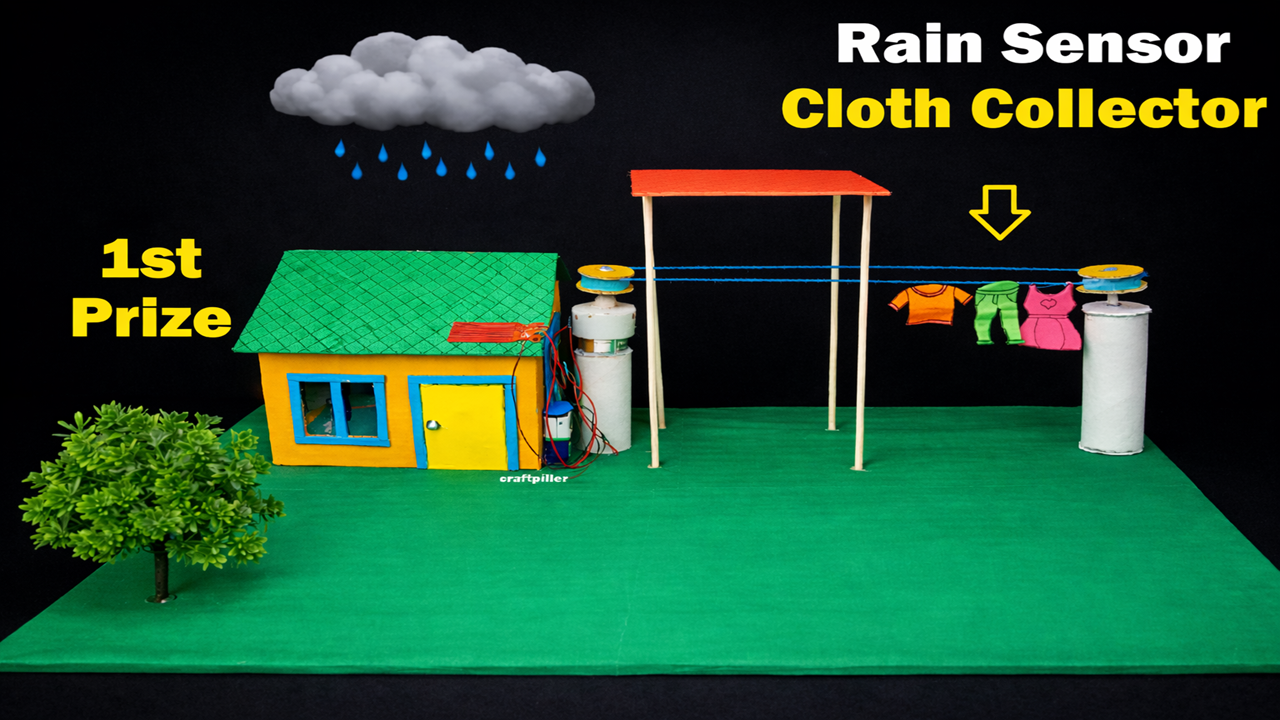
This is a smart and automatic system designed to protect clothes from rain. The project uses a rain sensor and motor mechanism to automatically collect clothes when rain starts. It is a very useful project for homes, apartments, hostels, and places where people dry clothes outside.
In our daily life, many people dry clothes in open sunlight. Sometimes, when they are away from home or busy with work, sudden rain wets the clothes again. This wastes time, effort, electricity, and water because the clothes need to be washed and dried again. To solve this common problem, we designed an automatic rain sensor cloth collector system.
This project helps students understand the practical use of science, electronics, sensors, motors, automation, and smart technology. It is also an example of how science can make human life easier and more comfortable.
Aim of the Project
The main aim of this project is:
- To automatically protect clothes from rain
- To demonstrate the use of rain sensors in automation
- To understand the working of electric motors and sensor circuits
- To save human effort and time
- To develop awareness about smart home technologies
Objective of the Project
The objectives of this science project are:
- To create an automatic clothes collecting system
- To detect rainwater using a rain sensor
- To control a motor automatically using sensor signals
- To move clothes to a safe covered area during rain
- To understand the importance of automation in daily life
What is a Rain Sensor?
A rain sensor is an electronic device used to detect rainwater. It senses the presence of water droplets on its surface. When rain falls on the sensor plate, the electrical conductivity changes, and the sensor sends a signal to the control circuit.
Rain sensors are widely used in:
- Automatic wipers in cars
- Smart irrigation systems
- Weather monitoring systems
- Automatic windows
- Smart home devices
In this project, the rain sensor is used to detect rainfall and activate the cloth collector system automatically.
Principle of the Project
The project works on the principle of electrical conductivity of water and automation using sensors.
When rainwater falls on the rain sensor:
- The sensor detects moisture.
- It sends a signal to the motor driver or control circuit.
- The motor starts rotating.
- The clothesline moves automatically.
- Clothes are pulled into a protected covered area.
When the rain stops, the system can either stop automatically or return to its original position depending on the design.
This project demonstrates how sensors and motors work together to create smart automated systems.
Components Used in the Project
The following materials and components are used in this working model:
Electronic Components
- Rain sensor module
- DC motor or geared motor
- Battery or power supply
- Motor driver
- Switch
- Connecting wires
Mechanical Components
- Clothesline
- Pulleys
- Supporting poles
- Small house model
- Roof or protective shed
Decorative Materials
- Cardboard
- Colored sheets
- Paint
- Glue
- Artificial plants
Explanation of Different Parts
1. Rain Sensor
The rain sensor is the most important part of this project. It is placed on the roof area where it can easily receive raindrops. The sensor detects water and sends an electrical signal to the circuit.
The sensor consists of conductive lines. When water falls on it, current flows between the lines, and the sensor becomes active.
This teaches students about:
- Conductivity
- Electric circuits
- Sensors and automation
2. DC Motor
The DC motor is used to move the clothesline automatically. When the rain sensor sends a signal, the motor rotates and pulls the clothes toward the covered area.
The motor converts electrical energy into mechanical energy. Students learn about:
- Motor mechanism
- Rotation
- Electrical motion systems
- Mechanical movement
3. Clothesline Mechanism
The clothesline is connected using threads or wires and pulleys. Clothes are attached to the line just like real drying systems used in homes.
When the motor rotates, the line moves smoothly from one side to another.
This mechanism helps students understand:
- Pulley systems
- Mechanical motion
- Force and movement
4. Covered Protection Area
The covered roof area protects the clothes from rainwater. Once the sensor detects rain, the clothes automatically move under this shelter.
This demonstrates practical engineering design and problem-solving skills.
5. Power Supply
The project uses a battery or DC power source to run the sensor and motor.
The power supply provides electrical energy for the entire system. Students learn the importance of:
- Voltage
- Current
- Power management
Working Procedure of the Project
Now let us understand the complete working process step by step.
Step 1 – Clothes Drying
Initially, clothes are hanging outside on the clothesline under sunlight.
The motor remains stopped, and the rain sensor remains inactive.
Step 2 – Rain Starts
When rain begins, water droplets fall on the rain sensor.
The sensor detects moisture immediately.
Step 3 – Sensor Sends Signal
The rain sensor sends an electrical signal to the motor circuit.
This signal activates the motor automatically.
Step 4 – Motor Rotates
The motor starts rotating and pulls the clothesline toward the covered area.
The clothes move automatically without any human effort.
Step 5 – Clothes Become Safe
The clothes reach the protected roof area where they are safe from rainwater.
Thus, the system prevents clothes from getting wet.
Conclusion
In conclusion, the Rain Sensor Cloth Collector is an innovative and practical science project that uses automation to solve a common household problem. The rain sensor detects rainwater and automatically activates the motor to move clothes into a safe covered area.
This project helps students understand important scientific concepts such as sensors, conductivity, motors, automation, and energy conversion. It also demonstrates how science and technology can make daily life easier, smarter, and more efficient.
The project is simple, creative, educational, and useful for real-life applications. It encourages students to think scientifically and develop problem-solving skills through practical learning.
Science projects like this inspire young minds to create smart inventions for the future.