
Introduction
Rainwater harvesting is the process of collecting and storing rainwater for future use. It is an important method of water conservation, especially in areas where water is limited or rainfall is seasonal.
Instead of allowing rainwater to flow away from rooftops and roads, it can be collected, filtered, stored, and reused for gardening, cleaning, agriculture, and, after appropriate treatment, other purposes.
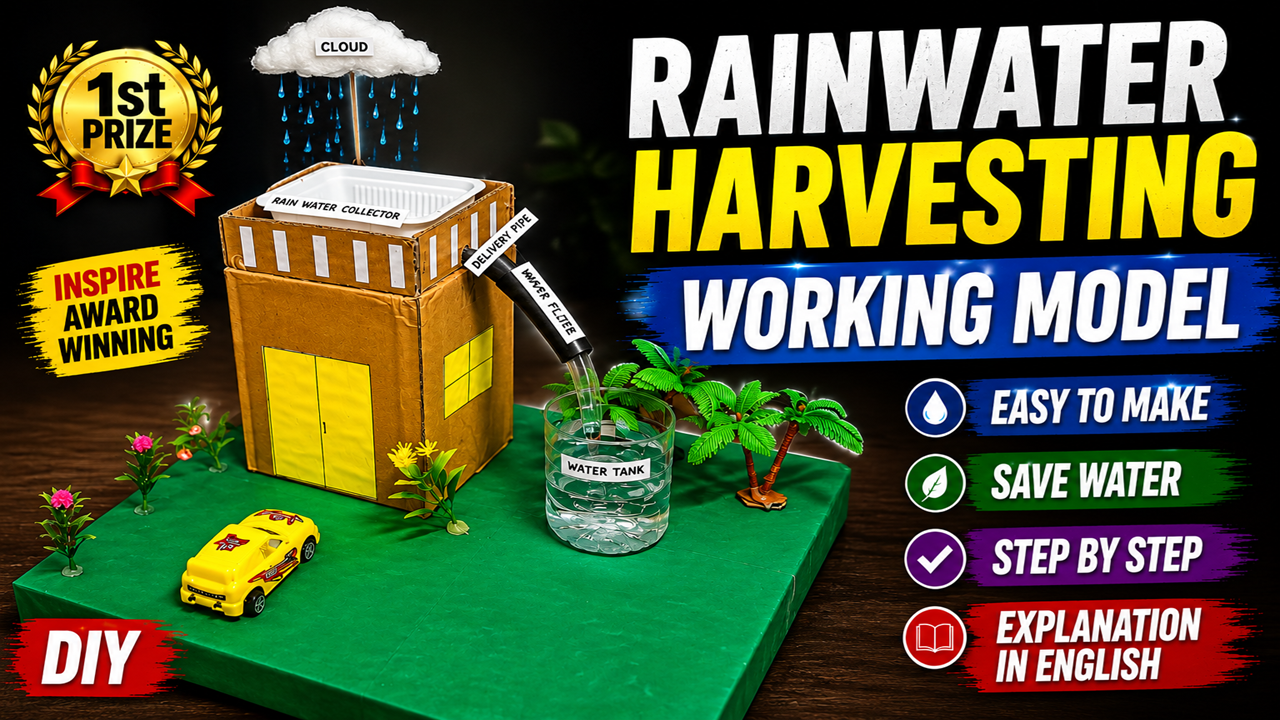
This Rainwater Harvesting Working Model demonstrates how rainwater can be collected from a building roof and directed into a storage tank through a delivery pipe. The model is simple, inexpensive, and suitable for school science exhibitions.
Main Concept of the Project
The model represents a small building with a rainwater collection system. A roof or collection surface receives rainwater. The water flows toward a collection channel and enters a pipe. The pipe carries the water into a water storage tank.
The basic process is:
Rainfall → Roof Collection → Rainwater Collector → Delivery Pipe → Filter → Storage Tank → Reuse
The collected water can later be used for watering plants, washing outdoor areas, gardening, or other suitable non-drinking purposes.
A real rainwater harvesting system may also include a first-flush device, which diverts the initial dirty runoff from the roof, and filters that remove leaves, sediment, and other particles before storage.
Materials Required
For making this model, you will need a thick cardboard or foam-board sheet for the base, cardboard boxes for the building, chart paper, glue, scissors, cutter, ruler, pencil, and markers.
For the water system, use a small plastic container or transparent cup as the storage tank, a small plastic tube or flexible pipe, a tray or container for the roof collector, and a small piece of mesh or sponge to represent the filter. You can also use a small plastic bottle as an additional storage container.
For decoration, use artificial plants, colored paper, small stones, toy vehicles, and other miniature objects. To demonstrate rainfall, you can use a bottle with small holes in its cap or a perforated container.
How to Make the Model
First, prepare a large rectangular cardboard base. Cover it with green paper to represent grass or a garden. Make sure the base is strong enough to support the building and water tank.
Next, construct a small house or building using cardboard boxes. Cover the walls with brown or colored paper. Add windows, doors, and a sloping roof. The roof should have a slight slope so that water can flow toward one side.
Place a shallow plastic tray or cardboard-lined container on the roof to act as the rainwater collector. Connect a small tube to the lowest point of the collector. This tube represents the delivery pipe.
Position the other end of the pipe above a transparent plastic cup or bottle. Label this container “WATER TANK.” Add a small mesh, sponge, or clean filter material near the pipe entrance to demonstrate the filtering stage. In a real system, an appropriately designed filter should be used rather than improvised materials.
Now create a rain cloud using cotton or white foam. Attach it above the building using a cardboard support. Make several small blue paper drops hanging from the cloud to represent rainfall.
For the working demonstration, gently pour a small amount of clean water through the cloud or directly onto the roof. The water should flow over the roof into the collector, travel through the delivery pipe, and finally enter the storage tank. This demonstrates how rainwater can be captured instead of being wasted.
Finally, decorate the model with plants and add labels such as “RAINWATER COLLECTOR,” “DELIVERY PIPE,” “FILTER,” “WATER TANK,” and “WATER REUSE.” You can also add arrows showing the direction of water flow.
Conclusion
The Rainwater Harvesting Working Model demonstrates a practical method of saving and managing water resources. It shows how rainwater falling on a building can be collected, directed through a pipe, filtered, and stored for later use.
This project teaches important concepts related to water conservation, sustainable development, environmental protection, and responsible use of natural resources. Rainwater harvesting can reduce dependence on other water sources and help recharge groundwater when designed appropriately.