
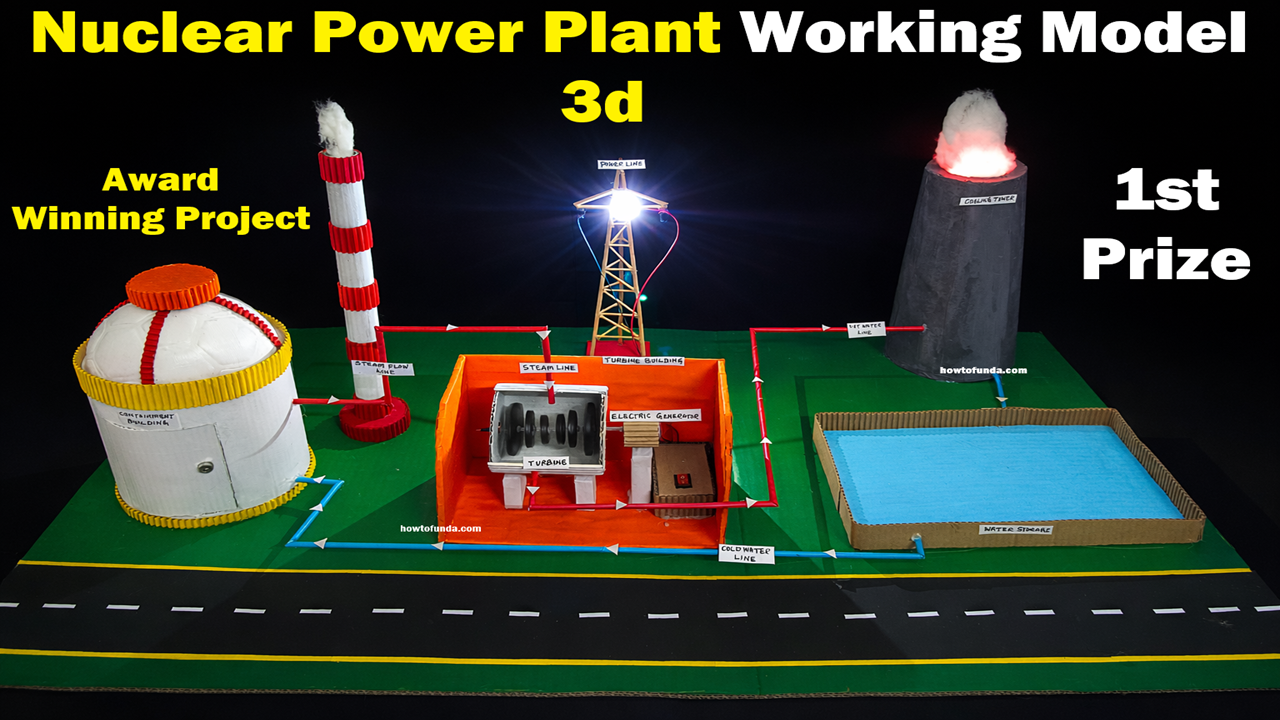
This 3D Nuclear Power Plant Working Model designed for a science project exhibition. The model clearly demonstrates how electricity is generated in a nuclear power plant using nuclear energy, steam, turbines, and generators. Even though it is made using simple materials like cardboard, thermocol, colors, and small electric components, it represents the real working principle of a nuclear power station in a simplified and easy-to-understand way.
Let us understand the complete working step by step.
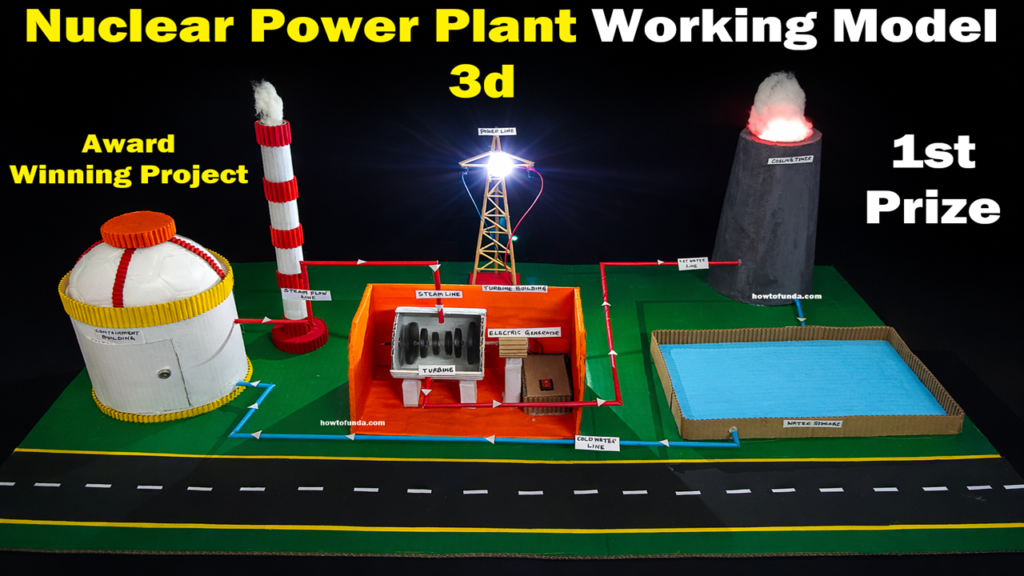
1. Main Parts of the Model
The model consists of the following major sections:
- Containment Building (Reactor Building) – The white dome-shaped structure on the left
- Steam Line and Chimney – The tall red and white striped structure
- Turbine Building – The orange open box in the center
- Electric Generator and Transmission Tower – The tower with glowing light
- Cooling Tower – The large black tower on the right with smoke effect
- Water Source (Cooling Water Tank) – The blue rectangular tank
- Steam and Cold Water Pipes – Red and blue pipelines connecting all parts
Each part represents a real component of an actual nuclear power plant.
2. Containment Building (Nuclear Reactor)
The white dome-shaped structure is the containment building, which houses the nuclear reactor. In a real nuclear power plant, this is where nuclear fission occurs.
Inside the reactor:
- Uranium fuel rods are placed.
- A nuclear fission reaction takes place.
- When uranium atoms split, a huge amount of heat energy is released.
In this working model, the actual nuclear reaction is not happening. Instead, the model represents the heat generation conceptually. The main purpose of this section is to show that heat is produced inside the reactor.
The containment building is dome-shaped because, in real plants, it is built very strong to prevent radiation leakage and to contain any possible accidents.
3. Heat Generation and Steam Production
When nuclear fission produces heat inside the reactor:
- Water surrounding the reactor absorbs this heat.
- The water gets converted into high-pressure steam.
In the model, this process is shown using red pipelines labeled as steam line. The red color indicates hot steam moving from the reactor to the turbine section.
Steam plays a very important role because it carries thermal energy from the reactor to the turbine.
4. Steam Line and Chimney
The tall red and white striped chimney-like structure represents the steam outlet or exhaust section. In real plants, excess steam and gases are managed carefully.
In this model:
- Steam moves through labeled pipes.
- The arrows show the direction of steam flow.
- It clearly explains the path of energy transfer.
The labeling makes it easy for students and judges to understand how steam flows from one unit to another.
5. Turbine Section (Turbine Building)
The orange box in the center is the turbine building. Inside it, you can see a small turbine model connected to a generator.
When high-pressure steam enters the turbine:
- The steam pushes the turbine blades.
- The turbine rotates at high speed.
- Mechanical energy is produced.
In real life, the turbine shaft is directly connected to an electric generator. In this model, a small motor or rotating mechanism is used to show this movement.
The turbine converts heat energy → mechanical energy.
6. Electric Generator
Next to the turbine is the electric generator. When the turbine rotates:
- It spins the generator shaft.
- Inside the generator, magnets and coils rotate.
- This produces electricity due to electromagnetic induction.
In the model, a small electric bulb is connected to show electricity production. The glowing light on the transmission tower clearly demonstrates that power is being generated.
This is the stage where:
Mechanical Energy → Electrical Energy
7. Power Transmission
The tall transmission tower with glowing light represents the power distribution system.
After electricity is generated:
- It passes through transmission lines.
- It is sent to homes, industries, and schools.
The glowing bulb on the tower makes the model interactive and attractive. It also visually proves that electricity is successfully produced.
8. Cooling System and Cooling Tower
On the right side, there is a large black cooling tower with smoke-like cotton at the top.
After steam rotates the turbine:
- The steam loses its pressure and temperature.
- It needs to be cooled down.
- It is sent to the cooling tower.
Inside the cooling tower:
- Cold water absorbs heat from steam.
- Steam condenses back into water.
- The condensed water is reused.
The white cotton at the top represents water vapor coming out. In reality, what comes out of cooling towers is mostly water vapor, not smoke.
The cooling process is very important because it allows water to be reused again and again.
9. Water Source (Cooling Water Tank)
The blue rectangular tank represents the water source (river, lake, or reservoir).
Cold water is taken from this source through blue pipelines labeled as cold water line.
The process works like this:
- Cold water enters cooling system.
- It absorbs heat from used steam.
- Steam becomes water again.
- Water is pumped back to reactor.
This creates a continuous cycle.
10. Complete Working Cycle Summary
Let us summarize the entire working process in simple steps:
- Nuclear fission occurs inside the reactor.
- Heat energy is produced.
- Water converts into high-pressure steam.
- Steam moves through steam pipes.
- Steam rotates the turbine.
- Turbine spins the generator.
- Generator produces electricity.
- Electricity flows to transmission tower.
- Used steam goes to cooling tower.
- Steam cools and turns back into water.
- Water is reused in the reactor.
This is a closed-loop system.
11. Energy Conversion in This Model
This project clearly explains multiple energy conversions:
- Nuclear Energy → Heat Energy
- Heat Energy → Mechanical Energy
- Mechanical Energy → Electrical Energy
This makes it an excellent demonstration of energy transformation concepts.
12. Why This Is a Good Exhibition Model
This model is attractive and educational because:
- It is 3D and realistic.
- It has labeled parts.
- It shows directional arrows.
- It demonstrates electricity generation using a real bulb.
- It explains non-renewable energy clearly.
- It includes cooling and recycling system.
Judges like such models because they explain both theory and practical working.
13. Importance of Nuclear Power Plants
Nuclear power plants:
- Produce large amounts of electricity.
- Do not emit carbon dioxide like coal plants.
- Require very small fuel quantities.
- Provide continuous power supply.
However, they also have risks:
- Radioactive waste disposal.
- High construction cost.
- Safety concerns.
This model can also be used to discuss advantages and disadvantages.
14. Conclusion
This 3D Nuclear Power Plant Working Model beautifully demonstrates how electricity is generated from nuclear energy. It clearly shows all major components like the reactor, turbine, generator, cooling tower, and transmission system. The colored pipelines and working light make the explanation easy to understand.
Even though the model is made using simple materials like cardboard and craft items, it effectively represents a complex industrial system. It teaches students about energy transformation, power generation, and engineering design.
This type of model is perfect for science exhibitions, Inspire Awards, and school competitions because it combines creativity, scientific accuracy, and practical demonstration.
If explained confidently with proper understanding of each stage, this project can definitely win prizes and impress judges.