

Introduction
Brakes are one of the most important safety systems in vehicles. Among different types of braking systems, hydraulic brakes are widely used in cars, bikes, and heavy vehicles because they provide strong and smooth braking. Hydraulic brakes work on the principle of fluid pressure transmission, where force applied at one point is transmitted equally to another point through a liquid.
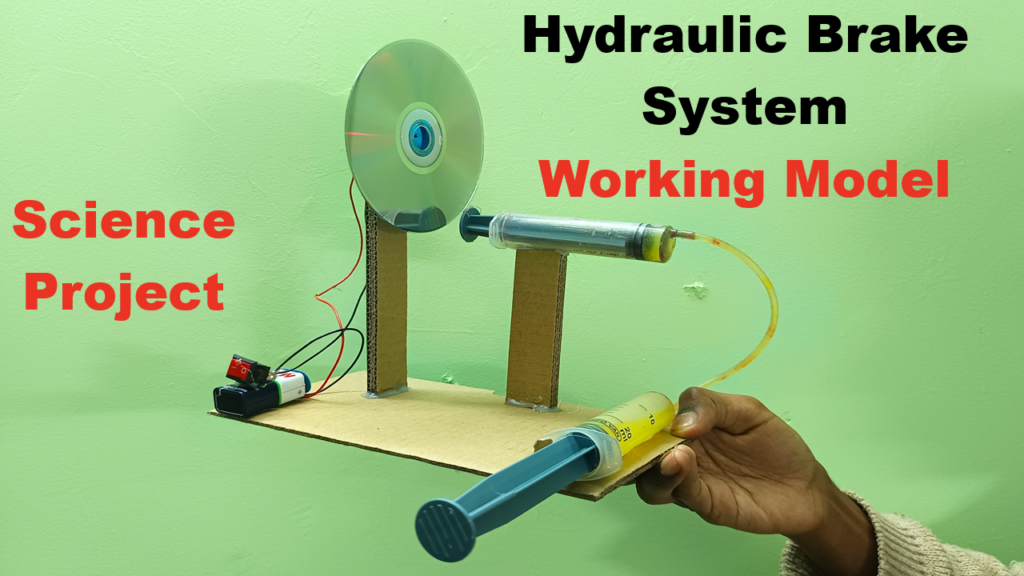
This Hydraulic Brakes Working Model is a DIY science exhibition project made using syringes, a CD (disc), and a DC motor. The model clearly demonstrates how hydraulic pressure is used to slow down or stop a rotating wheel, similar to real vehicle braking systems.
Aim of the Project
The main objectives of this project are:
- To understand the working principle of hydraulic brakes
- To demonstrate Pascal’s Law using a working model
- To show how braking force is transmitted using liquid pressure
- To create a low-cost mechanical science project for exhibition
Materials Used
- Cardboard base
- Old CD (acts as brake disc)
- DC motor (to rotate the disc)
- Two or three syringes (without needles)
- Transparent plastic tubes or IV pipes
- Water or colored liquid (brake fluid)
- Battery and switch
- Glue, tape
- Scissors or cutter
- Marker pens for labeling
Principle of Hydraulic Brakes
Hydraulic brakes work on Pascal’s Law, which states that pressure applied to a confined fluid is transmitted equally in all directions. When force is applied to the brake pedal, pressure is created in the brake fluid, which is transferred to the brake pads, causing them to press against the disc and stop the wheel.
Construction of the Model
A cardboard base is prepared to mount all components. A DC motor is fixed on the base, and a CD is attached to the motor shaft to act as a brake disc. The motor is connected to a battery so that the disc rotates continuously.
Two syringes are connected using transparent tubes and filled completely with water to remove air bubbles. One syringe acts as the brake pedal, and the other acts as the brake piston. The output syringe is positioned so that its plunger presses against the CD when activated.
Working of the Model
- When the DC motor is switched ON, the CD starts rotating
- Pressing the input syringe creates pressure in the liquid
- This pressure is transmitted through the tube
- The output syringe moves forward
- The plunger presses against the rotating CD
- Friction slows down or stops the CD
This demonstrates how hydraulic brakes control wheel motion.
Scientific Explanation
- Mechanical force is applied on the syringe
- Pressure is created in the liquid
- Pressure is transmitted equally
- Output force acts on the brake disc
- Friction between disc and plunger stops motion
Advantages of Hydraulic Brakes
- Smooth and powerful braking
- Equal pressure distribution
- Reliable and efficient
- Requires less manual force
Applications
- Cars and motorcycles
- Buses and trucks
- Industrial machines
- Heavy vehicles
Educational Importance
- Demonstrates real-life application of physics
- Helps understand Pascal’s Law
- Ideal for science exhibition and viva
- Encourages practical learning
Safety Measures
- Ensure no air bubbles in syringes
- Use low-voltage power supply
- Fix rotating parts firmly
Conclusion
The Hydraulic Brakes Working Model is an effective science exhibition project that explains how braking systems work in vehicles. By using syringes, a CD disc, and a DC motor, the model clearly demonstrates the role of hydraulic pressure and friction in stopping motion. This DIY project is simple, economical, and highly educational.