
Introduction
Farmers often work in fields during the early morning, evening, or night, when visibility is low. Snakes and other animals may hide under crops, near farm shelters, or around sleeping areas. A sudden encounter with a snake can be dangerous.
This Farmer Safety Project demonstrates a simple warning system that can detect the presence of a snake near a farmer’s resting or sleeping area and activate an alarm and warning light.
The model combines the ideas of sensor technology, automation, and farmer safety. When a snake or another object enters the detection area, a sensor can trigger a buzzer and a red LED, alerting the farmer so that they can move away and seek appropriate help.
Main Concept of the Model
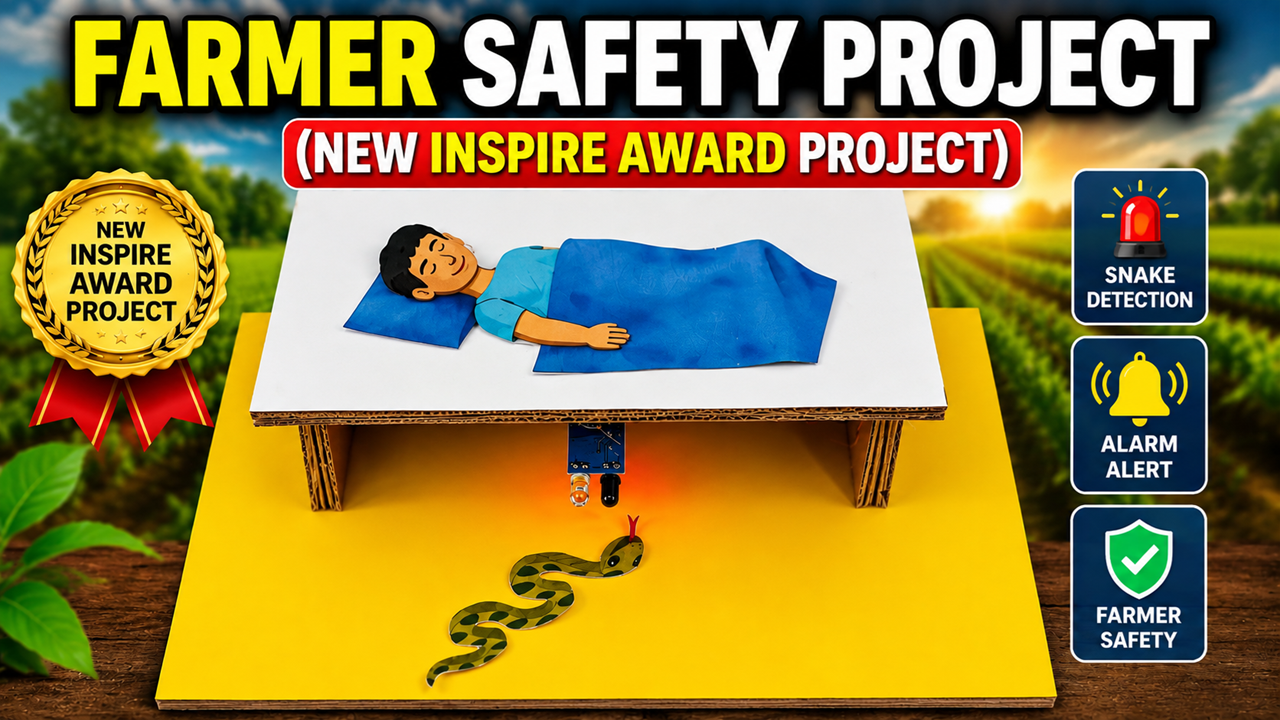
The project contains four main parts: a farmer sleeping area, detection sensor, alarm/buzzer, and warning LED. The farmer is represented by a small handmade figure lying on a raised cardboard platform. A model snake is placed underneath the platform to represent a possible danger.
In an actual electronic version, a suitable sensor can be positioned near the sleeping area. Depending on the design, a proximity, infrared, or other suitable sensor can detect movement or the presence of an object. When the sensor output reaches the required condition, a controller or switching circuit activates the alarm.
The red LED represents a warning light, while the buzzer produces a sound such as “beep-beep.” Together, these alerts warn the farmer about a possible hazard.
The basic sequence is:
Snake/Object Detected → Sensor Activated → Alarm ON → Warning Light ON → Farmer Alerted
This project demonstrates how simple automation can be used to improve safety in agricultural environments.
Materials Required
For making the model, you will need a thick cardboard sheet for the base, additional cardboard for the raised platform, white and colored chart paper, glue, scissors, a cutter, ruler, pencil, and markers. For the working electronic circuit, you can use a low-voltage battery pack, buzzer, red LED, suitable sensor module, connecting wires, switch, and optionally a small microcontroller such as an Arduino-compatible board. A printed or handmade snake, farmer figure, and small warning signs can be used for decoration.
How to Make the Model
First, prepare a large rectangular cardboard base. Cover it with yellow or brown paper to represent the ground or farm area. Add small paper plants or crop rows around the edges to give the model an agricultural appearance.
Next, construct a raised sleeping platform using strong pieces of cardboard. Make four legs and attach a flat cardboard sheet on top. Cover the upper surface with white paper. Create a small farmer figure using cardboard or foam and place it on the platform. Add a pillow and blue paper blanket to represent the farmer sleeping.
Now make a model snake using colored paper, clay, or a printed picture. Place it underneath or near the platform. Position the sensor in the area where the snake is expected to approach. The sensor should be securely fixed so that it remains pointed toward the detection zone.
For the electronic working section, connect the sensor to a low-voltage control circuit. Connect the circuit output to a buzzer and red LED. When the sensor detects movement or an object, the circuit should switch on the buzzer and LED. Add a small switch so that the demonstration can be turned on and off safely.
Finally, add labels such as “SNAKE DETECTION,” “ALARM ALERT,” “FARMER SAFETY,” and “BE CAREFUL.” You can also place an information card explaining the detection process.
Conclusion
The Farmer Safety Project demonstrates how technology can help protect farmers from potential hazards such as snakes. A sensor-based warning system can provide an early alert through sound and light, giving the farmer an opportunity to move away from danger and contact appropriate assistance.
The model combines science, electronics, automation, and social responsibility in one practical project. It also shows how low-cost technology can potentially be adapted for agricultural safety applications.