
1. Introduction
Hydroelectricity is the electricity generated using the energy of flowing or falling water. It is one of the most important renewable energy sources in the world.
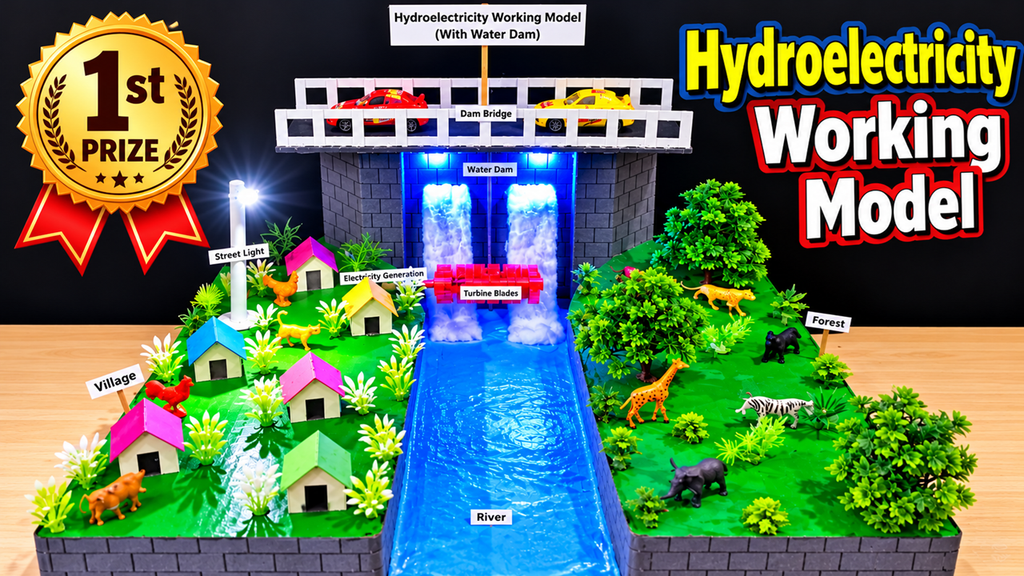
Dams are constructed across rivers to store large amounts of water in reservoirs. When water is released from the dam, it flows through special passages and strikes the turbine blades. The turbine starts rotating and drives a generator, which converts mechanical energy into electrical energy.
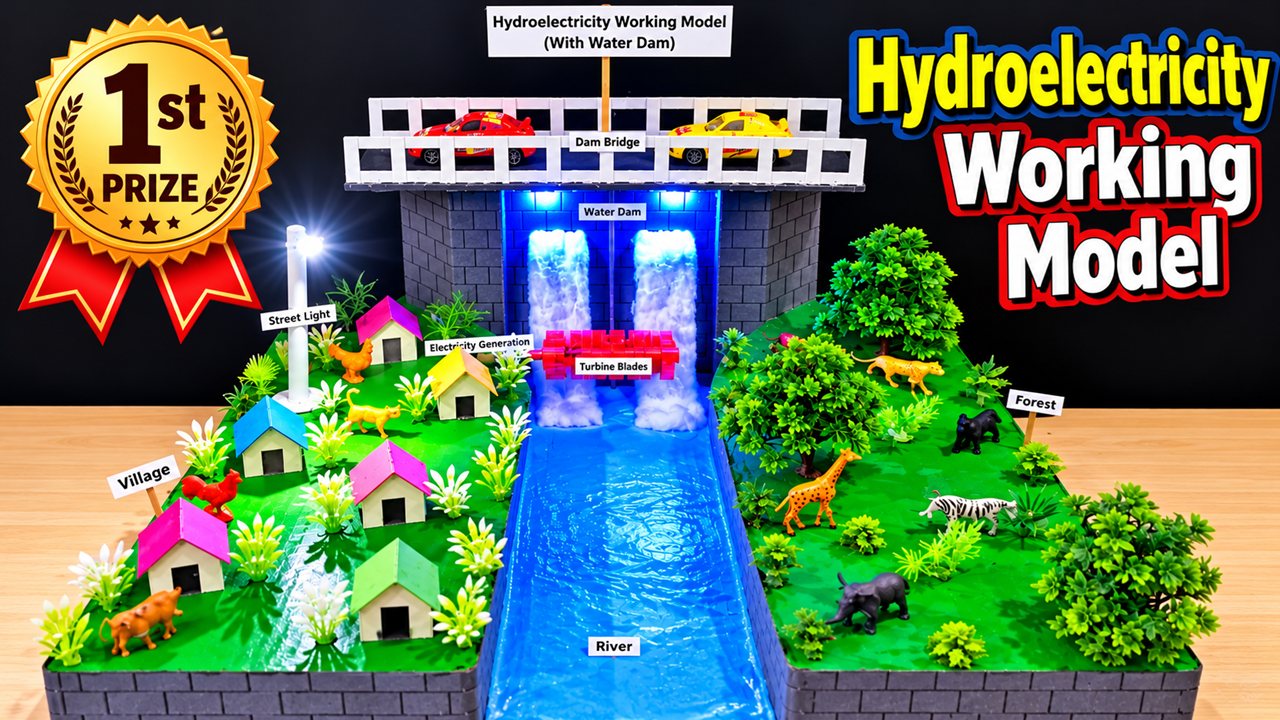
In this project, we demonstrate a hydroelectricity generation system using a miniature water dam. Our model shows how water stored behind a dam can be used to generate electricity and supply power to nearby villages, houses and streetlights.
The main objective of this project is to explain renewable energy generation and promote the importance of clean electricity.
2. Materials Required
To prepare this working model, we need the following materials:
- Large cardboard or thermocol sheets for the base.
- Green colour paper or artificial grass.
- Blue colour paper for the river.
- Cardboard sheets for constructing the dam.
- Ice cream sticks or plastic strips for the bridge.
- Small DC motor to act as a generator.
- Small plastic turbine or handmade turbine blades.
- Transparent plastic pipes for water flow.
- Small water pump (submersible DC pump).
- Plastic water storage container.
- LED lights for electricity demonstration.
- Connecting wires and switches.
- Battery or suitable power supply for the water pump.
- Small toy houses, cars and animals.
- Artificial trees and decorative plants.
- White and grey chart paper for dam construction.
- Glue gun, scissors, cutter and adhesive tape.
3. How to Make the Model
Step 1: Prepare the Base
Take a large rectangular cardboard or thermocol sheet. Divide the base into three main sections: the dam area in the centre, the village on the left side and the forest on the right side.
Cover the village and forest areas with green colour paper or artificial grass. Use blue colour paper to create a river flowing from the dam towards the front of the model.
Step 2: Construct the Water Dam
Take thick cardboard sheets and construct a large rectangular dam structure in the centre. Make the front wall using grey chart paper to represent concrete. Decorate it with small rectangular patterns to look like concrete blocks.
Create two openings in the dam wall for water to flow out. Place transparent plastic pipes behind these openings to guide water towards the turbine section.
Step 3: Prepare the Water Storage Reservoir
Place a plastic container behind or above the dam structure. This container acts as the water reservoir. Fill it with water.
Connect a small water pump to the reservoir or lower water collection area so that water can be circulated continuously.
Step 4: Prepare the Turbine
Take a small DC motor and attach a plastic turbine or handmade blades to its rotating shaft. Fix the motor near the water outlet so that flowing water strikes the turbine blades.
Connect two wires from the motor terminals to a small LED.
When water strikes the blades, the turbine rotates and drives the motor.
Step 5: Connect the Water Circulation System
Place a small DC water pump in the lower river collection area. Connect a pipe from the pump to the upper reservoir.
When the pump is switched ON, it lifts water to the reservoir. Water then flows down through the dam outlet, strikes the turbine and returns to the lower collection area.
This creates a continuous water circulation system.
Step 6: Connect the Electrical Circuit
Connect the DC motor terminals to an LED using suitable wires. When the turbine rotates, the motor acts as a small generator and produces electrical energy.
If the generated voltage and current are sufficient, the LED will glow. Otherwise, use a suitable rectifier or voltage-conditioning circuit.
Step 7: Prepare the Village and Forest
Make small houses using cardboard and colour paper. Place them on the left side to represent a village.
On the right side, create a forest using artificial trees, bushes and toy animals. Add a small bridge above the dam using ice cream sticks.
Finally, place labels such as WATER DAM, TURBINE, ELECTRICITY GENERATION, RIVER, VILLAGE and FOREST.
4. How Does the Working Model Work?
The working process starts with water stored in the reservoir behind the dam.
When the water outlet is opened, water flows downwards due to gravity. This flowing water carries potential energy that gets converted into kinetic energy.
The moving water strikes the turbine blades and makes the turbine rotate.
The turbine is connected to a DC motor, which works as a generator. As the motor shaft rotates, electrical energy is produced through electromagnetic induction.
This electricity can be used to glow an LED, demonstrating how hydroelectric power is generated.
After passing through the turbine, water flows into the river below the dam. In our model, a small DC pump collects this water and sends it back to the upper reservoir to repeat the process.
Thus, our model demonstrates the basic principle of hydroelectricity generation.
Important: The pump in this model uses external electrical energy to circulate water. The model demonstrates energy conversion, not free or self-sustaining electricity. In a real hydroelectric power station, water from the reservoir provides the energy to operate the turbine.
5. Applications of Hydroelectricity
- Generating electricity for houses and apartments.
- Supplying electricity to villages and cities.
- Operating industries and factories.
- Supporting agricultural irrigation systems.
- Providing electricity to streetlights.
- Supporting electricity demand during peak hours.
- Pumped-storage power generation.
- Reducing dependence on fossil fuels.
6. Advantages of Hydroelectricity
- It is a renewable source of energy.
- It produces very low direct greenhouse gas emissions during operation.
- It can generate large amounts of electricity.
- It reduces dependence on coal and petroleum.
- Reservoirs can also support irrigation and water storage.
- Hydroelectric plants can respond quickly to changes in electricity demand.
- It supports sustainable energy development.
7. Conclusion
Our Hydroelectricity Working Model demonstrates how flowing water can be used to generate electricity through a turbine and generator.
Dams store water and help control its flow. When water is released, it rotates the turbine, which drives the generator to produce electricity.
Hydroelectricity is an important renewable energy source that supports homes, industries, agriculture and economic development.
However, dam construction should be carefully planned because it can affect forests, wildlife, aquatic ecosystems and people living near rivers.
Our message is: SAVE WATER, USE RENEWABLE ENERGY AND BUILD A GREENER FUTURE!
8. Science Exhibition – Short Presentation Script
Good morning, respected judges, teachers and my dear friends.
My project name is Hydroelectricity Working Model with Water Dam.
Hydroelectricity means generating electricity using the energy of flowing or falling water.
In our model, we have constructed a water dam with a reservoir, turbine, generator, village, forest and river.
First, water is stored in the reservoir. When water is released through the outlet, it flows downwards and strikes the turbine blades.
The turbine starts rotating. It is connected to a DC motor, which acts as a generator and produces electricity.
This electricity is used to glow an LED, demonstrating power generation.
After passing through the turbine, water flows into the river. A small water pump sends it back to the reservoir to repeat the demonstration.
Hydroelectricity is a renewable energy source that helps us generate electricity without burning coal or petroleum.
However, we must also protect forests, rivers and wildlife while constructing dams.
My message is: WATER IS POWER, AND RENEWABLE ENERGY IS OUR FUTURE!
Thank you!