
1. Introduction
Good morning, respected judges, teachers, and my dear friends.
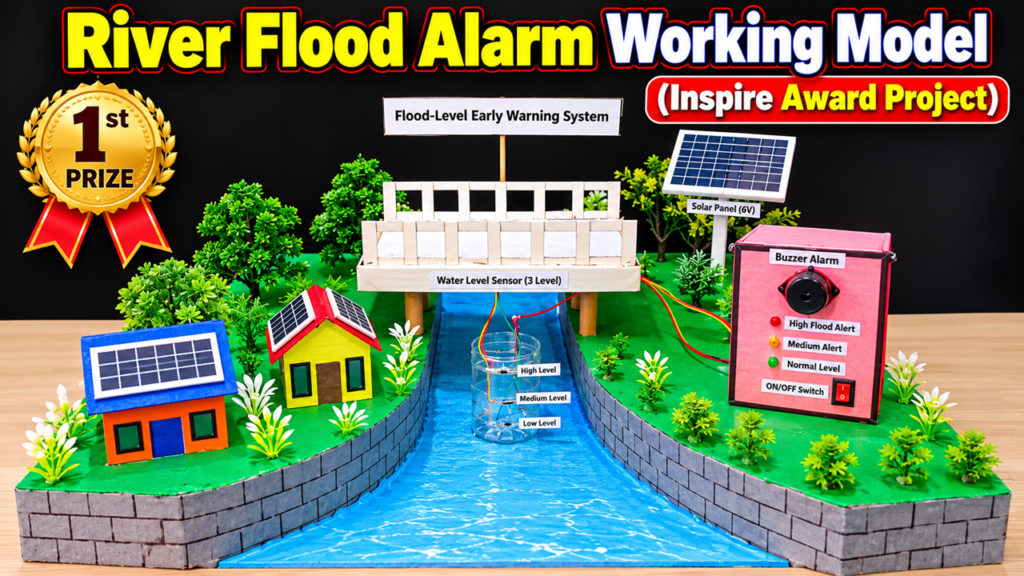
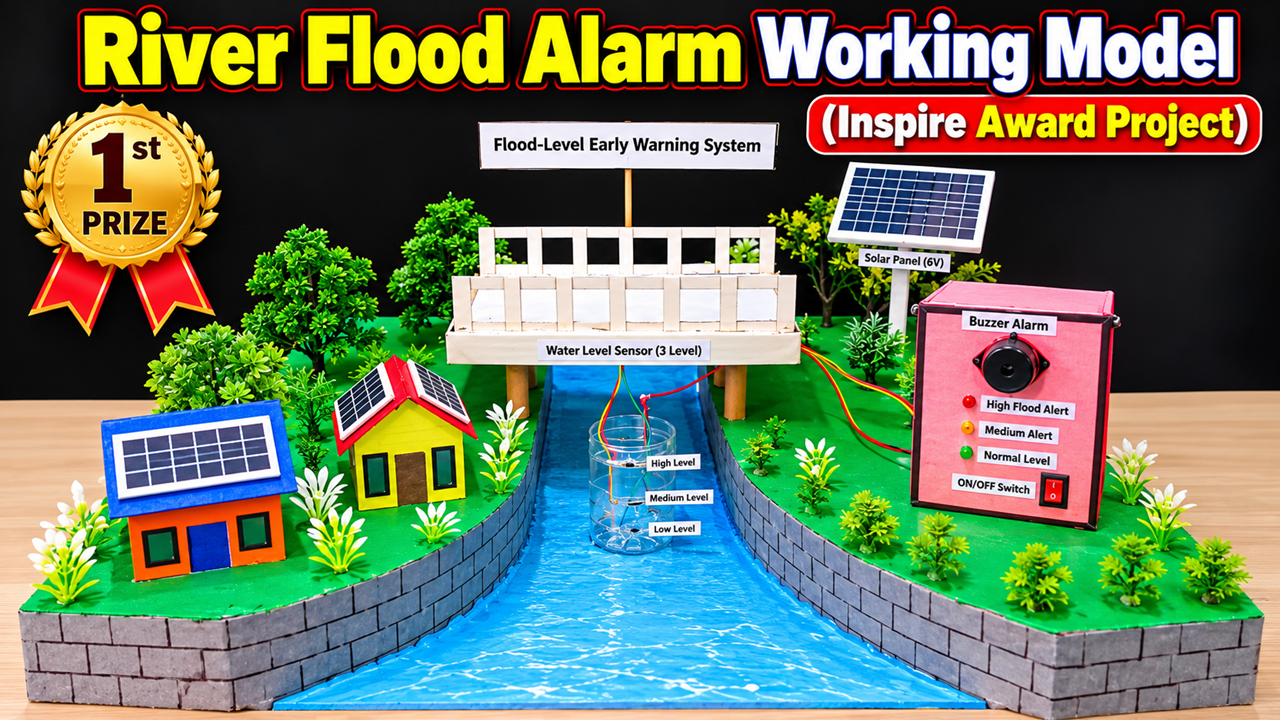
Today, I am going to present my science project, “River Flood Alarm Working Model – Flood-Level Early Warning System.”
Floods are among the most common natural disasters. Heavy rainfall, overflowing rivers, dam water releases, and poor drainage can cause floods. Floods can destroy houses, roads, crops, and electricity systems. They can also cause loss of human and animal lives.
My project demonstrates how a river flood alarm system can detect rising water levels and provide early warnings to people living near rivers. The main purpose of this model is to show how simple electronic components can help reduce flood-related risks and support disaster management.
2. Aim of the Project
The main aim of this project is to develop a model that detects different river water levels and alerts people when the water rises to a dangerous level.
The system demonstrates three water-level conditions:
- Low level: The river water is at a normal level.
- Medium level: The water is rising, and people should remain alert.
- High level: The water has reached a dangerous level, and an emergency warning is activated.
This type of system can help authorities provide warnings and give people more time to move to safer locations.
3. Materials Required
The following materials are used to construct this model:
- Cardboard sheets for the base, houses, and riverbank.
- Green chart paper or green foam sheets for grass and land.
- Blue chart paper or blue plastic sheet for the river.
- Small cardboard pieces for houses and bridges.
- Water-level sensors or metal probes.
- A suitable electronic controller or water-level detection circuit.
- Buzzer for the audible alarm.
- Red, yellow, and green LEDs for warning indications.
- Connecting wires.
- A switch to turn the system on and off.
- A low-voltage power supply or suitable battery.
- A small solar panel, if the model is designed to demonstrate solar-assisted power.
- Glue, scissors, ruler, markers, and decorative plants.
The exact electronic components depend on the circuit used in the model.
4. Making Process
Step 1: Prepare the base
Take a thick cardboard sheet and make a rectangular base. Cover the top with green chart paper to represent land and vegetation. Make the base strong enough to support the river, houses, bridge, and electronic components.
Step 2: Create the river
Use blue chart paper or a waterproof blue sheet to create a river flowing through the centre of the model. Make riverbanks on both sides using cardboard. Add small plants, trees, houses, and roads near the river to represent a community that may be affected by flooding.
Step 3: Construct the bridge
Make a bridge using cardboard strips. Place it across the river. Position the water-level sensor near the river or inside a transparent water container connected to the model. Ensure that the sensor remains stable.
Step 4: Install the water-level detection system
Place the low-, medium-, and high-level detection probes at different heights. The lowest probe represents the initial level, the middle probe represents a rising river, and the highest probe represents a critical flood level.
Connect the probes to a suitable water-level detection circuit or controller. The circuit must be designed to recognise the different water levels and activate the corresponding indicators.
Step 5: Connect the warning system
Connect green, yellow, and red LEDs to the appropriate outputs of the circuit. Connect the buzzer to the high-level warning output. Add an ON/OFF switch and check that the circuit operates according to the intended design.
Step 6: Add the solar panel
Mount a small solar panel on a stand near the houses. If solar power is intended to operate the circuit, connect it through a suitable voltage regulator or charging circuit, as required. A rechargeable battery can store energy for operation when sunlight is unavailable.
Step 7: Decorate and label
Add miniature houses, trees, roads, bushes, and other details. Attach labels such as “Water-Level Sensor,” “Low Level,” “Medium Level,” “High Level,” “Buzzer Alarm,” and “Flood-Level Early Warning System.”
Finally, test the electronics before demonstrating the project.
5. Working Principle
The working principle of this project is based on detecting changes in water level.
When the river water is below the first detection point, the system indicates a normal condition. As the water rises and reaches the medium-level probe, the circuit activates the medium-level warning, represented by a yellow LED.
When the water reaches the high-level probe, the circuit activates the red LED and buzzer, depending on the circuit design. This indicates that the water has reached a critical level and that people should follow official flood warnings and emergency instructions.
The system demonstrates how an automatic warning can be generated without requiring someone to watch the river continuously. Actual flood-warning systems may also use rain gauges, river-flow measurements, communication networks, and weather forecasts.
6. Live Demonstration at the Exhibition
During the exhibition, I will demonstrate the model using a small container of water.
First, I will show the normal water level. The green indicator represents a safe or normal condition.
Next, I will slowly raise the water level to the medium-level sensor. The yellow indicator will show that the river is rising and that caution is required.
Finally, I will raise the water to the high-level sensor. The red indicator and buzzer should activate, demonstrating the emergency warning.
This experiment shows how the system responds to different water levels. The demonstration should use low-voltage electronics and be performed carefully to keep water away from exposed electrical connections.
7. Advantages and Applications
This model demonstrates several useful applications:
- It shows how rising water levels can be detected automatically.
- It provides visual and audible warnings.
- It can help explain flood preparedness and disaster management.
- It demonstrates the use of sensors and electronic circuits.
- It introduces the concept of solar-assisted power for monitoring systems.
- It can be adapted for rivers, reservoirs, drainage channels, and water tanks.
A real-world system would require reliable sensors, weatherproof equipment, backup power, communications, regular maintenance, and testing before it could be used for public safety.
8. Conclusion
To conclude, my River Flood Alarm Working Model demonstrates how technology can help detect rising water levels and provide early warnings. Although this is a small educational model, it explains an important real-world idea: early information can help communities prepare for floods and reduce potential damage.
Through this project, I learned about water-level sensors, electronic circuits, warning indicators, renewable energy, and disaster management.
My message is simple: “Early Warning, Timely Action, and Community Preparedness Can Save Lives.”
Thank you!