
Introduction
“Good morning, respected judges. Today, I am proud to present our project: a Smart, Non-Programmable Fire Fighting Robot.
Fire disasters strike unexpectedly, causing devastating losses to life and property. Deploying human firefighters into intensely toxic, high-temperature environments is highly hazardous. While micro-controller-based autonomous robots exist, they are often complex to program, expensive to manufacture, and prone to software glitches under extreme thermal duress.
Our project tackles this challenge directly. We have built an incredibly efficient, budget-friendly autonomous robot that does not require an Arduino or any programming, demonstrating that simple hardware logic can solve critical, real-world problems.”
Project Overview & Core Components
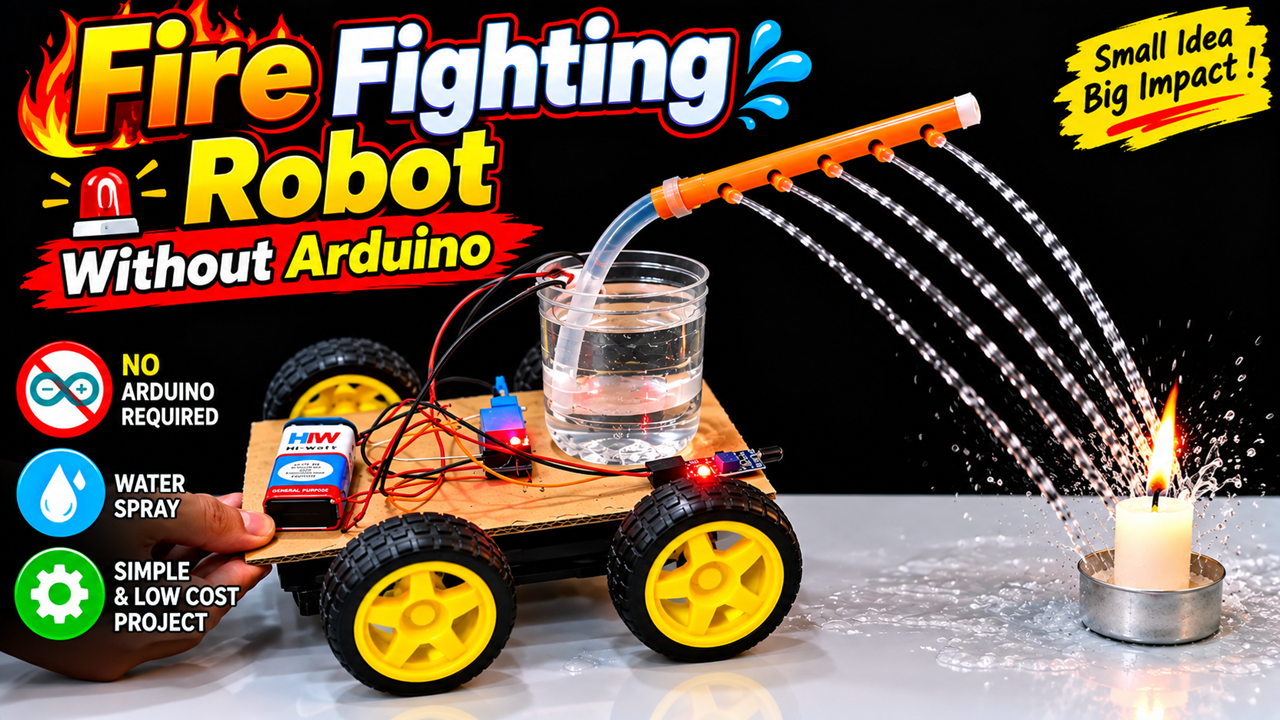
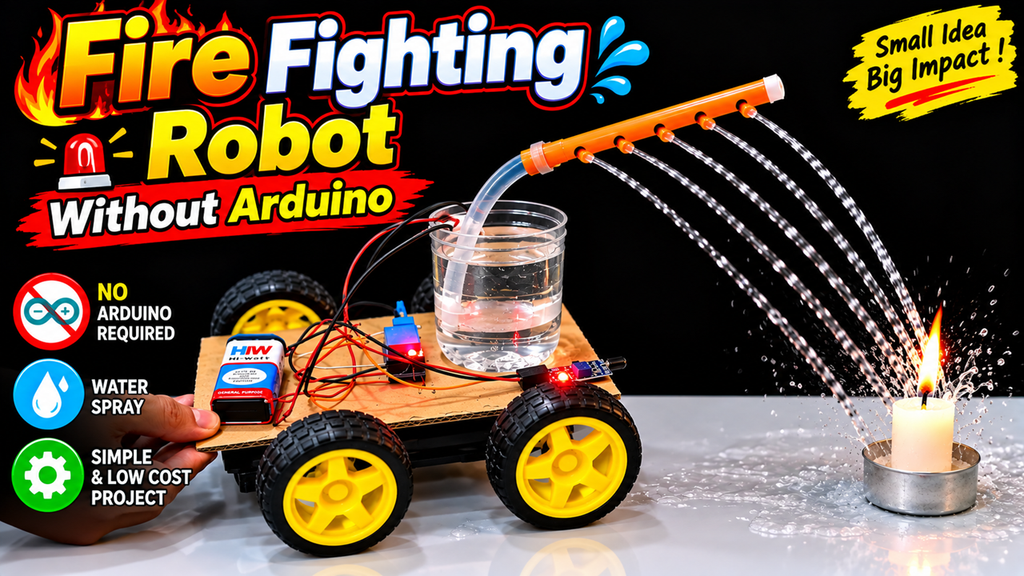
“As you can see from our working model, this vehicle is built on a simple, lightweight chassis designed to navigate toward a fire source automatically. The entire system relies on purely analog electronic components working in a seamless loop:
- The Fire Detection Sensors (IR/Flame Sensors): Mounted at the front, these act as the eyes of our robot. They are specifically tuned to detect the infrared radiation wavelengths emitted by open flames.
- The Transistor/Relay Driving Circuit: Instead of a complex micro-controller, we use simple transistor switches or a basic relay board. These act as the brain, routing electronic signals instantaneously without waiting for lines of code to execute.
- The Extinguishing System: This features a mini submersible DC water pump placed inside an onboard water reservoir, connected to an elevated spray nozzle that targets the center of the flame.
- The Mobility Drive: Driven by a standard 9V HW battery, high-torque DC geared motors, and rugged wheels, it provides the necessary movement to reach the hazard zone.”
How the System Works
“When the robot is placed near a fire source, it operates through a highly responsive hardware loop:
- Flame Sensing: The moment a candle or fire breaks out, the infrared light from the flame hits the photodiode of our flame sensor module. This drops the sensor’s internal resistance.
- Analog Triggering: This resistance change allows a small current to flow into the signal pin. This signal goes straight to the transistor or relay module, acting as a physical electronic gate.
- Simultaneous Activation: As the gate switches ‘ON’, it immediately closes the power circuit for both the drive motors and the water pump. The robot drives forward to line itself up with the hazard.
- Targeted Extinguishing: Simultaneously, the DC water pump draws water from the reservoir and forces it through the upper spray tube. The calculated arc of the water spray falls directly onto the flame, putting it out within seconds.
- Auto-Shutdown: Once the fire is successfully extinguished, the infrared radiation disappears. The sensor switches back to its default state, cutting the power and stopping the robot automatically.”
Real-World Impact and Innovation
“What makes this model truly unique—and highly fitting for the Inspire Award theme of ‘Small Idea, Big Impact’—is its extreme simplicity and affordability:
- Zero Coding Dependency: Because there is no software, the robot can never experience an operating system crash or loop freeze when exposed to high heat.
- Low Cost & Accessibility: By eliminating expensive micro-controllers, this system can be mass-produced at a fraction of the cost, making it highly accessible for small businesses, local kitchens, or small-scale industries.
- Rapid Hardware Response: Hardware-level triggers operate at the speed of electricity, providing a faster initial response than systems requiring sensor data processing time.
For future updates, we plan to scale this model by adding a simple mechanical steering system and expanding the water reservoir to handle larger, real-world fire scenarios.”
Conclusion
“Our project proves that we do not always need expensive, complex computers to build life-saving technology. With basic components, we can create reliable, immediate solutions that protect our communities. Thank you, judges. I am now open to any questions you may have.”