
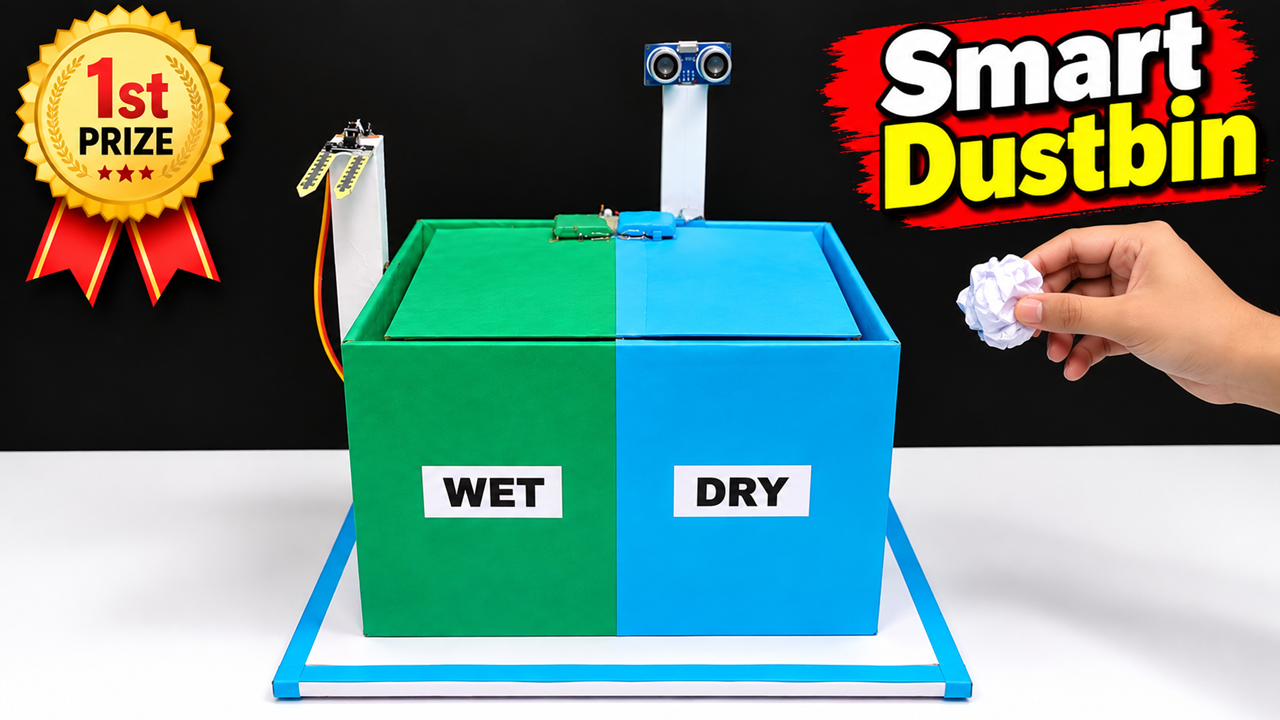
Good morning, respected judges. Today, I am proud to present our project: the Smart Automated Waste Segregation Dustbin.
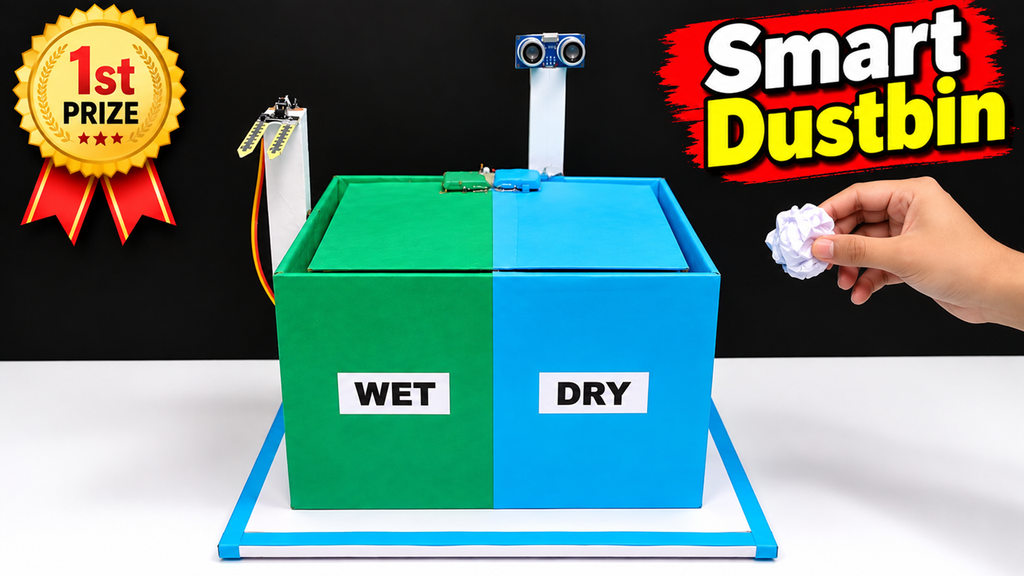
Urbanization is accelerating globally, and with it, waste management has become one of our greatest ecological challenges.
While recycling initiatives exist worldwide, their success is heavily bottle-necked by human error. Millions of tons of recyclable materials end up ruined in landfills because they were improperly mixed with organic waste at the source.
Our project eliminates human negligence entirely by introducing an automated, touchless system that accurately detects, separates, and manages waste into Wet and Dry categories instantly.”
Project Overview & Core Components
“As you can see from our working model, the bin is divided into two distinct, color-coded compartments: Green for Wet waste (such as food scraps and organic matter) and Blue for Dry waste (such as paper, plastic, and cardboard).
The entire automated ecosystem relies on three critical electronic elements working together:
- The Proximity / Ultrasonic Sensor: Mounted centrally at the top, this acts as the system’s eyes. It continuously scans the space directly in front of the bin to detect an approaching user or hand holding trash.
- The Soil Moisture / Rain Sensor Module: Hidden beneath the initial intake flap, this sensor instantly analyzes the physical properties of the waste to determine if moisture content is present.
- The Micro Servo Motors: Act as the physical actuators. They receive commands from our micro-controller to mechanically tilt, slide, or open the correct flap based on the sensor’s reading.”
How the System Works
“When a user brings trash near the system, it operates in a highly efficient, automated pipeline:
- Touchless Activation: As a hand approaches, the ultrasonic sensor detects the precise distance. It triggers the main intake shield to prepare for incoming waste without requiring the user to physically touch a dirty lid, ensuring maximum hygiene.
- Moisture Assessment: The thrown item briefly contacts the internal sorting tray. If the material contains liquid or organic moisture, the moisture sensor triggers a positive signal. If the object is bone-dry—like this crumpled paper ball—the signal remains negative.
- Mechanical Segregation: Based on this data, the micro-controller instructs the servo motors to actuate. If classified as wet, the sorting mechanism tilts left, dropping the item into the Wet compartment. If classified as dry, it tilts right into the Dry compartment.
- Reset Mode: The mechanism instantly resets back to its horizontal baseline position within a second, standing ready for the next piece of garbage.”
Real-World Impact and Future Scalability
“What makes this model stand out is its immediate scalability for smart city infrastructures, public parks, and hospitals. By automating segregation at the exact point of disposal:
- We significantly reduce the labor-intensive, hazardous manual sorting traditionally done by municipal workers.
- We maximize the volume of clean, unsoiled dry plastic and paper that can be successfully sent straight to recycling plants.
- We speed up organic composting because the wet waste stream remains completely free of toxic plastics.
In future iterations, this system can be upgraded with IoT modules to send cellular alerts to municipal trucks when a compartment is 90% full. It can also integrate an inductive proximity sensor to isolate metal scraps from plastic entirely.”
Conclusion
“Our Smart Dustbin proves that small-scale automated engineering can solve large-scale environmental crises. By turning a regular trash can into an intelligent assistant, we take a massive step toward cleaner cities and a truly sustainable future. Thank you, judges. I am now open to any questions you may have.”