
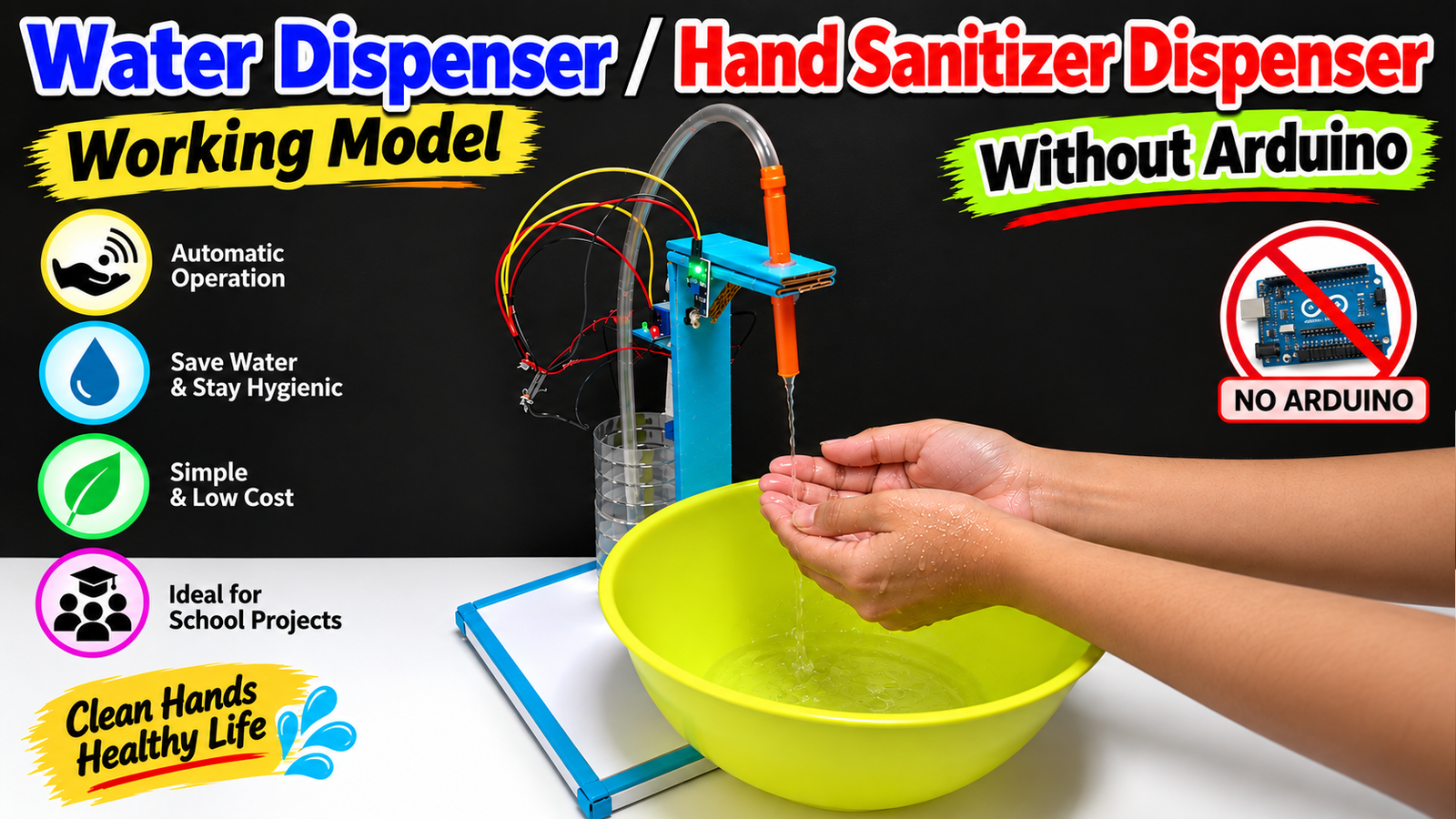
Sensor projects are excellent for school science exhibitions because they demonstrate how real-world problems can be solved through detection, automation, and simple electronic control systems. Many of these projects can be built using inexpensive components such as IR sensors, LDRs, ultrasonic sensors, soil-moisture sensors, gas sensors, temperature sensors, water-level sensors, and Arduino boards. Some can even be made without Arduino using relay modules, transistors, timers, or simple control circuits.
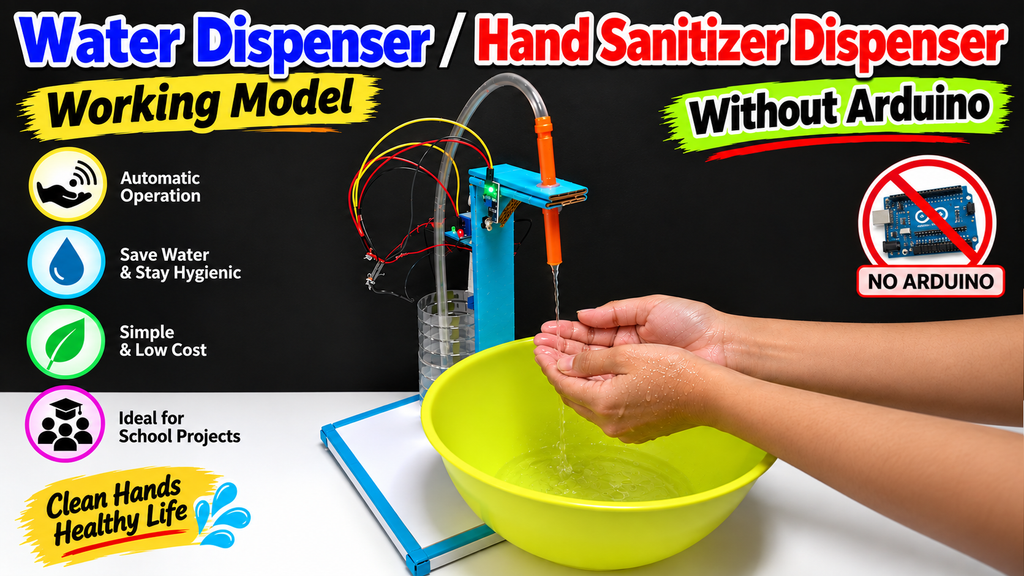
Below are 25 practical sensor project ideas, with the problem, working principle, components, and possible improvements explained for each.
1. Automatic Water Dispenser Using IR Sensor
Problem: Touching taps and dispenser buttons can spread germs and also lead to unnecessary water wastage.
Idea: Build a touchless water dispenser that detects a person’s hand and automatically operates a small DC water pump.
How it works: An IR sensor continuously detects an object placed near it. When a hand comes within the detection range, the sensor produces a signal. This signal can activate a relay module, which switches ON a DC pump. Water flows through a tube and nozzle. When the hand is removed, the sensor changes state and the pump turns OFF.
Components: IR sensor, relay module, DC water pump, battery or DC adapter, water container, tube, nozzle, and cardboard/acrylic stand.
Science principle: Infrared reflection and electrical switching.
Why it is good for students: It demonstrates sensing, automation, electrical control, and water conservation in one model. It can also be converted into a hand-sanitizer or liquid-soap dispenser.
2. Automatic Street Light Using LDR Sensor
Problem: Street lights sometimes remain ON during daylight, wasting electricity.
Idea: Create a street-light model that automatically switches ON at night and OFF during the day.
How it works: An LDR, or Light Dependent Resistor, changes its resistance depending on the amount of light falling on it. During daytime, strong light causes the circuit to keep the LEDs OFF. When darkness arrives, the resistance changes and the control circuit switches the LEDs ON.
Components: LDR, LEDs, resistors, transistor or relay, battery, wires, and miniature road model.
Science principle: Variation of electrical resistance with light intensity.
Extension: Add multiple street lights and demonstrate how automatic control can reduce electricity consumption.
3. Smart Dustbin Using Ultrasonic Sensor
Problem: People often touch dustbin lids, which can be unhygienic.
Idea: Make a dustbin that automatically opens its lid when a person brings their hand near it.
How it works: An ultrasonic sensor sends high-frequency sound waves and measures the time taken for the waves to return after hitting an object. When a hand is detected within a preset distance, a servo motor rotates and opens the lid.
Components: Ultrasonic sensor, Arduino, servo motor, dustbin, battery, and connecting wires.
Science principle: Reflection of sound waves and distance measurement.
Extension: Add a second sensor inside the bin to indicate when the dustbin is full.
4. Automatic Plant Watering System
Problem: Plants may dry out when people forget to water them.
Idea: Create an automatic irrigation system that waters a plant only when the soil becomes dry.
How it works: A soil-moisture sensor measures the moisture content of the soil. When the soil becomes sufficiently dry, the controller activates a small water pump. Water is delivered to the plant through a tube. When sufficient moisture is detected, the pump stops.
Components: Soil-moisture sensor, Arduino or relay circuit, DC pump, water container, tube, battery, and plant pot.
Science principle: Electrical changes caused by moisture in soil.
Benefits: The project demonstrates water conservation and smart agriculture.
5. Automatic Hand Sanitizer Dispenser
Problem: Manual sanitizer bottles require users to touch the pump.
Idea: Design a touchless sanitizer dispenser.
How it works: An IR sensor detects the hand placed below the nozzle. A controller activates a small pump or dispensing mechanism for a short period. Sanitizer is then released without physical contact.
Components: IR sensor, Arduino or timer circuit, mini pump, relay/MOSFET, sanitizer container, tube, nozzle, and battery.
Science principle: Infrared sensing and automatic switching.
Extension: A timer can be added so that only a controlled quantity of sanitizer is dispensed each time.
6. Water Tank Overflow Alarm
Problem: Overfilled water tanks waste water and can damage surrounding areas.
Idea: Create a model that detects when a tank reaches a particular water level and produces an alarm.
How it works: Water-level sensors are placed at different heights inside a transparent tank. When water reaches the highest sensor, the circuit activates a buzzer and LED. A relay can also be used to switch OFF the water pump.
Components: Water-level probes or water-level sensor, buzzer, LEDs, relay, pump, battery, and transparent container.
Science principle: Water conducts electricity, allowing the circuit to detect contact with water.
Extension: Add several LEDs to show LOW, MEDIUM, and FULL levels.
7. Automatic Night Lamp
Problem: Lights are often switched ON manually even when they are not needed.
Idea: Make a lamp that automatically turns ON when the surroundings become dark.
How it works: An LDR detects ambient light. When light intensity decreases below a certain level, the control circuit activates an LED. During daylight, the LED automatically switches OFF.
Components: LDR, transistor, resistor, LED, battery, and switch.
Science principle: Light-dependent resistance.
Difficulty: Beginner.
This is one of the easiest sensor projects for younger students.
8. Obstacle Detection Vehicle
Problem: Robots and vehicles need to detect objects in their path to avoid collisions.
Idea: Build a small robot that automatically detects obstacles and changes direction.
How it works: An ultrasonic sensor measures the distance between the robot and an obstacle. If the obstacle is too close, the controller stops the motors and turns the robot in another direction.
Components: Arduino, ultrasonic sensor, motor driver, two or four DC motors, wheels, battery, and robot chassis.
Science principle: Distance measurement using ultrasonic waves.
Extension: Use two or more sensors to make the robot capable of navigating more intelligently.
9. Smart Parking System
Problem: Drivers waste time searching for available parking spaces.
Idea: Create a miniature parking area showing which spaces are occupied.
How it works: IR or ultrasonic sensors are installed in individual parking slots. When a vehicle enters a slot, the sensor detects it. A red LED indicates an occupied space, while a green LED indicates an available space.
Components: IR sensors, Arduino, LEDs, resistors, model cars, and cardboard parking structure.
Science principle: Object detection.
Extension: Add an LCD display showing the number of available spaces.
10. Automatic Fan Using Temperature Sensor
Problem: Fans often run continuously even when the room is cool.
Idea: Build a fan that automatically starts when the temperature rises.
How it works: A temperature sensor measures surrounding temperature. The controller compares the reading with a preset value. If the temperature rises above that value, a DC fan turns ON.
Components: Temperature sensor such as LM35, Arduino, transistor or relay, DC fan, and battery.
Science principle: Conversion of temperature into an electrical signal.
Extension: Use different temperature levels to control fan speed.
11. Fire Detection and Alarm System
Problem: Early detection of fire can prevent major damage.
Idea: Build a small fire-alert system using a flame sensor.
How it works: A flame sensor detects infrared radiation associated with a flame. When a flame is detected, the circuit activates a buzzer and warning LED. A relay could also activate a small demonstration pump or emergency light.
Components: Flame sensor, Arduino or comparator circuit, buzzer, LED, relay, and battery.
Science principle: Detection of infrared radiation from flames.
Important: For demonstrations, use a safe simulated flame or supervised small flame; never leave an experimental fire unattended.
12. Gas Leakage Detector
Problem: Gas leaks can create serious safety hazards.
Idea: Build a model that detects the presence of combustible gases and produces an alarm.
How it works: A gas sensor detects changes in gas concentration. When the concentration crosses a programmed threshold, a buzzer and warning LED activate.
Components: Gas sensor module, Arduino, buzzer, LED, display, and battery.
Science principle: Change in sensor resistance caused by gas exposure.
Extension: Add an LCD to display a relative gas-level reading.
13. Rain Detection System
Problem: Rain can damage clothes, crops, books, and outdoor equipment if it is not detected.
Idea: Build a rain detector that automatically gives an alert when rain begins.
How it works: A rain sensor contains conductive tracks. When water droplets fall onto the sensor surface, conductivity changes. The controller detects this change and activates a buzzer or LED.
Components: Rain sensor, Arduino, buzzer, LED, and battery.
Extension: Connect the sensor to a small servo mechanism that moves a miniature roof or clothesline cover.
14. Smart Umbrella Stand
Problem: Wet umbrellas can make floors slippery.
Idea: Create a model that detects water dripping from umbrellas and gives an alert.
How it works: A water sensor placed at the bottom of a collection tray detects accumulated water. When the water reaches a certain level, an LED or buzzer is activated.
Components: Water sensor, buzzer, LED, battery, tray, and miniature umbrella stand.
Science principle: Electrical conductivity of water.
This is an original and simple exhibition idea because it addresses a common everyday problem.
15. Automatic Door Using PIR Sensor
Problem: Doors in public places can require frequent touching.
Idea: Build an automatic door that opens when a person approaches.
How it works: A PIR sensor detects movement caused by a person’s body. The controller activates a servo motor, which opens the miniature door. After a delay, the door closes.
Components: PIR sensor, Arduino, servo motor, cardboard door, battery, and LEDs.
Science principle: Detection of changes in infrared radiation associated with moving objects.
16. Smart Blind Stick
Problem: Visually impaired people may encounter obstacles while walking.
Idea: Create a prototype walking stick that alerts the user when an obstacle is nearby.
How it works: An ultrasonic sensor continuously measures distance. When an obstacle comes within a selected range, the device produces a buzzer sound or vibration.
Components: Ultrasonic sensor, Arduino, buzzer, vibration motor, battery, and stick.
Science principle: Ultrasonic distance measurement.
Extension: Use different vibration patterns for different distances.
17. Smart Refrigerator Door Alarm
Problem: Leaving a refrigerator door open wastes electricity.
Idea: Create a miniature system that warns when a refrigerator door remains open.
How it works: A magnetic reed switch detects whether the door is open or closed. If the door stays open longer than a preset period, the buzzer sounds.
Components: Magnetic reed switch, Arduino or timer circuit, buzzer, LED, and battery.
Science principle: Magnetic switching.
18. Automatic Railway Crossing Model
Problem: Railway crossings require warning systems to prevent accidents.
Idea: Build a miniature railway crossing that detects an approaching train and automatically lowers a barrier.
How it works: An IR sensor detects the model train. The controller activates warning LEDs and a buzzer and moves a servo motor to lower the barrier.
Components: IR sensors, Arduino, servo motor, LEDs, buzzer, toy train, and cardboard railway model.
Science principle: Object detection and automated control.
19. Smart Traffic Light System
Problem: Fixed traffic signals may waste time when traffic is uneven.
Idea: Create a traffic-light model that changes signal timing according to traffic density.
How it works: IR sensors detect vehicles on different roads. The controller counts or estimates traffic and gives a longer green-light period to the road with greater traffic.
Components: IR sensors, Arduino, red/yellow/green LEDs, resistors, and cardboard road.
Science principle: Sensor-based decision making.
20. Automatic Pet Feeder
Problem: Pets may not receive food at regular times when owners are away.
Idea: Build a timed automatic feeding mechanism.
How it works: A controller activates a servo motor at predetermined times. The servo rotates a small gate, allowing a measured quantity of dry food to fall into a bowl.
Components: Arduino, RTC module or timer, servo motor, container, and bowl.
Science principle: Automation and programmed timing.
Extension: Add an ultrasonic sensor to detect whether food remains in the bowl.
21. Smart Classroom Energy Saver
Problem: Classroom lights and fans are sometimes left running when nobody is present.
Idea: Automatically control classroom appliances based on occupancy and light level.
How it works: A PIR sensor detects people while an LDR measures ambient light. If people are present and the room is dark, the lights can be activated. If nobody is present, the system can switch them OFF.
Components: PIR sensor, LDR, Arduino, relay module, LEDs, and model classroom.
Science principle: Combining multiple sensor inputs for automated decisions.
22. Automatic Water-Level Pump Controller
Problem: Water pumps may continue running after a tank is full.
Idea: Build a controller that automatically starts and stops a pump according to water level.
How it works: Low-level and high-level sensors are installed in the tank. When water falls below the low level, the pump turns ON. When water reaches the high level, the pump turns OFF.
Components: Water-level sensors, relay, DC pump, battery, tank, LEDs, and wires.
Science principle: Electrical detection of water level.
Benefit: This project combines water conservation with automation and is particularly suitable for a science exhibition.
23. Smart Soil Moisture Indicator
Problem: People often do not know whether a plant needs water.
Idea: Create a device that visually indicates soil moisture.
How it works: A moisture sensor is inserted into the soil. Depending on the moisture level, different LEDs illuminate. For example, green can indicate sufficient moisture, yellow can indicate moderate moisture, and red can indicate dry soil.
Components: Soil-moisture sensor, Arduino or comparator circuit, LEDs, resistors, and battery.
Science principle: Change in electrical conductivity/resistance associated with soil moisture.
Extension: Combine it with an automatic pump to create a complete smart irrigation system.
24. Smart Waste Segregation Bin
Problem: Mixing wet and dry waste makes recycling more difficult.
Idea: Build a prototype bin that attempts to identify different types of waste and direct them into separate compartments.
How it works: Different sensors can be combined depending on the level of sophistication. An inductive sensor can help detect metallic objects, while moisture sensing can distinguish relatively wet materials. A servo mechanism can then direct the waste toward different compartments.
Components: Moisture sensor, inductive/metal sensor, Arduino, servo motors, LEDs, and cardboard compartments.
Science principle: Material properties such as electrical conductivity and moisture content.
Important: This is a prototype; real-world waste classification requires more sophisticated sensing.
25. Smart Flood Warning System
Problem: Rapidly rising water levels can create dangerous flood conditions.
Idea: Build a miniature flood-warning system for homes or communities near water bodies.
How it works: A water-level sensor or ultrasonic sensor measures the water level. As the level rises, LEDs can change from green to yellow to red. At the danger level, a buzzer activates.
Components: Water-level or ultrasonic sensor, Arduino, LEDs, buzzer, transparent container, and miniature houses.
Science principle: Water-level and distance measurement.
Extension: Add a miniature automatic flood barrier that rises when the water reaches a critical level.