
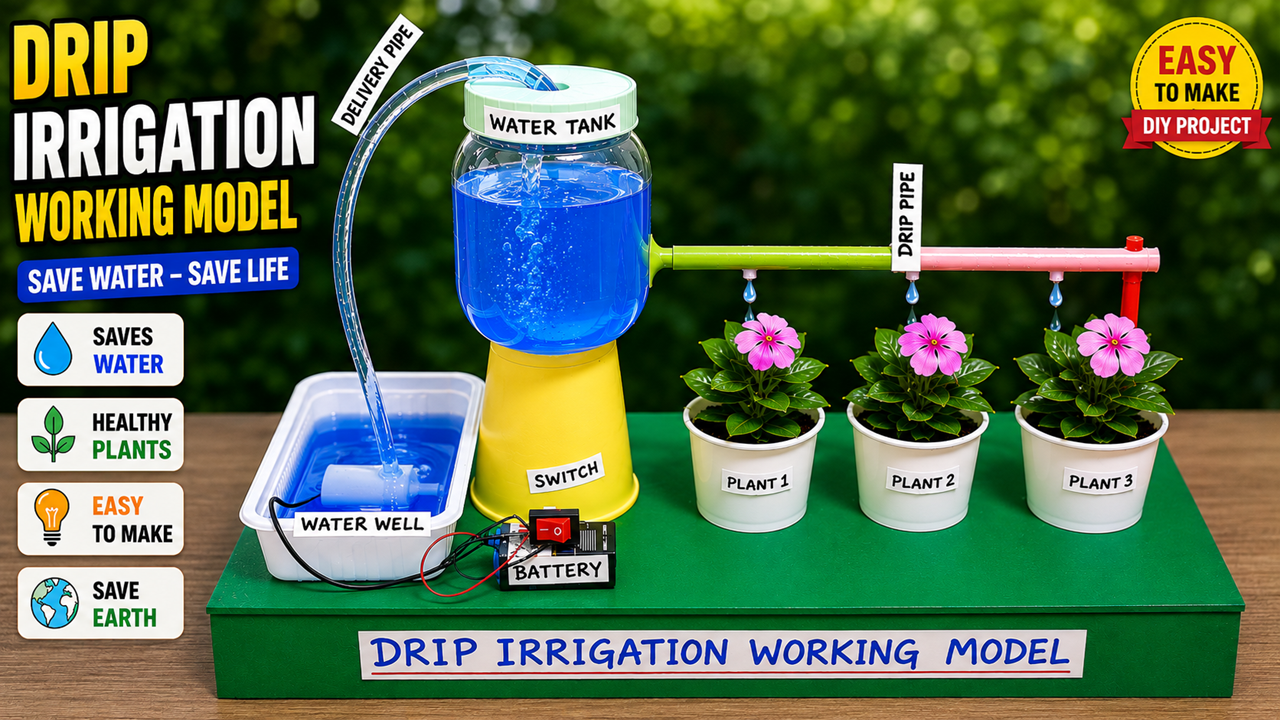
A Drip Irrigation Working Model is an excellent and practical science exhibition project that demonstrates how water can be supplied directly to the roots of plants in a controlled manner. This simple DIY model explains an important agricultural technique used to improve water efficiency, reduce unnecessary water loss, and support healthy plant growth.
The model shown consists of a water tank, water pump, delivery pipe, drip pipe, individual plants, battery, and switch. When the system is switched on, water is pumped from the water source into the tank and then delivered through the drip pipe. Small outlets allow water to fall slowly near the plants, demonstrating the basic principle of drip irrigation.
What is Drip Irrigation?
Drip irrigation is a method of watering plants in which water is delivered slowly and directly to the soil near the plant roots.
Unlike conventional methods where water may be distributed over a large area, drip irrigation supplies water more precisely to the plants that need it.
The basic process can be represented as:
Water Source → Pump → Water Tank → Delivery Pipe → Drip Pipe → Plant Roots
This controlled delivery can help reduce water losses associated with unnecessary surface flow and evaporation.
Objective of the Project
The main objective of this working model is to demonstrate the importance of efficient water management in agriculture.
The project helps students understand:
- How drip irrigation works
- How water is transported through pipes
- How water can be supplied directly near plant roots
- The importance of conserving water
- The role of pumps in irrigation
- The importance of efficient agricultural practices
It is suitable for a school science exhibition, environmental project, agriculture project, STEM activity, geography project, or DIY working model.
Materials Required
The model can be constructed using simple and easily available materials:
- Cardboard or foam board
- Plastic water container
- Small DC water pump
- Battery
- On/off switch
- Flexible plastic tubing
- Drip pipe
- Small plants or artificial plants
- Small plant pots
- Water tray or reservoir
- Connecting wires
- Glue
- Tape
- Paint
- Scissors
- Small connectors or drip outlets
For a school exhibition model, artificial plants can be used to avoid making a mess with soil and water.
How to Make the Model
First, prepare a strong rectangular cardboard base and cover it with green paper to represent an agricultural field.
Place three or more small plant pots in a row on the base. These represent crops growing in a field.
Next, place a small water reservoir or water well at one side of the model. Install a small DC water pump inside the reservoir.
Connect the pump to a plastic delivery pipe. The delivery pipe carries water upward into the transparent water tank.
From the tank, connect another pipe horizontally along the row of plants. This pipe represents the drip irrigation pipe.
Create small outlets or attach drip emitters at suitable positions above each plant. These outlets should release water slowly near the base of the plants.
Finally, connect the pump to the battery through an ON/OFF switch.
How Does the Working Model Work?
When the switch is turned ON, electrical energy from the battery powers the water pump.
The pump draws water from the reservoir and pushes it through the delivery pipe into the water tank.
The water then travels from the tank through the drip pipe.
Small openings in the drip pipe allow water to come out as slow drops.
These drops fall close to the plants rather than flooding the entire area.
The demonstration can be repeated by switching the pump ON and OFF.
The model therefore shows how water can be delivered in a controlled and targeted manner.
Science Behind Drip Irrigation
The project demonstrates several scientific principles.
Water Flow
The pump creates pressure that moves water through the pipe system.
Gravity
When water is stored at a higher level, gravity can help water move through the irrigation pipe. In some systems, a pump may not be necessary if there is sufficient elevation and pressure.
Controlled Water Delivery
Small outlets or emitters restrict the flow of water, allowing it to be released gradually.
Root-Zone Irrigation
The objective is to deliver water near the plant’s root zone, where it can be used by the plant.
Advantages of Drip Irrigation
Drip irrigation can provide several benefits when properly designed and managed:
- Efficient water use
- Water is delivered close to plant roots.
- It can reduce unnecessary runoff.
- It can help maintain more consistent soil moisture.
- It can be useful in areas where water is limited.
- Fertilizers can be applied through irrigation systems in some agricultural setups.
- It can support efficient cultivation of crops.
The actual water savings depend on factors such as crop type, soil, climate, system design, and management.
Applications
Drip irrigation is widely used in agriculture and horticulture. It can be particularly useful for:
- Vegetable gardens
- Fruit orchards
- Flower cultivation
- Nurseries
- Greenhouses
- Home gardens
- Agricultural fields
Farmers can design drip systems according to the number and spacing of plants and the amount of water required.
Exhibition Explanation
A student can explain the model like this:
“This is a Drip Irrigation Working Model. Drip irrigation is a method of supplying water slowly and directly near the roots of plants. In this model, a battery powers the water pump. The pump transfers water from the reservoir to the water tank through a delivery pipe. From the tank, water flows through the drip pipe. Small outlets release water drop by drop near each plant. This method helps demonstrate how water can be supplied in a controlled way and why efficient irrigation is important for water conservation.”
How to Improve the Project
The basic model can be upgraded by adding:
- Adjustable drip emitters
- Water-level sensors
- Soil-moisture sensors
- Automatic pump control
- Solar panels
- Arduino control
- Multiple crop sections
- Automatic irrigation based on soil moisture
- Digital water-consumption display
For an advanced STEM version, a soil-moisture sensor and Arduino can be added. When the soil becomes dry, the Arduino can activate the pump, and when sufficient moisture is detected, the pump can be switched off.
Conclusion
The Drip Irrigation Working Model is a simple, attractive, and meaningful science exhibition project that connects agriculture, water conservation, physics, and technology.
By showing water moving from a reservoir through a pump, tank, delivery pipe, and drip line to individual plants, the model makes the concept easy to understand.
The central message of the project is:
“Save Water – Deliver Every Drop Where It Is Needed.”
With inexpensive materials and a simple working mechanism, this project is ideal for students who want to demonstrate how technology can support efficient irrigation and sustainable agriculture.