
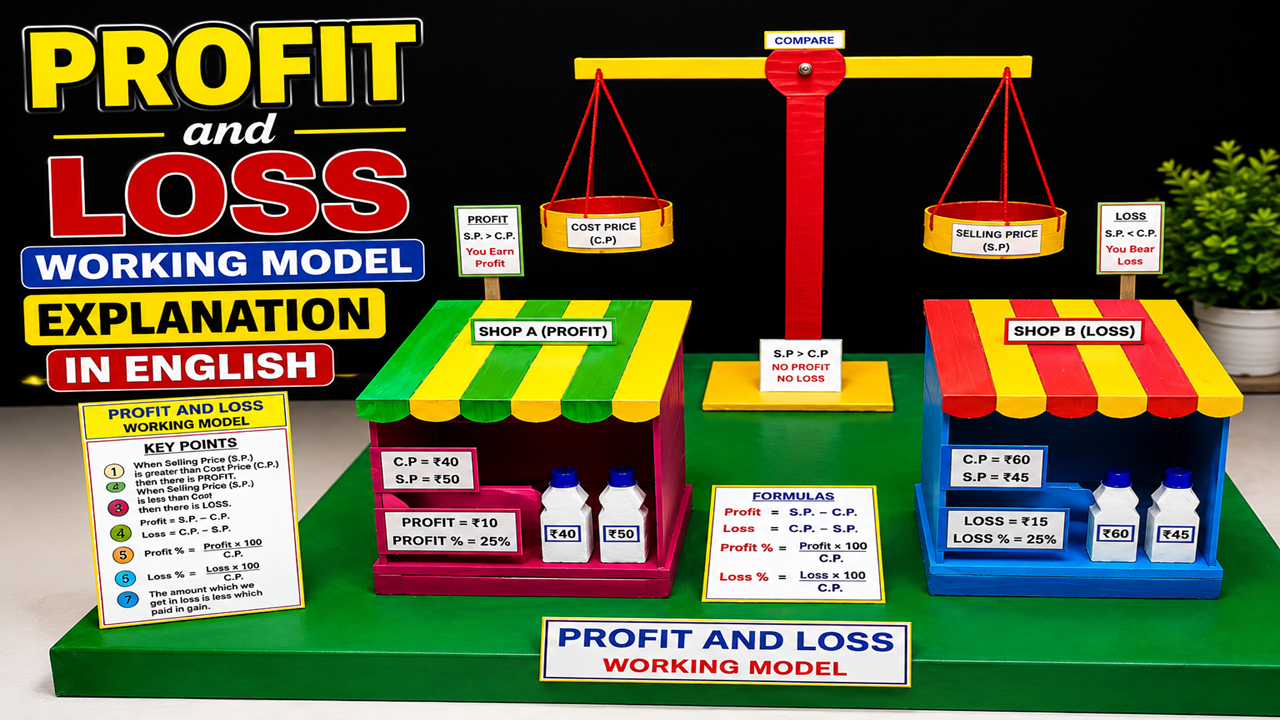
A Profit and Loss Working Model is an excellent Mathematics project for school exhibitions. This creative DIY model helps students understand important commercial mathematics concepts such as Cost Price (C.P.), Selling Price (S.P.), Profit, Loss, Profit Percentage, and Loss Percentage through a simple and attractive shop-based setup.
Instead of learning formulas only from a textbook, students can use this model to visualize how buying and selling prices affect profit or loss. The two miniature shops in the model represent two different business situations—Shop A makes a profit, while Shop B experiences a loss.
Objective of the Project
The main objective is to demonstrate the basic concepts of profit and loss using a real-life shopping situation.
The model helps students understand:
- Cost Price
- Selling Price
- Profit
- Loss
- Profit Percentage
- Loss Percentage
- Comparison between C.P. and S.P.
- Practical application of mathematical formulas
It is suitable for Mathematics exhibitions, school projects, classroom demonstrations, DIY working models, and activity-based learning.
Materials Required
The model can be created using simple craft materials:
- Cardboard
- Chart paper
- Coloured paper
- Ice-cream sticks
- Glue
- Scissors
- Sketch pens
- Small plastic bottles or containers
- Thread
- Small cardboard trays
- Wooden sticks
- Paint
- Toy products
- A cardboard base
- Labels for formulas and prices
The shops can be decorated in different colours to make the comparison between profit and loss immediately visible.
How the Model Works
The model contains two miniature shops.
Shop A – Profit
In Shop A, the Cost Price is ₹40 and the Selling Price is ₹50.
Since:
S.P. > C.P.
the shopkeeper earns a profit.
Profit is calculated as:
Profit = S.P. − C.P.
Therefore:
Profit = ₹50 − ₹40 = ₹10
The profit percentage is:
Profit % = (Profit ÷ C.P.) × 100
So:
Profit % = (₹10 ÷ ₹40) × 100 = 25%
Therefore, Shop A earns a ₹10 profit or 25% profit.
Shop B – Loss
Shop B demonstrates the opposite situation.
Here:
C.P. = ₹60
S.P. = ₹45
Since:
S.P. < C.P.
the shopkeeper suffers a loss.
The loss is:
Loss = C.P. − S.P.
Therefore:
Loss = ₹60 − ₹45 = ₹15
The loss percentage is:
Loss % = (Loss ÷ C.P.) × 100
Therefore:
Loss % = (₹15 ÷ ₹60) × 100 = 25%
Thus, Shop B experiences a ₹15 loss or 25% loss.
Working Principle
The central balance in the model is labelled “Compare.” This represents the basic mathematical comparison between Cost Price and Selling Price.
There are three possible situations:
1. S.P. > C.P.
When the selling price is greater than the cost price:
Profit = S.P. − C.P.
2. S.P. < C.P.
When the selling price is less than the cost price:
Loss = C.P. − S.P.
3. S.P. = C.P.
When both prices are equal:
No Profit and No Loss
This makes the balance symbolically useful for explaining the comparison.
Important Formulas
The formula board in the model can display:
Profit = S.P. − C.P.
Loss = C.P. − S.P.
Profit % = (Profit ÷ C.P.) × 100
Loss % = (Loss ÷ C.P.) × 100
These formulas allow students to calculate the result quickly after comparing C.P. and S.P.
Exhibition Explanation
A student can explain the model like this:
“This is a Profit and Loss Working Model. It demonstrates how we calculate profit or loss in a business transaction. In Shop A, the cost price is ₹40 and the selling price is ₹50. Since the selling price is greater than the cost price, there is a profit of ₹10, which is 25%. In Shop B, the cost price is ₹60 and the selling price is ₹45. Since the selling price is lower than the cost price, there is a loss of ₹15, which is 25%. Therefore, by comparing the cost price and selling price, we can determine whether a business transaction results in profit, loss, or no profit and no loss.”
Educational Importance
This model makes commercial mathematics visual, practical, and interactive. Students can change the prices displayed in the shops and calculate the new profit or loss.
For example, if a product costs ₹100 and is sold for ₹120:
Profit = ₹120 − ₹100 = ₹20
Profit % = 20%
Similarly, if a product costs ₹100 and is sold for ₹80:
Loss = ₹100 − ₹80 = ₹20
Loss % = 20%
This approach helps students understand that profit and loss are not merely formulas—they are concepts used in everyday business and shopping.
Conclusion
The Profit and Loss Working Model is a creative and useful Mathematics exhibition project that connects classroom formulas with a real-world business situation. The colourful shops, products, price labels, comparison balance, and formula board make the concept easy to demonstrate.
The model clearly shows the relationship between Cost Price and Selling Price and helps students understand how to calculate profit, loss, profit percentage, and loss percentage.
It is a simple, low-cost, and attractive project that can be further enhanced with movable price cards, an interactive balance, LED indicators, or even an Arduino-based digital calculator.