
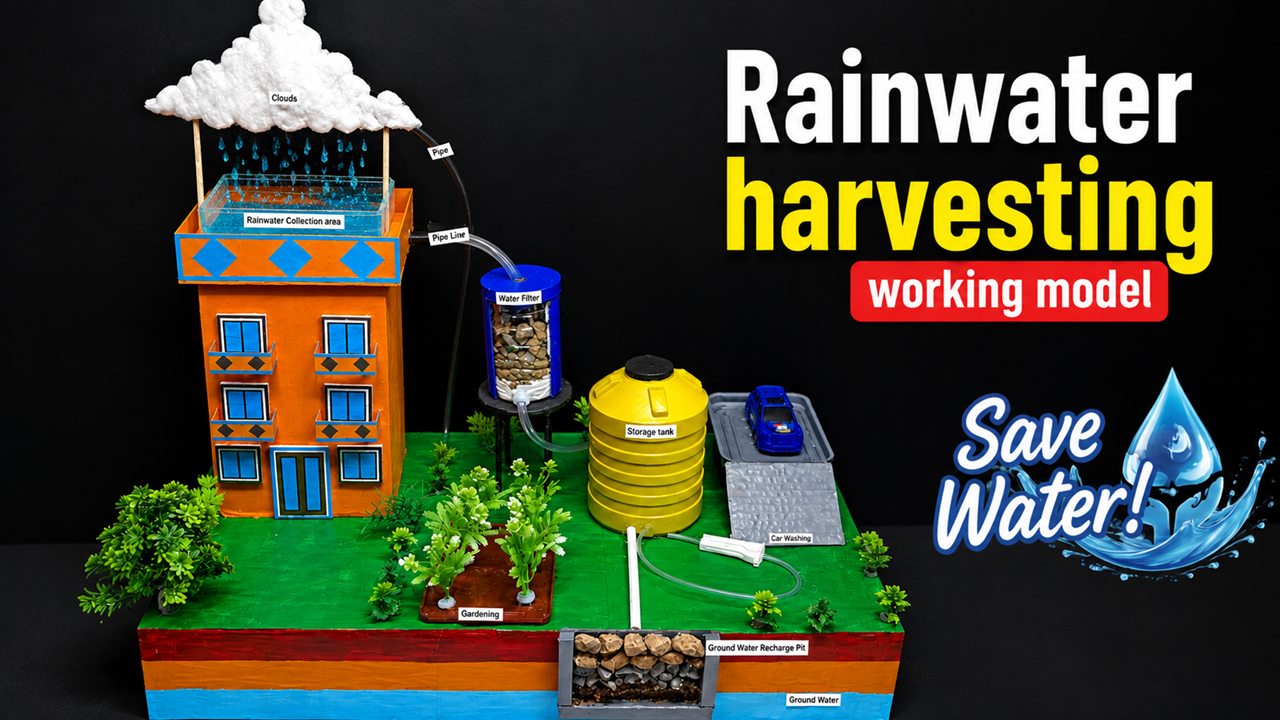
Learn how to make a creative Rainwater Harvesting Working Model for a school science exhibition. This DIY project demonstrates rooftop rainwater collection, filtration, storage, water reuse, gardening, car washing, and groundwater recharge. A simple and attractive environmental science project for students.
What is Rainwater Harvesting?
Rainwater harvesting is the process of collecting and storing rainwater for future use or allowing it to recharge groundwater.
Instead of allowing rainwater to flow away through roads and drains, we can collect it from rooftops and other suitable surfaces. The collected water can be filtered and stored in tanks. It can then be used for purposes such as gardening, cleaning, toilet flushing, and other non-drinking applications, depending on the quality and treatment of the water.
Rainwater harvesting is an important method of water conservation because freshwater is a limited resource and demand for water continues to increase.
Objective of the Project
The main objective of this working model is to demonstrate a simple and practical system for:
- Collecting rainwater
- Directing rainwater through pipes
- Filtering collected water
- Storing water in a tank
- Reusing stored water
- Watering plants and gardens
- Reducing unnecessary water wastage
- Recharging groundwater
The project also helps students understand how a sustainable water-management system can be designed for homes, schools, apartments, and communities.
Main Parts of the Working Model
The model consists of several important sections.
1. Rooftop Rainwater Collection Area
The top of the building acts as the rainwater collection surface. In the model, artificial clouds and water droplets represent rainfall.
When rain falls on the rooftop, the water is directed toward a collection tray or channel.
In a real building, the roof is connected to gutters and downpipes that carry rainwater toward a storage or filtration system.
2. Collection Tray
The transparent tray shown above the building represents the rainwater collection area.
It collects the water falling from the artificial cloud and provides a pathway toward the pipe.
This makes the working principle easy for students and visitors to understand.
3. Pipes
A pipe carries the collected water from the rooftop toward the filtration unit.
The pipe demonstrates an important part of a real rainwater harvesting system: proper water flow from the collection surface to the treatment or storage area.
4. Water Filter
The model includes a transparent water filter containing materials such as stones and other filtering media.
The filter demonstrates how suspended particles and visible impurities can be reduced before water enters the storage tank.
However, students should explain that a simple exhibition filter does not automatically make rainwater safe for drinking. Real potable-water systems require appropriate treatment and testing.
5. Storage Tank
After filtration, the water enters the yellow storage tank.
The storage tank represents the place where harvested rainwater can be stored for later use.
In a real system, the size of the tank depends on factors such as rainfall, roof area, water demand, and available space.
How the Working Model Operates
The working process can be explained in a simple sequence:
Rainfall → Rooftop Collection → Pipe → Filter → Storage Tank → Reuse / Groundwater Recharge
When artificial rain falls from the cloud, the water lands on the collection area.
The collected water then flows through the pipe.
Next, it passes through the filter containing stones and other filtering materials.
The filtered water flows into the storage tank.
The stored water can then be directed toward the garden or car-washing area in the model.
Excess water can be sent toward the groundwater recharge pit.
This demonstrates that rainwater does not have to be wasted after reaching the ground. It can instead become a useful resource.
Groundwater Recharge Pit
One of the most important features of this model is the groundwater recharge pit.
Groundwater is water stored beneath the Earth’s surface in soil and rock formations. When rainwater is allowed to infiltrate into suitable ground, some of it can replenish groundwater.
The model shows different layers beneath the ground surface to represent soil and filtering materials.
Water entering the recharge pit slowly moves downward through the layers.
This demonstrates the basic idea of groundwater recharge.
A real recharge system needs to be designed according to local soil conditions, groundwater conditions, water quality, and site requirements. Untreated or contaminated water should not simply be injected into groundwater.
Water Reuse
The stored rainwater shown in the model can be used for several purposes.
For example:
Gardening
Rainwater can be used to water plants and maintain gardens, reducing the demand for treated freshwater.
Car Washing
Harvested water can potentially be used for vehicle cleaning, subject to appropriate local practices and water quality considerations.
Cleaning
With appropriate treatment and depending on the intended use, harvested rainwater can be useful for certain cleaning activities.
The key idea is to use the right quality of water for the right purpose.
Materials Required
A similar model can be created using easily available materials such as:
- Cardboard
- Chart paper
- Transparent plastic sheet or tray
- Plastic pipes or flexible tubes
- Small plastic container for the filter
- Small storage tank/container
- Pebbles and stones
- Sand or suitable filter media
- Artificial plants
- Toy car
- Glue
- Scissors
- Paint
- Wooden sticks
- Blue paper or plastic for water
- Small water pump, if required
- Water container
Students can modify the materials according to the size and design of their exhibition model.
Science Behind Rainwater Harvesting
The project demonstrates several scientific concepts.
Water Conservation
Rainwater is collected instead of allowing it to flow away unused.
Filtration
Water passes through filtering materials that help remove some suspended particles.
Gravity
Water naturally flows from a higher level toward a lower level, which allows rooftop water to travel through pipes.
Storage
Water can be collected and stored for future use.
Infiltration
Water can move through soil and other permeable layers, contributing to groundwater recharge.
Together, these principles demonstrate how a relatively simple system can help manage water resources more efficiently.
Advantages of Rainwater Harvesting
Rainwater harvesting has several potential benefits:
- Conserves freshwater
- Reduces dependence on external water supplies
- Provides water for suitable non-potable uses
- Can reduce surface runoff
- Can support groundwater recharge
- Helps promote water awareness
- Can be adapted for homes, schools, and institutions
- Encourages sustainable water management
The exact benefits depend on rainfall, system design, maintenance, local regulations, and water demand.
How to Improve the Exhibition Model
Students can make the model more attractive and interactive by adding:
- A working water pump
- Transparent pipes
- A water-level indicator
- LED indicators
- A digital water-level display
- Multiple buildings
- A larger recharge pit
- A garden irrigation system
- A rain sensor
- An Arduino-based automatic controller
- A demonstration of water conservation before and after harvesting
An Arduino could even be added to automatically operate a pump or monitor the water level, turning the project into a combination of environmental science and electronics.
Conclusion
The Rainwater Harvesting Working Model is a creative and meaningful science exhibition project that demonstrates a practical solution to one of the world’s most important environmental challenges: water conservation.
The model clearly shows the journey of rainwater from the cloud to the rooftop, collection area, pipe, filter, storage tank, garden, car-washing area, and groundwater recharge pit.
Its biggest strength is that it transforms an abstract environmental concept into a visible working system that students can demonstrate to teachers, judges, and visitors.
The project also teaches an important message:
“Every drop of rainwater is a valuable resource. Collect it, conserve it, reuse it, and recharge the Earth.”
With simple DIY materials, creative presentation, and a clear explanation of the science involved, this rainwater harvesting model can become an impressive school science exhibition, STEM, environmental awareness, or Inspire Award project.