
Introduction
An earthquake is the sudden shaking of the Earth’s surface caused mainly by the movement of tectonic plates along faults. Earthquakes can damage buildings, roads, bridges, and other structures.
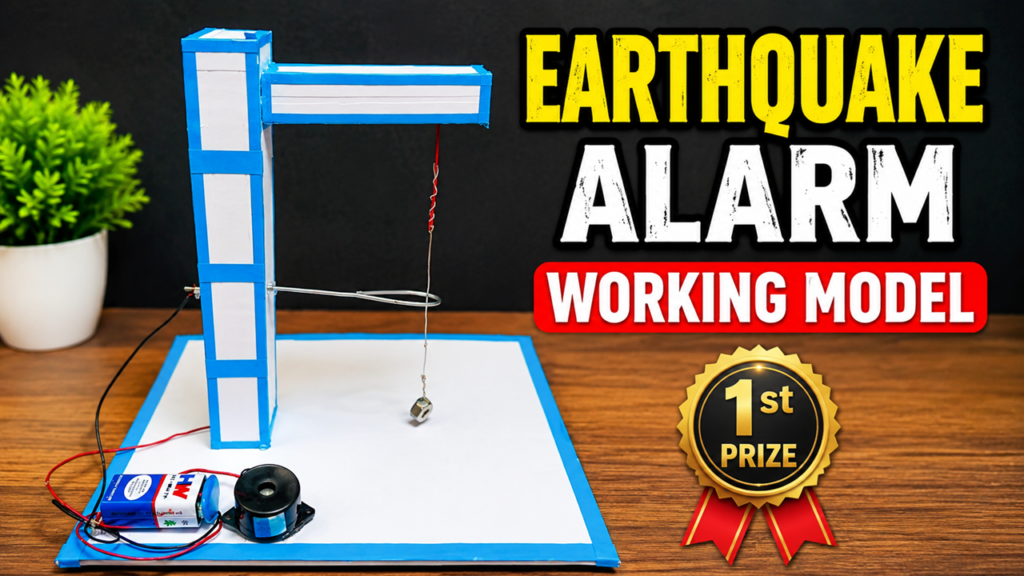
An early warning or detection system can provide an alert when strong vibrations are detected. This project demonstrates a simple Earthquake Alarm Working Model using a vibration-sensitive mechanism, an electrical circuit, a battery, and a buzzer.
The model is designed to show the basic idea of how an alarm can be activated when the ground or structure experiences shaking.
Main Concept of the Model
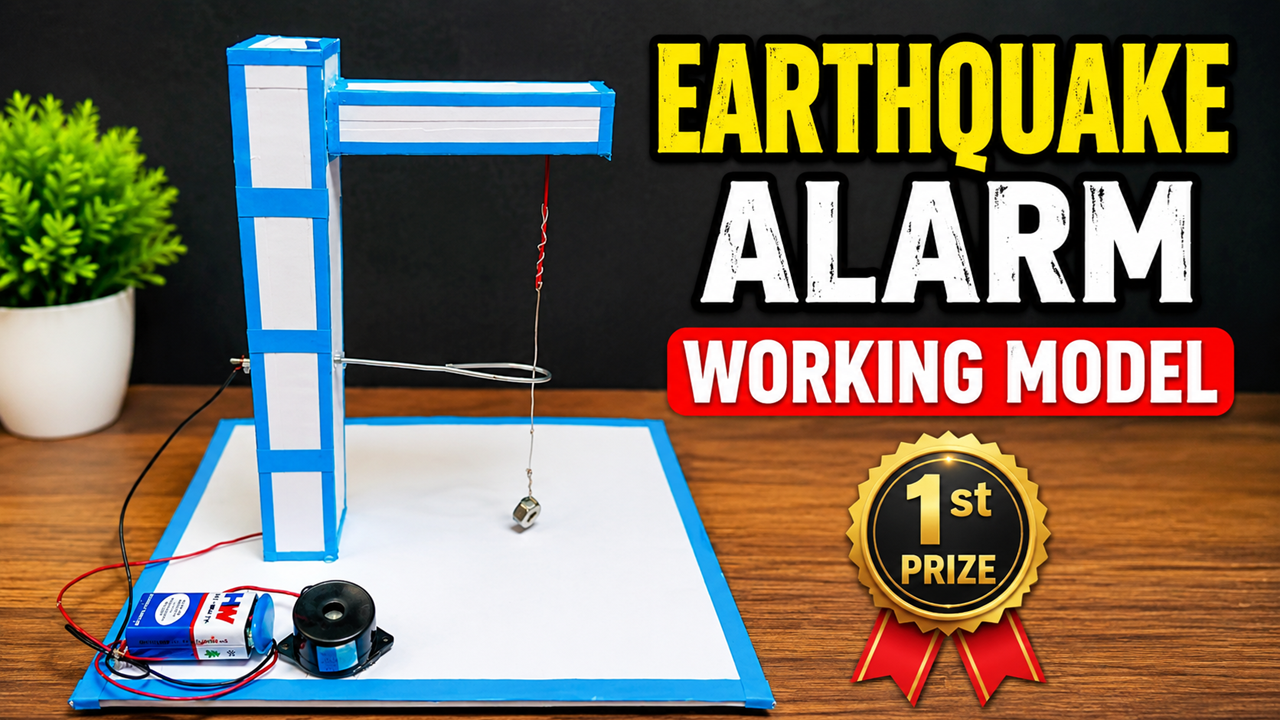
The main parts of this model are the support structure, hanging vibration sensor, electrical contacts, battery, and buzzer. The hanging metal object acts as a simple mechanical sensor. When the model is shaken, the hanging object moves. This movement can bring two electrical contacts together or separate them, causing the circuit to switch on.
When the circuit is completed, current flows from the battery through the buzzer. The buzzer produces a loud sound, representing an earthquake warning alarm.
The basic working sequence is:
Earthquake Vibration → Sensor Moves → Electrical Contact Changes → Circuit Activates → Buzzer Sounds
This is a simple demonstration of the principle. Real earthquake detection and warning systems use sensitive instruments such as seismometers and accelerometers, along with electronic processing and communication systems.
Materials Required
To make this project, you will need a strong cardboard or foam-board sheet for the base, cardboard strips for the vertical support and horizontal arm, white and blue chart paper, glue, scissors, a cutter, ruler, pencil, and markers.
For the working circuit, you will need a battery pack, buzzer, connecting wires, a small metal weight or nut, thin copper wire, and two metal contacts. A small switch can also be included for turning the demonstration on and off.
How to Make the Model
First, prepare a rectangular cardboard base. Cover it with white paper and create a blue border around the edges. The base represents the ground or platform on which the structure is standing.
Next, build a tall vertical support column using several layers of cardboard. Make it strong and stable because it will hold the upper arm and sensor. Cover the column with white paper and blue strips to give it a neat appearance.
Attach a horizontal cardboard arm near the top of the column. The arm should extend over the base. From this arm, suspend a thin wire with a small metal nut, bolt, or other lightweight weight at its lower end. This hanging weight acts as the vibration sensor.
Position two small metal contacts close to the hanging weight. Arrange them so that when the model experiences shaking, the weight moves enough to touch or influence the contacts. Connect the contacts to a low-voltage battery and buzzer circuit.
Connect one wire from the battery to the buzzer, then connect the buzzer to one sensor contact. Connect the second sensor contact back to the other battery terminal. When the sensor completes the circuit, the buzzer should sound.
Test the model gently by moving or shaking the base. The hanging weight should swing and activate the alarm. Adjust the distance between the contacts if necessary so that the alarm responds reliably.
Finally, add labels such as “EARTHQUAKE SENSOR,” “VIBRATION,” “ALARM,” “BATTERY,” and “BUZZER.” You can also add an information card explaining how earthquakes produce vibrations and how detection equipment responds to them.
Conclusion
The Earthquake Alarm Working Model demonstrates how vibrations can be detected and converted into an audible warning. It provides students with an easy way to understand the basic relationship between earthquake motion, sensors, electrical circuits, and alarms.
Although this model is useful for educational demonstration, it should not be considered a real earthquake prediction or safety device. Actual earthquake early-warning systems use sophisticated sensors and communication networks. The project nevertheless shows how a simple sensor-based system can be developed to respond automatically to movement and provide an alert.