
Introduction
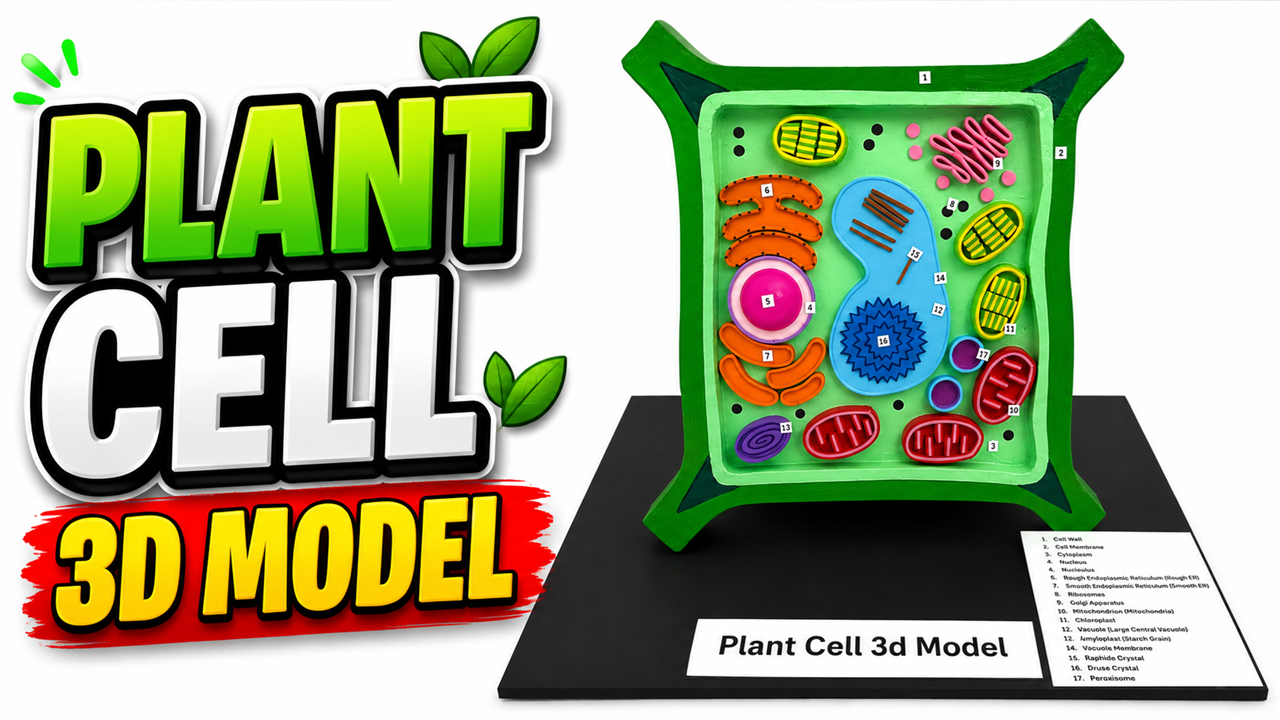
The Plant Cell 3D Model is an educational science project that demonstrates the internal structure of a plant cell using a colorful three-dimensional model. A plant cell is the basic structural and functional unit of plants. It contains several specialized organelles, each performing an important role in the growth, survival, and reproduction of the plant.
This model helps students understand the location and function of different cell organelles in an easy and interactive way. It is an excellent project for school science exhibitions, biology classes, and STEM learning activities.
Aim
To construct a three-dimensional model of a plant cell and explain the structure and function of its organelles.
Objective
- To identify the major parts of a plant cell.
- To understand the function of each organelle.
- To compare plant cells with animal cells.
- To develop a clear understanding of cell biology through a 3D model.
Materials Required
- Thick cardboard or foam board (Base)
- Foam sheet (EVA sheet) in different colors
- Cardboard sheets
- Acrylic paints
- Colored clay or modeling foam (Optional)
- Hot glue gun
- Fevicol
- Cutter
- Scale
- Marker pen
- Printed labels or small paper tags
- Double-sided tape
- Paint brushes
Theory
A plant cell is the smallest living unit of a plant. It is surrounded by a rigid cell wall, which gives strength and protection. Inside the cell are several organelles that work together to perform different life processes such as photosynthesis, energy production, storage, and reproduction.
Unlike animal cells, plant cells contain chloroplasts, a large central vacuole, and a cell wall.
Scientific Principle
Each organelle inside the plant cell has a specific function, and together they ensure the proper functioning of the cell.
Examples:
- Cell Wall provides support.
- Chloroplast performs photosynthesis.
- Mitochondria produce energy.
- Nucleus controls all cell activities.
- Vacuole stores water and nutrients.
Main Parts of a Plant Cell
| Organelle | Function |
|---|---|
| Cell Wall | Gives shape, support, and protection |
| Cell Membrane | Controls movement of substances into and out of the cell |
| Cytoplasm | Jelly-like fluid where organelles are suspended |
| Nucleus | Controls all cell activities |
| Nuclear Membrane | Protects the nucleus |
| Nucleolus | Produces ribosomes |
| Chloroplast | Performs photosynthesis using chlorophyll |
| Mitochondria | Produces energy (ATP) through respiration |
| Large Central Vacuole | Stores water, food, and waste materials |
| Golgi Apparatus | Packages and transports proteins |
| Rough Endoplasmic Reticulum (RER) | Protein synthesis and transport |
| Smooth Endoplasmic Reticulum (SER) | Lipid synthesis and detoxification |
| Ribosomes | Manufacture proteins |
| Lysosomes | Digest waste materials and damaged cell parts |
| Peroxisomes | Break down harmful substances and fatty acids |
How to Make the Model
Step 1: Prepare the Base
- Cut a square cardboard or foam board.
- Cover it with black chart paper.
- Fix a name label: Plant Cell 3D Model.
Step 2: Make the Cell Wall
- Cut a large rectangular shape with slightly curved corners from thick foam board.
- Paint or cover it with dark green foam sheet.
- This forms the Cell Wall.
Step 3: Create the Cell Membrane
- Cut another slightly smaller rectangle.
- Paste it inside the cell wall using light green foam sheet.
- Leave a small gap between the wall and membrane.
Step 4: Add the Cytoplasm
- Fill the inside using light green foam or chart paper.
- This represents the cytoplasm.
Step 5: Make the Organelles
Use colored foam sheets or modeling clay to create different organelles.
Nucleus
- Large pink circle with a smaller dark pink nucleolus.
Chloroplasts
- Green oval shapes with internal lines.
Mitochondria
- Red oval shapes with folded inner membranes.
Golgi Apparatus
- Curved orange layers stacked together.
Endoplasmic Reticulum
- Curved ribbon-like structures around the nucleus.
Ribosomes
- Small black dots scattered throughout the cytoplasm.
Vacuole
- Large blue water-filled sac occupying much of the cell.
Lysosomes and Peroxisomes
- Small colored circles.
Step 6: Arrange the Organelles
Glue all organelles neatly inside the cell according to their natural positions.
Step 7: Add Labels
Attach numbered or named labels to each organelle.
Prepare a legend listing:
- Cell Wall
- Cell Membrane
- Cytoplasm
- Nucleus
- Nucleolus
- Rough Endoplasmic Reticulum
- Smooth Endoplasmic Reticulum
- Golgi Apparatus
- Ribosomes
- Mitochondria
- Chloroplast
- Vacuole
- Lysosome
- Peroxisome
Step 8: Final Decoration
- Ensure all parts are securely glued.
- Use bright colors for easy identification.
- Keep labels neat and readable.
- Clean the model before display.
Working
Although this is a display model, it demonstrates how the different organelles work together to keep a plant cell alive.
- The cell wall provides strength and protection.
- The cell membrane regulates the movement of substances.
- The chloroplasts capture sunlight to produce food through photosynthesis.
- The mitochondria convert food into usable energy.
- The nucleus controls all activities of the cell.
- The Golgi apparatus packages and transports proteins.
- The endoplasmic reticulum helps in the synthesis and transport of proteins and lipids.
- The large central vacuole stores water, nutrients, and waste while maintaining cell pressure.
- The ribosomes produce proteins needed for growth and repair.
Together, these organelles perform all the essential functions required for the survival and growth of the plant.
Difference Between Plant Cell and Animal Cell
| Plant Cell | Animal Cell |
|---|---|
| Has a cell wall | No cell wall |
| Contains chloroplasts | No chloroplasts |
| Large central vacuole | Small or many vacuoles |
| Fixed rectangular shape | Round or irregular shape |
| Performs photosynthesis | Cannot perform photosynthesis |
Conclusion
The Plant Cell 3D Model is a colorful and informative science project that provides a clear understanding of the structure and function of plant cells. By representing each organelle in three dimensions, the model makes complex biological concepts simple and engaging. It is an ideal project for school science exhibitions, helping students confidently explain how plant cells function and how they differ from animal cells.