
Introduction
Earthquakes are natural disasters that occur due to sudden movements in the Earth’s crust. They can cause severe damage to buildings, infrastructure, and human life. Early warning systems play a crucial role in reducing the impact of such disasters.
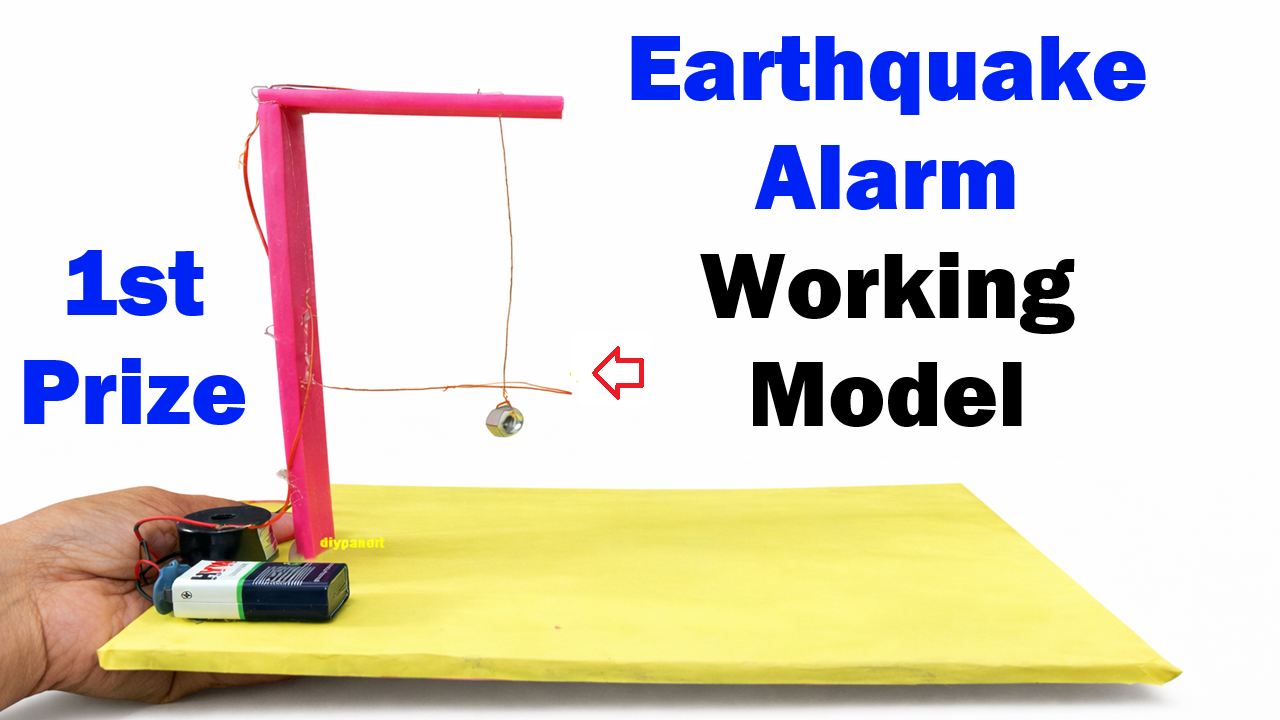
The Earthquake Alarm Working Model is a simple and effective science project that demonstrates how vibrations can be detected and converted into an alert signal using a buzzer.
This model is ideal for school science exhibitions and helps students understand disaster management techniques.
Materials Required
This project can be made using simple and low-cost materials:
- Cardboard base and stand
- Metal wire or thread
- Small metal weight (nut/bolt)
- Buzzer
- Battery
- Connecting wires
- Switch (optional)
- Glue and tape
Working Principle
The earthquake alarm model works on the principle of vibration detection and electrical circuits.
- A metal weight is suspended using a thread or wire.
- Under normal conditions, the weight does not touch the surrounding wire, so the circuit remains open.
- When vibrations occur (simulating an earthquake), the suspended weight swings and touches the metal wire.
- This contact closes the circuit.
- As a result, electric current flows and activates the buzzer, producing an alarm sound.
This simple mechanism demonstrates how motion can be used to trigger warning systems.
Working Model Explanation
The model consists of a vertical stand with a suspended metal object and a connected circuit.
- A metal wire is shaped in a loop or frame.
- A small metal weight is suspended in the center using a thread.
- One terminal of the battery is connected to the frame, and the other is connected to the suspended weight through a buzzer.
- In normal conditions, there is no contact, so the circuit remains OFF.
- When the base is shaken, the weight swings and touches the frame.
- This completes the circuit and activates the buzzer.
The alarm continues as long as the contact is maintained.
Advantages
- Simple and easy to build
- Demonstrates real-life disaster alert system
- Low-cost project
- Ideal for science exhibitions
- Provides awareness about earthquake safety
Educational Value
This project helps students understand:
- Basics of electrical circuits (open and closed circuits)
- Concept of vibration and motion
- Importance of early warning systems
- Disaster management techniques
It also improves creativity and practical skills.
Applications
- Earthquake detection systems
- Safety alarms in buildings
- Industrial vibration monitoring
- Educational demonstrations
Limitations
- Detects only nearby vibrations
- Not suitable for real earthquake prediction
- Requires proper sensitivity adjustment
Conclusion
The Earthquake Alarm Working Model is a simple yet powerful demonstration of how natural disasters can be detected using basic scientific principles. It shows how vibrations can trigger an alert system, helping people take precautionary measures.
This project not only enhances understanding of science concepts but also creates awareness about disaster preparedness. It is an excellent choice for school exhibitions and encourages students to think about innovative solutions for real-world problems.