
Introduction
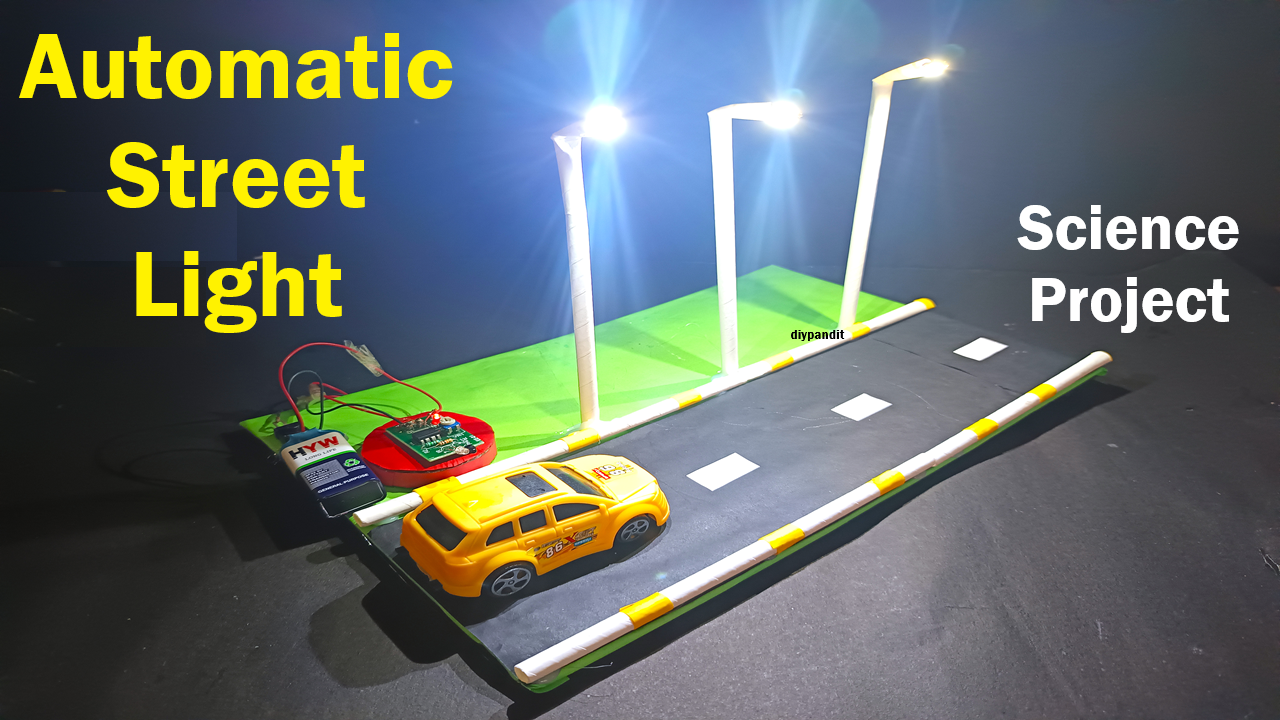
Street lights play an important role in ensuring safety and visibility on roads during the night. In many places, street lights are switched ON and OFF manually, which leads to electricity wastage if they remain ON during daytime. To overcome this problem, automatic street light systems are used. These systems automatically turn ON the street lights at night and turn them OFF during the day, helping in energy conservation.
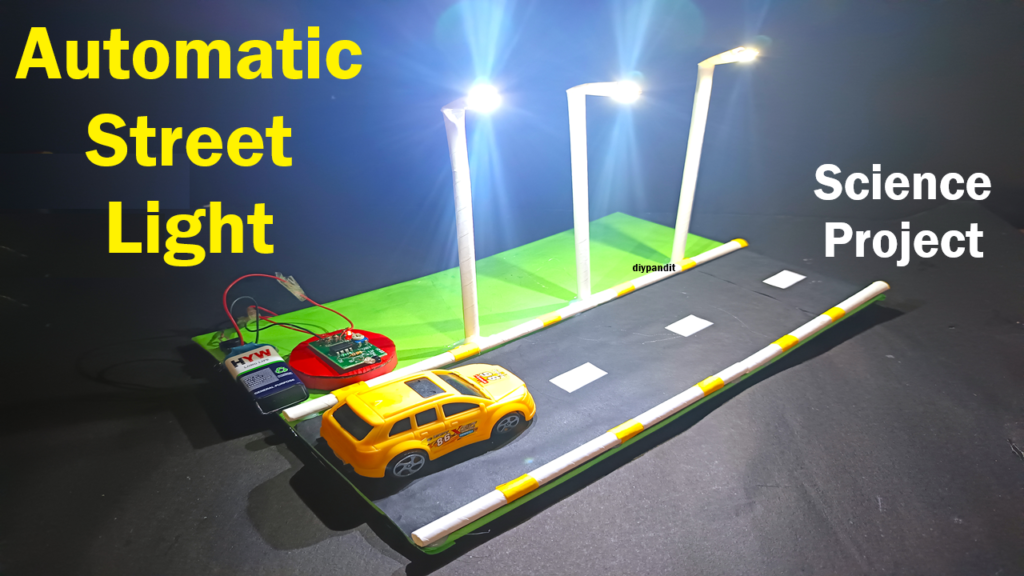
This Automatic Street Light Working Model is designed as a science exhibition project using simple components. It demonstrates how street lights operate automatically using light intensity without human involvement.
Aim of the Project
The main objectives of this project are:
- To understand the working of an automatic street light system
- To demonstrate energy saving using smart technology
- To create awareness about electricity conservation
- To develop a low-cost, eco-friendly science model
Materials Used
- Cardboard base
- LED lights (street lights)
- LDR (Light Dependent Resistor)
- Resistor
- Transistor / relay module
- Battery
- Switch
- Connecting wires
- Street poles (made using straws or sticks)
- Glue, tape, and markers
Principle of Working
The automatic street light works on the principle of light sensing. An LDR (Light Dependent Resistor) changes its resistance based on the intensity of light falling on it.
- In daylight, the LDR has low resistance
- In darkness, the LDR has high resistance
This change in resistance is used to control the LED street lights.
Construction of the Model
The model is prepared on a cardboard base representing a road. Small poles are fixed on both sides of the road, and LED lights are mounted on top of the poles to represent street lights. The LDR is placed in an open area to sense surrounding light. The circuit components are connected neatly behind the base.
Working of the Model
- During daytime, sufficient sunlight falls on the LDR
- The LDR sends a signal to keep the LED lights OFF
- When it becomes dark or night, light on the LDR decreases
- The circuit activates the LEDs automatically
- Street lights glow without manual switching
When light is again focused on the LDR using a torch, the lights turn OFF, demonstrating automatic operation.
Advantages of Automatic Street Lights
- Saves electricity
- Reduces manual effort
- Works automatically
- Eco-friendly and cost-effective
- Ideal for smart cities
Applications
- Roads and highways
- Parks and gardens
- Smart cities
- Industrial areas
- Village street lighting
Conclusion
The Automatic Street Light Working Model is an effective science project that demonstrates the use of smart technology for energy conservation. It shows how street lights can operate automatically using light sensors, reducing electricity wastage and human effort. This model is highly suitable for science exhibitions and promotes the idea of sustainable development.
Save Electricity – Build a Smarter Future.