
Introduction
A wind vane, also known as a weather vane, is an instrument used to determine the direction of the wind. It is one of the oldest and simplest weather-measuring devices.
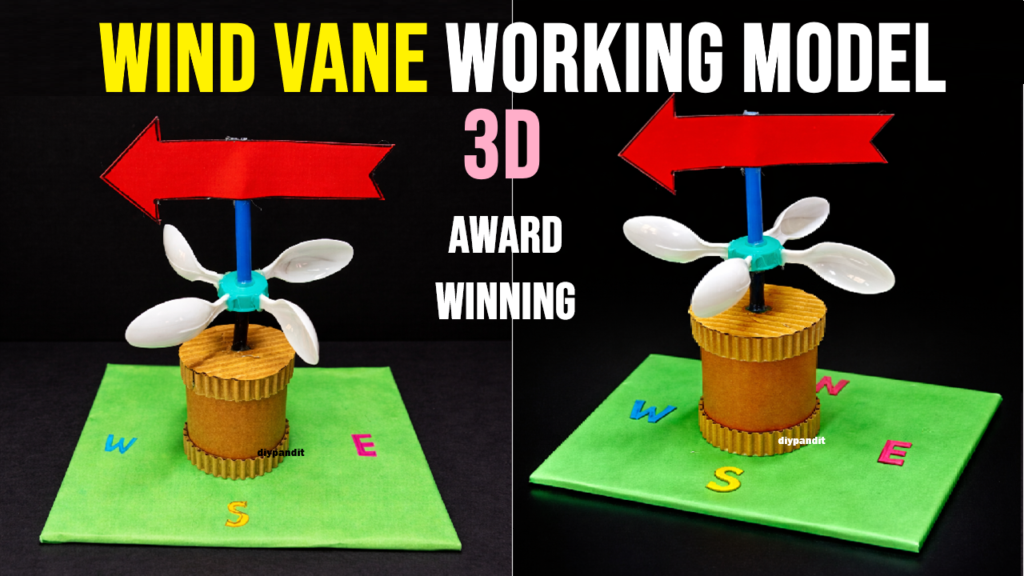
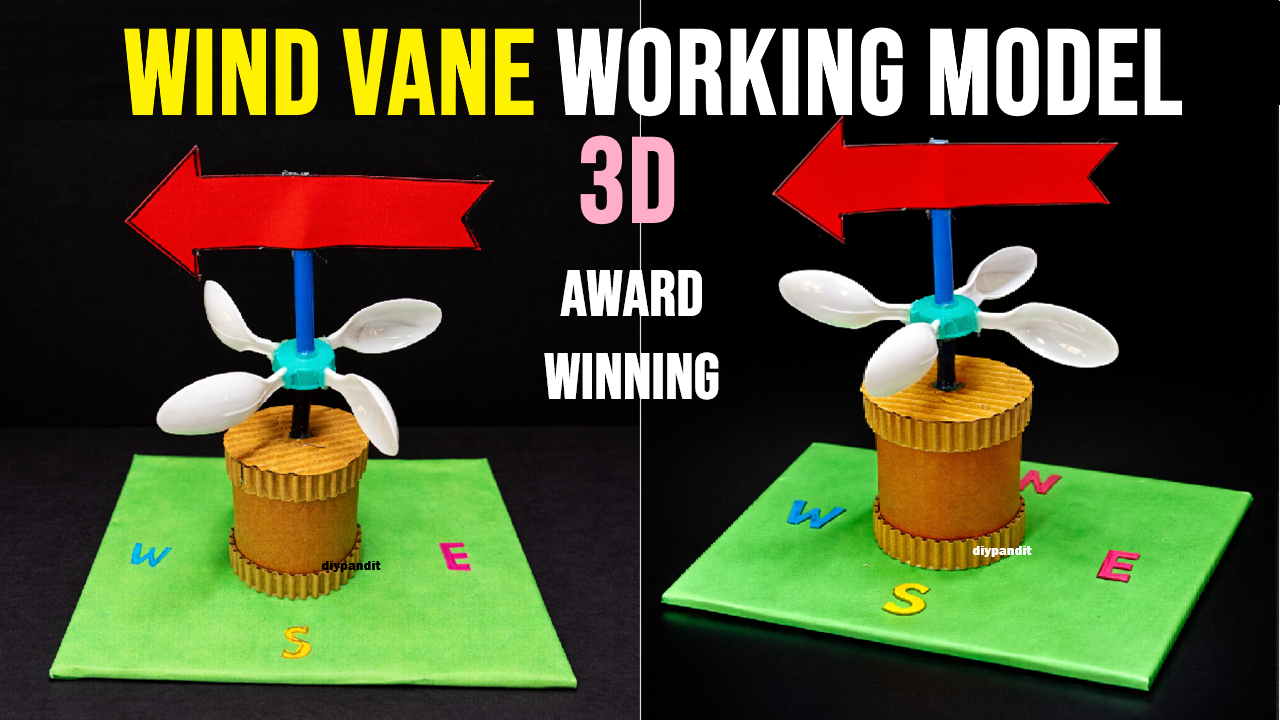
The Wind Vane Working Model is a useful and educational science project that demonstrates how wind direction can be identified using a simple mechanical setup. This project is ideal for school science exhibitions and helps students understand basic weather science in a practical and engaging way.
Materials Required
This model can be made using easily available materials:
- Cardboard base
- Straw or stick (for vertical support)
- Arrow (made from cardboard or paper)
- Bottle cap or small motor shaft (for rotation)
- Glue and scissors
- Colored paper for direction labels (N, S, E, W)
- Lightweight blades or fins (optional for decoration)
Working Principle
The wind vane works on the principle of air pressure and balance.
- The arrow is designed with one end broader than the other.
- When wind blows, it pushes the larger surface area more strongly.
- This causes the arrow to rotate.
- The pointed end of the arrow aligns itself in the direction from which the wind is coming.
The base is marked with directions (North, South, East, West) to identify wind direction accurately.
Working Model Explanation
The model consists of a rotating arrow mounted on a vertical stand fixed to a base.
- A vertical rod is fixed at the center of the base.
- A rotating mechanism (like a straw or cap) is placed on top of the rod.
- An arrow is attached horizontally so that it can rotate freely.
- Direction labels (N, S, E, W) are placed on the base.
- When air (or wind) is blown, the arrow rotates and points in the wind’s direction.
In this model, decorative blades may also rotate, making it visually appealing and easy to demonstrate.
Advantages
- Simple and easy to understand
- Low-cost and eco-friendly
- Ideal for school science exhibitions
- Demonstrates real-life weather instruments
- Encourages creativity and design skills
Educational Value
This project helps students learn:
- Basics of weather science
- Wind direction and its importance
- Concept of air pressure and force
- Practical application of simple machines
It also improves observation and analytical skills.
Applications
- Weather forecasting stations
- Airports and aviation
- Agriculture and farming
- Sailing and navigation
Limitations
- Requires proper alignment with directions
- Works best in open air
- Cannot measure wind speed (only direction)
Conclusion
The Wind Vane Working Model is a simple yet powerful demonstration of how wind direction is measured. It shows how basic scientific principles like air pressure and balance can be applied to create useful instruments.
This project is not only educational but also practical, helping students understand weather patterns and their importance in daily life. It is an excellent choice for science exhibitions and inspires curiosity about environmental science and meteorology.